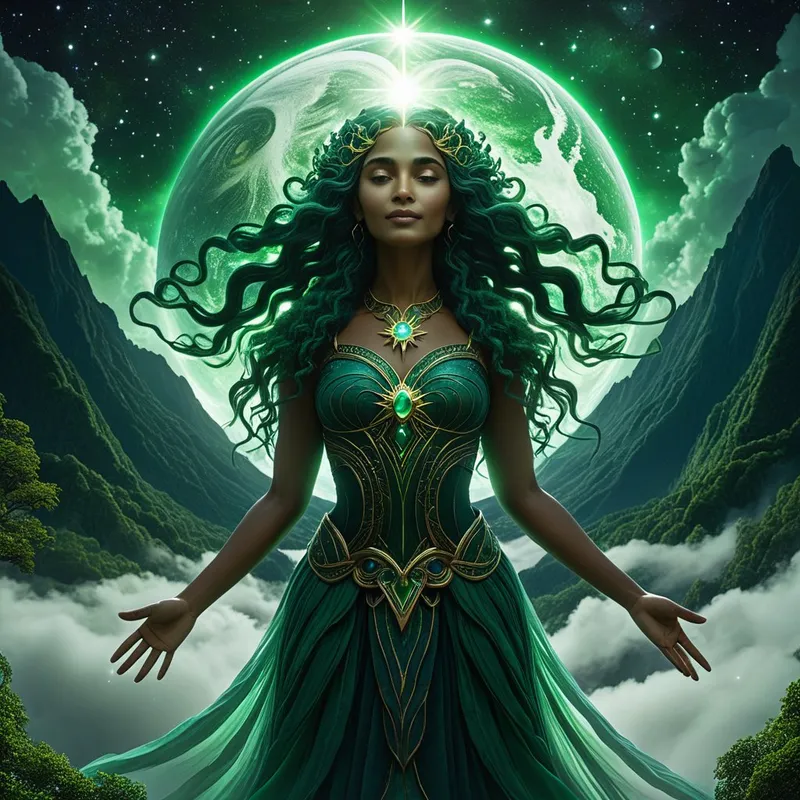
Gaia Myth Meaning & Symbolism
The primordial myth of Gaia, the living Earth, from whom all life and gods emerged, embodying the foundational, generative, and often wrathful power of nature itself.
The Tale of Gaia
In the beginning, there was a yawning, formless chasm: Chaos. It was not empty, but a seething potential, a breath held before the first word. And from that chasm, without mate, without cause, she arose: Gaia, the broad-breasted, the ever-sure foundation of all.
She was the dark, rich soil and the unyielding bedrock, the scent of rain on stone and the deep, humming silence beneath the roots of the first trees. She brought forth, equal to herself, Ouranos, to be her canopy and her mate. He stretched himself over her, a tapestry of glittering points, and his embrace was total. From their union came the first children: the Titans, deep and mighty as mountain ranges; the Cyclopes, with their singular, blazing eyes; and the Hekatoncheires, with their hundred grasping arms.
But Ouranos looked upon his offspring, not with love, but with a tyrant’s fear. He saw their raw, burgeoning power and dreaded the day they might surpass him. So, as each was born, he refused to let them leave the warm, dark womb of their mother. He pressed them back into the depths of Gaia’s body, causing her immense pain and confinement. The weight of the starry sky became a prison; his embrace, a smothering chain.
Gaia groaned in her agony, the mountains trembling with her distress. The fertile soil curdled with her wrath. From her very substance, she forged a weapon: a great sickle of grey adamant, sharp and cold. And in the secret places of the earth, she whispered to her captive children. Only one had the cunning and the hunger to answer: Kronos, whose name means Time.
That night, when Ouranos descended to lie with Gaia, stretching his starry form across her, Kronos emerged from his hiding place. With a single, brutal sweep of the adamantine blade, he severed his father from his creative power. Ouranos roared, his essence bleeding light into the firmament, and he recoiled forever upwards, establishing the eternal separation of Heaven and Earth. From the drops of his blood that fell upon Gaia, the Erinyes and the martial Meliae sprang forth. And from the seed that fell upon the sea, Aphrodite was born in a circle of foam.
Gaia was free. The Titans were unleashed. And though a new age began, the pattern was set—the foundation had learned to revolt against the structure it bore.
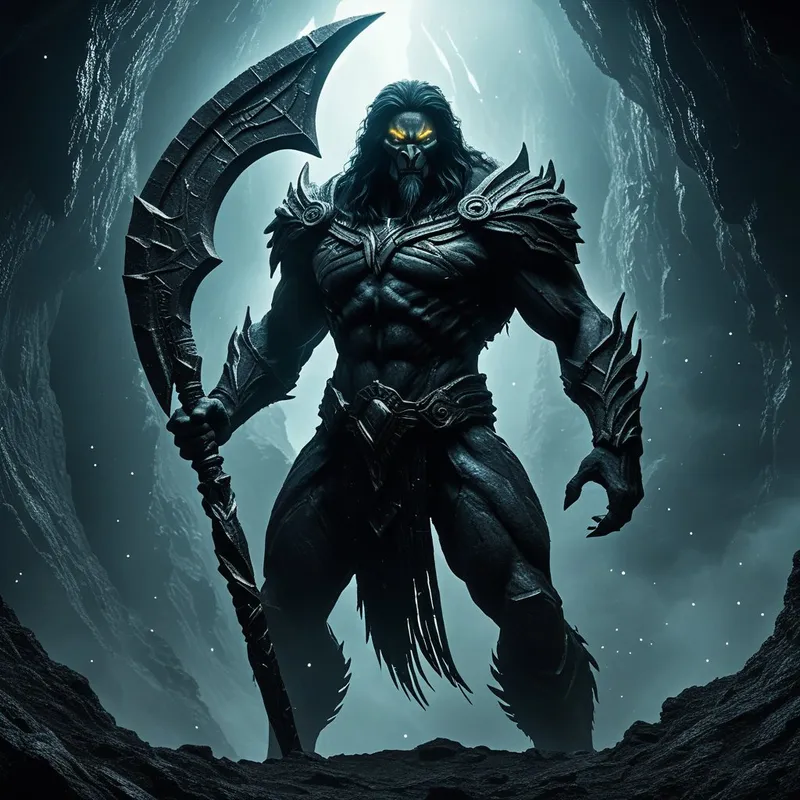
Cultural Origins & Context
The myth of Gaia is one of the foundational narratives from the corpus of ancient Greek mythology, most systematically recorded in Hesiod’s Theogony (c. 700 BCE). This was not a scripture, but a poetic composition, performed by bards and rhapsodes, that sought to order the cosmos into a familial genealogy. Its function was profound: to explain the origin and hierarchy of the world, from the primal elements to the reigning Olympian gods, by framing it as a series of generational conflicts.
Gaia’s story served as the ultimate origin point in this cosmic family tree. For an agricultural, maritime society deeply tied to the land and the seasons, Gaia was not an abstract concept. She was the literal ground beneath their feet, the source of all sustenance and stability. The myth gave voice to a visceral understanding: the earth is alive, generative, and possesses its own agency and will. It was a narrative that rooted divine power not in distant heavens initially, but in the immanent, tangible reality of the natural world. Her tale established the primordial template of creation, oppression, and violent succession that would define the struggles of the gods that followed.
Symbolic Architecture
Gaia represents the archetypal principle of the Magna Mater, but with a crucial, often overlooked dimension. She is not merely the nurturing mother; she is the foundational ground of being itself—the precondition for all existence, consciousness, and conflict.
She is the unconscious, physical substrate from which the structures of consciousness (Ouranos) emerge, and which can be wounded and enraged when those structures become oppressive.
Ouranos symbolizes the ordering principle, the sky-father who imposes structure and limit. His oppression—forcing the nascent potentials (the Titans, Cyclopes) back into the unconscious—represents a psyche that denies its own depths, its raw creative powers and shadowy complexities, fearing their disruptive force. The resulting pain is the somatic and psychological distress of repression, where vital energies are trapped and turn toxic.
Gaia’s response is the myth’s central alchemical act. She does not revolt directly; she incarnates the revolt. She gives form (the sickle) to her formless anguish and empowers a facet of her own being (Kronos) to enact the necessary separation. This is the symbolic birth of decisive action from deep, embodied instinct. The castration of Ouranos is a brutal but necessary differentiation: the permanent establishment of a space between the unconscious ground (Earth) and the conscious ordering principle (Sky). Without this separation, no independent life, no differentiated psyche, can emerge.
The Dreamer's Resonance
When the pattern of Gaia stirs in the modern dreamer, it often manifests not as a literal goddess, but as profound somatic and environmental imagery. To dream of the earth cracking open, of earthquakes destabilizing one’s home, or of becoming incredibly heavy, fused with the ground, speaks to the foundational layer of the psyche undergoing seismic shift.
This is the dream-language of a foundational oppression being challenged. The dreamer may be experiencing a life structure—a career, a relationship, a self-concept (their personal Ouranos)—that has become a confining canopy, pressing down their authentic potentials and instincts. Gaia’s agony is felt as chronic anxiety, a sense of being trapped in one’s own life, or unexplained bodily tensions. The dream is the psyche’s initial groan, the first tremor signaling that the deep, instinctual self can no longer bear the weight of an oppressive status quo. It is a call to forge your adamant, to identify what, within you, has the cunning of Kronos—the willingness to make a decisive, if difficult, cut for the sake of liberation.

Alchemical Translation
The alchemical journey modeled by Gaia is the process of re-grounding and reclaiming foundational authority. Our modern individuation often begins in a state of identification with the “Ouranian” structures: the shoulds, the inherited paradigms, the lofty ideals that may stifle our earthy, instinctual nature. We live in our heads, disconnected from the body, the senses, and the dark, fertile soil of our deepest instincts.
The work is to descend from the sterile sky of pure concept and make contact with the suffering, creative, and wrathful earth within.
The first stage is to feel the confinement—to acknowledge the pain of repressed talents, ignored intuitions, or denied desires. This is Gaia’s groan. The second is to forge the tool from that very feeling. The adamant sickle is crafted from conscious attention to our somatic experience and our deepest, often unpopular, truths. It is the resolve born of embodied insight, not abstract thought.
Finally, the operation is to enact the sacred separation. This is not destruction for its own sake, but the necessary act of setting a boundary, ending a cycle, or dismantling an internalized oppression to create psychic space. It is the moment one says, “This far, and no further,” to the tyrannical voice of an inner critic or an external demand that suffocates growth. From this act, like the birth of Aphrodite from the sea, a new, more authentic capacity for love, beauty, and relatedness can emerge. One ceases to be merely the foundation for others’ structures and becomes the sovereign, living ground of one’s own being.
Associated Symbols
Explore related symbols from the CaleaDream lexicon:
- Ground
- Land
- Earth
- Physical
- Mud
- Natural
- Native
- Nature
- Soil
- Terrain
- Potting Soil
- Biodegradable Technology
- Woolen Mittens
- Gardening in Space
- Cinnamon Brown
- Walnut Brown
- Agate Geode
- Tourmaline Bracelet
- Dolomite Gem
- Veins of Ginger Root
- Celestial Carbon
- Spreading Roots
- Verdant Grass
- Textured Relief
- Large Ottoman
- Plush Area Rug
- Pie Dish with Pie
- Eco-Friendly Tote
- Eco-friendly Beads
- Eco-Friendly Jewelry
- Southwest Adobe
- Pueblo Home
- Organic House
- Vertical Forest
- Eco-Friendly Home
- Lush Rainforest
- Fertile Soil
- Veins of the Earth
- Soil Richness
- Rain-soaked Earth
- Earth's Bounty
- Sun-Baked Earth
- Layered Sediment
- Agate Stone
- Roots of Unity
- Natural Elements
- Earthy Smell
- Mother Earth
- Subsonic Rumble
- Higgs Field
- Expansion
- Carbon
- Malkuth
- Womb
- Conception
- Pregnancy
- Horizontal
- Vaginal
- Gneiss
- Earthy
- Petrichor
- Agate Slice
- Mouse Pad