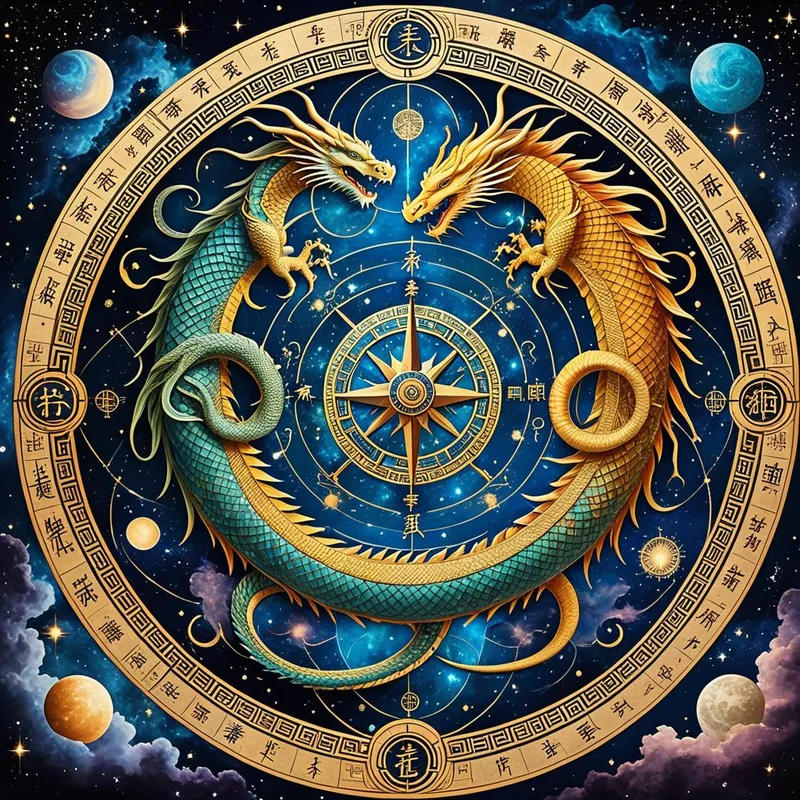
Fuxi and Nüwa Myth Meaning & Symbolism
The serpent-bodied siblings who survived the great flood, mended the sky, and created humanity, establishing the first laws of civilization from primordial chaos.
The Tale of Fuxi and Nüwa
In the time before time, when the world was a formless broth of mist and potential, the Hundun breathed. From its breath emerged the Yin and Yang, and from their dance, the first mountains rose and the first waters gathered. And in these waters, upon the sacred slopes of Kunlun, were born Fuxi and Nüwa. They were not as we are now. Their upper forms were of sublime human beauty, but from the waist down, they were as the great, coiling serpents or dragons of the deep earth, powerful and primal, connected to the very pulse of the world.
They lived in a paradise of instinct, where the seasons turned without name and creatures spoke in the tongues of wind and stream. But the harmony was broken. The water god Gong Gong, in a rage of pride, smashed his head against the pillar of the world, the mountain Buzhou. With a crack that echoed through all creation, the sky tore open. The celestial dome tilted, and the stars slipped from their courses. From the great rent poured endless fire and flood. The earth split, rivers ran backwards, and a terrible deluge rose to swallow all life. The world was returned to chaos.
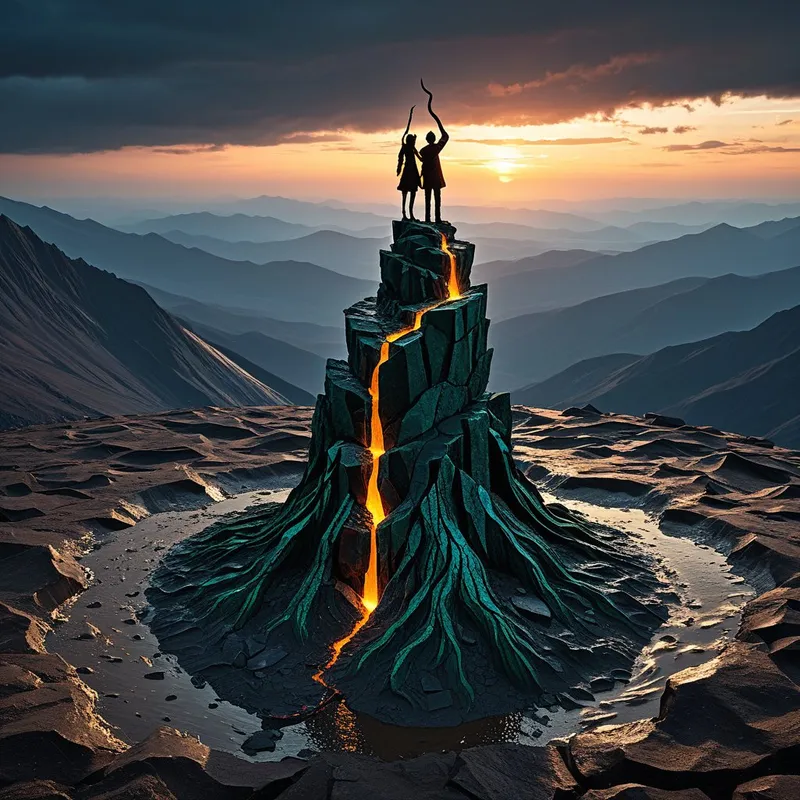
Only Fuxi and Nüwa, upon the highest peak, survived the cataclysm. They looked upon a drowned, silent world beneath a shattered, weeping sky. A profound loneliness, deeper than the ocean, filled them. The mandate of creation had fallen to them. With the mud of the yellow earth, Nüwa began to shape figures. She breathed into them the spirit of life, and they became the first humans. But this was slow work for repopulating a vast world. So she took a vine, dipped it in the thick mud, and flicked it. Each droplet that fell became a person. Thus were the nobles and the commoners born from the same earth, by the same hand.
Yet the sky still bled. Fuxi, the master of patterns, saw the order in the chaos. Together, they gathered five-colored stones from the riverbeds of the world—azure, crimson, yellow, white, and black—representing the five elements and the five directions. They melted them in a divine crucible and, with immense effort, patched the gaping wound in the heavens. To ensure it held, they slew a giant turtle and used its four legs to replace the broken pillar, steadying the four corners of the world.
With order restored, Fuxi turned his mind to the future. He observed the patterns on the back of a dragon-horse that emerged from the Yellow River, and the markings on a turtle’s shell from the Luo River. From these, he divined the Bagua, the map of all changing phenomena in the universe. He taught humanity to fish with nets, to hunt, to domesticate animals, and to cook with fire. He instituted marriage rites, replacing primal chaos with social order. Nüwa gave the gift of music, crafting the first reed pipe to bring harmony to the human heart. From the ruins of the flood, they built not just a new world, but a civilized one.
Cultural Origins & Context
The myth of Fuxi and Nüwa is not the product of a single author or text, but a cultural tapestry woven over millennia. Its threads appear in classical texts like the Chuci (Songs of Chu), the Huainanzi, and later in texts such as the Duyizhi from the Tang dynasty. It is a foundational narrative from the Han Chinese tradition, deeply embedded in the folk consciousness.
Primarily an oral tradition before being codified by scholars, this myth functioned as an etiological narrative—a story explaining origins. It answered profound questions: Where do humans come from? Why is the sky where it is? Who gave us our customs? It served to legitimize the social and cosmic order of early Chinese civilization, rooting institutions like kingship (from Fuxi, the first of the San Huang), family structure, and technological mastery in a divine, primordial act. The myth was told not just as history, but as a sacred charter, reinforcing the idea that human culture is a direct continuation and mirror of a restored cosmic order.
Symbolic Architecture
At its core, this myth is a grand allegory for the emergence of consciousness and culture from the undifferentiated waters of the unconscious. The serpentine bodies of Fuxi and Nüwa symbolize their rootedness in the chthonic, instinctual world—the deep, creative, and often terrifying psyche. Their human torsos represent the rising aspiration toward order, intellect, and spirit.
The flood is not merely water; it is the overwhelming tide of unprocessed psychic material that threatens to dissolve the nascent ego.
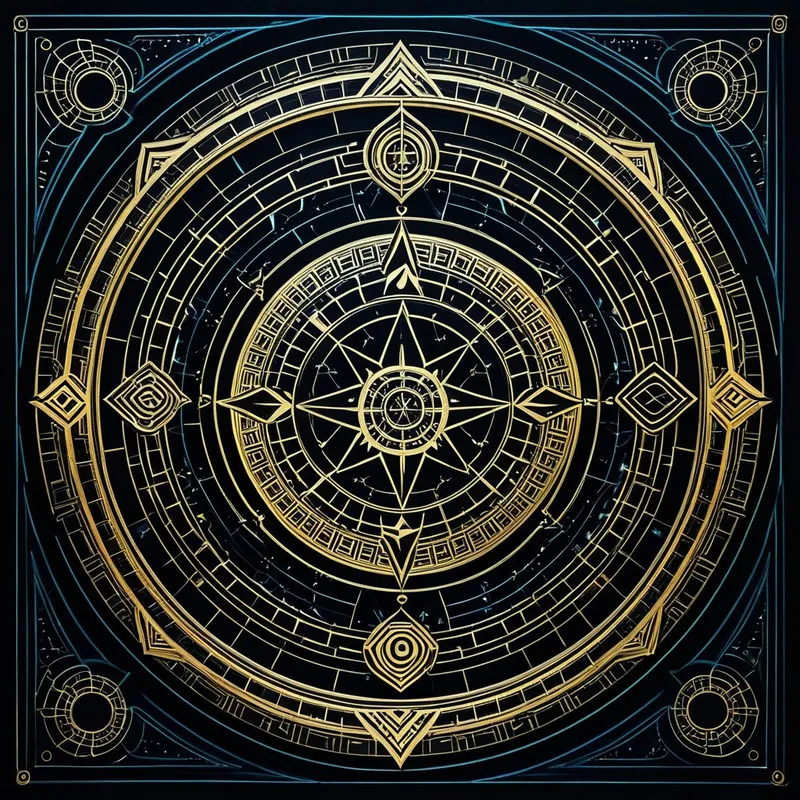
The broken sky represents a shattered worldview or a catastrophic rupture in one’s psychic structure. The act of mending it with five-colored stones is the labor of synthesis, integrating disparate, elemental parts of the self (the five elements) into a cohesive, functioning whole. Fuxi’s compass and square are not just tools for measurement, but archetypal symbols of the mind’s capacity to impose circle (heaven, spirit, the eternal) and square (earth, matter, the temporal) onto chaos, creating a livable inner reality.
Their sibling relationship, and later spousal union in some versions, embodies the sacred marriage (hieros gamos) of complementary principles: Fuxi as the masculine, active, ordering principle (Yang), and Nüwa as the feminine, receptive, generative principle (Yin). They are two halves of a single creative psyche. Nüwa’s creation of humanity from yellow earth grounds the human soul in the material world, while Fuxi’s gifts of the Bagua and social laws provide the structures necessary for that soul to navigate existence meaningfully.
The Dreamer’s Resonance
When this myth stirs in the modern dreamer, it often signals a profound process of re-creation following a psychic catastrophe. To dream of overwhelming floods or fractured skies may point to a life event—a loss, betrayal, or trauma—that has fundamentally shattered one’s sense of order and self. The dream-ego feels alone on a mountain peak, facing a vast, damaged reality.
Dreams featuring coiled serpents or beings that are half-human, half-animal can evoke the primal, creative energy of the Fuxi-Nüwa archetype. This is the somatic intelligence of the deep psyche rising, insisting on participation. The dreamer may find themselves trying to “fix” something broken with unusual tools or materials, mirroring the mending of the sky. This is the psyche’s innate drive toward healing and wholeness, attempting to gather the scattered “colored stones” of one’s experiences, talents, and insights to repair the personal cosmos.
Such dreams call the dreamer to embrace their own dual nature—to acknowledge the wise, instinctual serpent-body of feeling and intuition, and to employ the human, cognitive faculties to build a new order from the ruins of the old.
Alchemical Translation
The journey of Fuxi and Nüwa models the alchemical process of individuation—the forging of an integrated Self from the primal matter of the psyche. The initial state of paradisiacal unity in Hundun is the unconscious, pre-conscious state of infancy. The conflict—the flood—is the necessary crisis that forces differentiation and conscious engagement with the world.
The great work begins not in calm, but in catastrophe. The shattered sky is the prerequisite for the artisan’s stained glass.
The first alchemical operation is survival (enduring the flood), which requires a retreat to the inner mountain—the core of the Self. The second is creation (fashioning humans from clay), which is the act of giving form to the previously formless contents of the soul, populating the inner world with acknowledged complexes and potentials. The third and most crucial is reparation (mending the sky with five-colored stones). This is the coniunctio oppositorum, the sacred marriage and synthesis of opposites. The dreamer must consciously integrate their own elemental aspects—emotion (fire), intellect (metal), intuition (water), sensation (earth), and will (wood)—into a functioning, transcendent whole.
Finally, Fuxi’s establishment of culture represents the final stage: giving the newly ordered inner world a language and a structure. This is the point where personal transformation is translated into a meaningful life in the outer world—creating one’s own “Bagua” or personal cosmology, establishing healthy boundaries (the square), and connecting to the transcendent (the compass). The myth teaches that from our deepest ruptures, if we have the courage to intertwine our instinctual wisdom with our conscious will, we can not only repair ourselves but become creators of a more profound and authentic world.
Associated Symbols
Explore related symbols from the CaleaDream lexicon: