Fuujin Myth Meaning & Symbolism
The myth of Fuujin, the fearsome god of wind, reveals the primal power of the invisible, the necessity of chaos, and the breath that animates all life.
The Tale of Fuujin
In the time before time, when the world was a formless, swirling mass, the first breath was drawn. It was not a gentle sigh, but a violent, creative gasp that tore the heavens from the earth. From this primordial exhalation, he was born—Fuujin.
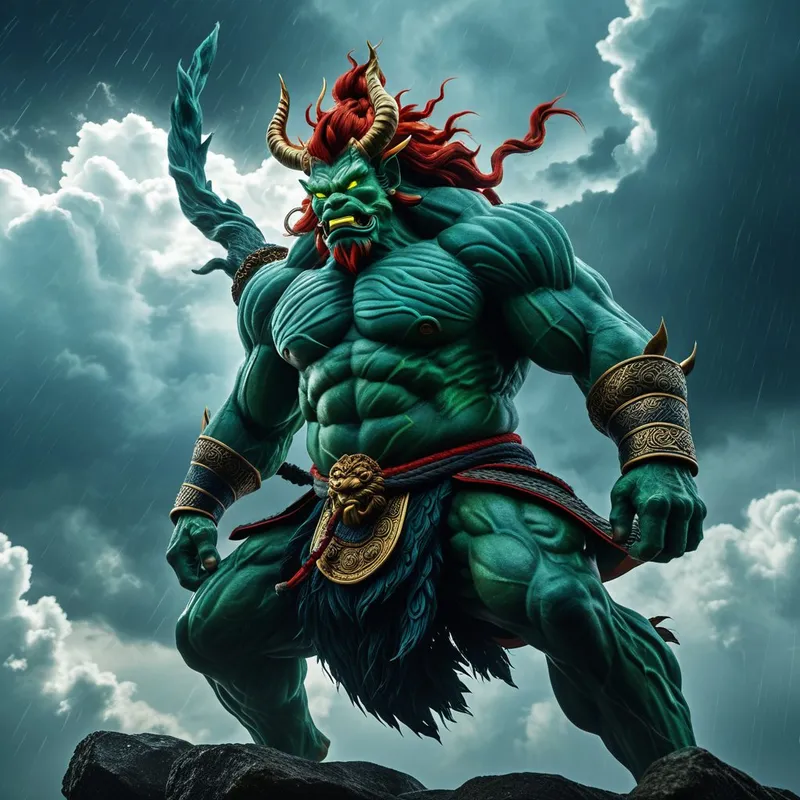
He is the Storm-Bringer, the Gale-Walker. His skin is the deep green of a churning sea, his hair a wild mane of crimson fire, perpetually streaming behind him as if in his own eternal tempest. Upon his back, he carries his great treasure and terrible weapon: a vast, leathern bag, swollen with all the winds of the world. Within it slumber the zephyr that kisses cherry blossoms, the breeze that carries birdsong, and the typhoon that can flatten forests and drag palaces into the deep.
His brother is Raijin, the Thunder-Drummer, whose beat is the heart of the storm. Together, they are chaos incarnate, riding black clouds across the land. The people below hear the roar of Fuujin’s winds long before they see the dark horizon. They feel it first—a sudden stillness, a pressure in the ears, the frantic dance of leaves pointing in one direction. Then comes the sound, a low moan building to a shriek as Fuujin opens his bag.
He is not evil, but he is utterly indifferent. His winds are the great levelers. They do not see the peasant’s hut or the emperor’s tower; they only see resistance. He scatters the fleet of the invader, but also the harvest of the faithful. He is the breath that fills the sails of discovery and the same breath that snuffs out the lantern of life. In the oldest tales, his howl is the sound of the world itself being shaped, carved, and cleansed. He is the invisible sculptor, and the land itself bears his fingerprints in curved dunes, polished stone, and forests bent in perpetual prayer to his passing.

Cultural Origins & Context
Fuujin’s origins are woven into the very fabric of Shinto and the early cultural exchanges along the Silk Road. While his iconography—the demonic visage, the bag of winds—bears striking resemblance to the Greek wind god Boreas and similar figures from Hindu and Buddhist cosmology (likely transmitted via China and Korea), his essence was deeply naturalized into the Japanese psyche.
He is a kami of a particularly raw and powerful kind, a personification of a force that is both vital and terrifying to an island nation. Farmers needed his rains, but feared his typhoons. Sailors relied on his breaths, but dreaded his tempests. This ambivalence is central. Fuujin and Raijin were often depicted on temple and castle walls, not as objects of worship in a serene sense, but as apotropaic figures—their fierce glares meant to ward off the very calamities they represented. By giving the uncontrollable wind a face and a form, the culture could engage with it, narrate it, and in a sense, plead with it. The myths were a way of mapping the terrifying sublime of nature onto a comprehensible, albeit formidable, divine psychology.
Symbolic Architecture
Fuujin is the archetype of the Unseen Mover, the primal force of change that is felt but not seen. His symbolism is profoundly psychological.
The wind does not argue; it simply rearranges. It is the first argument against stagnation, the invisible hand that insists, "You are not as solid as you think."
His bag is a potent symbol of containment and potential. It holds all possibilities of movement, from the gentlest suggestion to the most destructive fury. Psychologically, it represents the unconscious itself—a vast reservoir of psychic energy (libido) that, when released, can inspire creativity or unleash chaos. Fuujin’s control over the bag is tenuous at best; he is as much its servant as its master, mirroring our own fraught relationship with our inner drives.
His demonic form (oni-like appearance) is crucial. He is not a benevolent, human-like deity. He is other. This represents the fact that the fundamental forces of psyche and nature are not human, do not share our morals or concerns, and cannot be domesticated. They are transpersonal. To encounter Fuujin is to encounter the raw, amoral power of one’s own spirit, the gusts of passion, anger, inspiration, and change that can uproot a carefully constructed life.
Finally, he is Breath itself (fū). He is the pneuma, the prana, the animating life force that distinguishes the living from the inert. His myth reminds us that the same breath that whispers a poem can become a scream that shatters glass.

The Dreamer's Resonance
When Fuujin enters the modern dreamscape, he rarely appears in his classic mythological form. The dreamer is more likely to encounter his essence: an overwhelming, invisible force.
The dream may involve being in a house where all the windows and doors suddenly blow open, and an irresistible wind surges through, scattering papers, overturning furniture. The dreamer may struggle to close a door against a gale, feeling the pressure build in their chest. Or they may be outside, attempting to walk or run into a headwind that makes every step a monumental effort, while their voice is stolen from their lips.
Somatically, this is the psyche signaling a buildup of unstoppable pressure. It often coincides with life periods where repressed emotions (anger, creative impulses, the need for radical change) have been “bagged up” and contained for too long. The unconscious is now acting as Fuujin, releasing these winds. The feeling of being battered, uprooted, or voiceless in the dream mirrors the dreamer’s felt experience of being at the mercy of internal or external circumstances they can no longer control. The dream is not a prophecy of doom, but a stark announcement: "The containment has failed. The storm is here. You must now relate to the chaos, not the calm."
Alchemical Translation
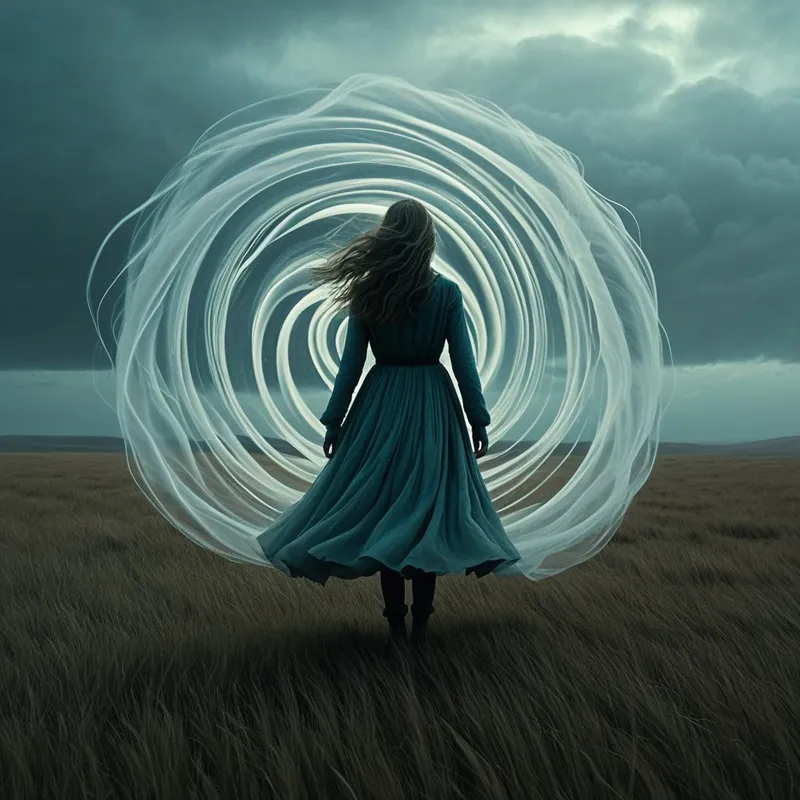
The individuation process, the alchemical journey of becoming whole, is not a serene walk in a garden. It is, at times, a typhoon. Fuujin’s myth provides the map for this necessary devastation.
The first step is Acknowledging the Bag. We all carry our sack of winds—our unexpressed potentials, our stifled rages, our silent yearnings. The alchemical work begins by recognizing this bag on our back, feeling its weight and its restless stirrings. To deny it is to invite a catastrophic, unconscious release.
The second is Conscious Release. Where Fuujin opens the bag indiscriminately, the modern individual’s task is to learn to untie the cords with intention. This is the translation of raw, chaotic wind into directed breath. That same fury can become fierce advocacy. That restless energy can become artistic discipline. That howling loneliness can become the space for deep introspection.
The goal is not to defeat the wind god, but to become the one who can stand in the gale, understand its direction, and eventually, learn to sail by it.
Finally, the myth leads to Integration of the Demon. The individuated Self must make room for the Fuujin within—the untamed, powerful, non-human aspect of spirit. This is the "rebel" archetype in its purest form: the part of us that refuses to be permanently settled, defined, or stagnant. To integrate Fuujin is to accept that chaos is not the enemy of order, but its precursor and necessary refresher. It is to find one’s center not in stillness, but in the ability to remain rooted while the world, and the self, is remade by the storm. We become, in the end, both the mountain that withstands the wind and the wind that shapes the mountain.
Associated Symbols
Explore related symbols from the CaleaDream lexicon: