Fujin Myth Meaning & Symbolism
The story of Fujin, the primal wind deity, whose chaotic breath shapes the world and whose containment reveals the necessity of wildness within order.
The Tale of Fujin
In the time before time, when the world was a formless, oily sea, silence was not peace. It was a suffocating weight, a held breath waiting to be expelled. From this primordial stillness, chaos stirred. Not a malevolent chaos, but a necessary one—the first desire for motion, for separation, for being.
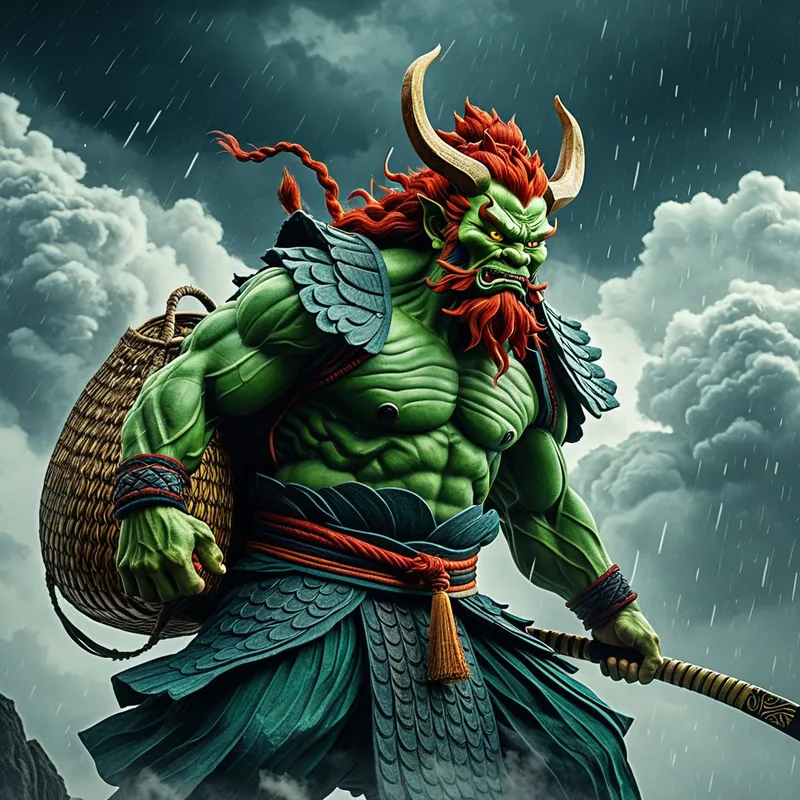
He emerged not with a whisper, but with a shriek that tore the fabric of the void. He was Fujin. His skin was the verdant green of a storm-tossed sea, his hair a wild mane of crimson fire, perpetually whipped by the gales that were his essence. In his mighty arms, he clutched a great bag, its cloth bulging and straining against the tempests trapped within. He was not alone. From the same chaotic womb came his brother, Raijin, whose drums were the first thunderclaps, whose laughter was lightning.
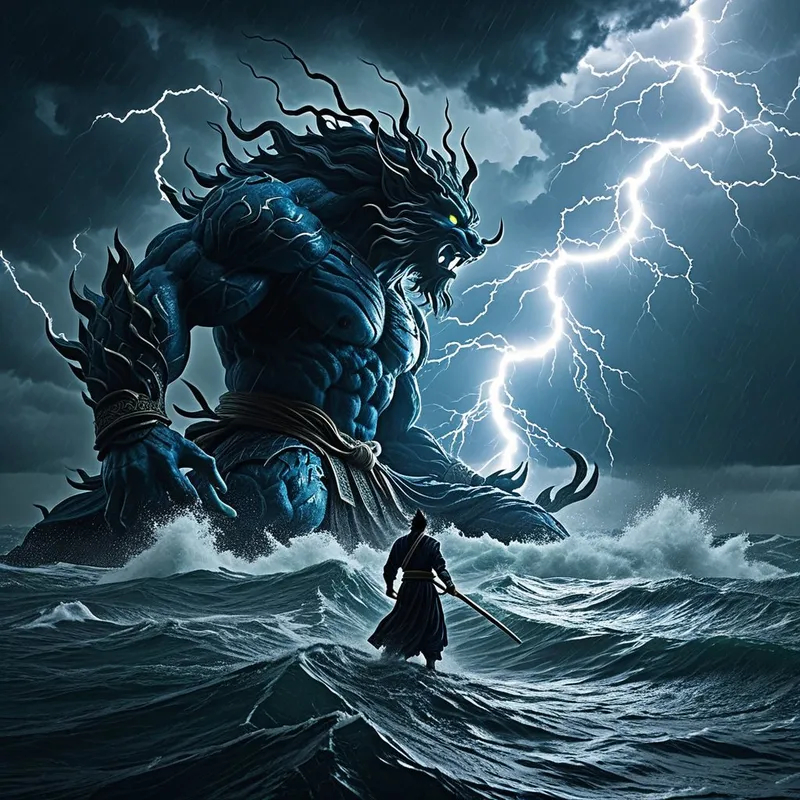
Together, they were the world’s first musicians, and their symphony was destruction. Fujin opened his bag. He did not simply release the wind; he unleashed it. It was a howling, mindless force, a billion invisible knives scouring the featureless deep. The sea, once placid, rose in monstrous peaks and fell into terrifying troughs. Raijin beat his drums, and with each flash and boom, the chaotic waters were seared with light and sound.
For eons, this was the only state: a churning, roaring, elemental fury. The brothers reveled in their power, defining existence through sheer, unchecked force. But within the chaos, a pattern began to form. The winds, in their relentless pushing, began to gather the heavier elements. The sea began to pull apart. Something was being made from the madness.
Then came the other Kami. They emerged from the calmer places, the spaces between the gusts. They saw not just terror in the storm, but potential. They saw the land being sculpted by Fujin’s breath, the atmosphere being charged by Raijin’s fire. A great council was held in the high plain of Takamagahara. The decision was not to destroy the wild brothers, but to harness them. To invite them into the nascent order.
A mighty struggle ensued—not of hatred, but of nature. The orderly Kami sought to bind the wind, to make it blow for the sails of ships, to carry seeds, to cool the brow of the summer sun. Fujin fought this constraint with every fiber of his being. His winds tore at the very fabric of the heavenly plain. Yet, in a moment of profound transformation, he saw it. He saw the islands of Ashihara taking shape below, sculpted by his own fury. He saw that without some measure of his wildness, this new world would be as static and dead as the primordial sea.
With a roar that became a sigh, he allowed a covenant to be forged. His bag would never be sealed shut. He would remain a force of unpredictable power, capable of bringing typhoons and tearing down the old. But he would also be the breath that fills the lungs of the world, the carrier of clouds and seasons, the unseen hand that guides the flight of the hawk and the fall of the leaf. He was bound, yet forever unbound—the necessary chaos within the cosmic order.
Cultural Origins & Context
Fujin’s origins are deeply entwined with the earliest strata of Japanese spiritual thought, known as Shinto. He is not a god with a elaborate, linear biography found in a single text like the Kojiki or Nihon Shoki. Instead, he emerges from a polytheistic, animistic worldview where natural forces are themselves sacred personalities, or kami.
His iconography—the green oni-like visage, the bag of winds—was solidified and popularized through Buddhist art and syncretism. He is often paired with Raijin as guardian deities (Nio) at temple gates, protecting the sacred space from evil spirits. This pairing reflects a fundamental understanding of the environment: wind and thunder are inseparable companions in a storm, representing the dual aspects of atmospheric violence. Farmers, sailors, and villagers told stories of Fujin not as a distant myth, but as an immediate reality. A gentle breeze was his favor; a devastating typhoon was his wrathful aspect, a reminder of nature’s ultimate sovereignty over human endeavor. He was propitiated and respected, a force to be acknowledged in ritual and daily life, embodying the Shinto reverence for the powerful, often untamable, spirit of the natural world.
Symbolic Architecture
Fujin is the archetypal symbol of the primal, animating breath—the pneuma or prana of the world. His myth is not about the creation of matter, but about the infusion of that matter with dynamic, often disruptive, energy.
The wind does not ask permission. It is the first principle of change, the invisible hand that dismantles stagnation.
His great bag is a profound symbol. It represents containment and potential. All the possibilities of movement, change, and communication are held within it. To open it is to initiate process, for good or ill. Fujin’s green skin connects him to the natural world in its raw, untamed state, while his wild red hair signifies the fiery, chaotic energy he commands. His partnership with Raijin establishes a core psychic duality: Wind is the unseen force, the antecedent (the breath before the word); Thunder is the manifest result, the shocking impact (the word itself). One is cause, the other is effect. One is constant pressure, the other is sudden release.
Psychologically, Fujin represents the libido in its purest, most undifferentiated form—not as sexual energy, but as general psychic life-force, desire, and will. He is the restless energy that precedes thought, the emotional gust that upsets our inner calm, the inspiring "breath of fresh air" that signals a new idea. He is the necessary chaos that must exist before any new order can be born.

The Dreamer's Resonance
To dream of Fujin, or of a great, personified wind, is to encounter the psyche’s own animating, and potentially disruptive, force. Somaticly, one might wake with a racing heart, a feeling of breathlessness, or the sensation of being physically pushed or buffeted.
Such a dream often arises during periods of intense internal or external transition. The dream-Fujin may appear as a terrifying storm threatening to destroy the dreamer’s "house" (the ego-complex or current life structure). This signals a confrontation with repressed emotional energy—a backlog of anger, restless creativity, or unexpressed passion—that is now demanding recognition and release. The bag of winds may appear as a locked chest or a swollen, pulsating object in the dreamscape, representing the dreamer’s own untapped potential or pent-up feelings they fear to "open."
Conversely, a dream where the wind is a helpful, guiding force—clearing away debris, filling sails—suggests the dreamer is successfully channeling this primal energy into positive change. They are allowing the winds of inspiration or necessary change to propel them forward, having made peace with the inherent unpredictability of the process.
Alchemical Translation
The individuation process, the journey toward psychic wholeness, is not a gentle stroll. It requires encountering and integrating our inner Fujin—the wild, untamed, and often frightening aspect of our own vitality that resists the ego’s desire for total control.
The goal is not to seal the bag, but to learn the art of holding it. To become the kami who can carry the storm without being destroyed by it.
The initial stage is Chaos Unleashed. This is the "typhoon" phase of life: a sudden divorce, a creative frenzy, a breakdown that shatters old identities. The inner Fujin runs rampant, and the ego feels victimized by forces beyond its control. The alchemical task here is not to stop the storm, but to observe it. To recognize this chaos as a form of energy, not merely as destruction.
The next stage is The Covenant. This is the conscious decision to relate to this energy, not from a place of fear, but from a place of respect and dialogue. One begins to ask: What is this wind trying to clear away? What stagnant air is it replacing? This involves creating a psychic structure—the "bag"—strong enough to contain the energy. In practice, this means establishing rituals, creative outlets, or therapeutic spaces where raw emotion and restless energy can be safely expressed and examined.
The final translation is Harnessed Breath. The integrated Fujin becomes the sustaining breath of the mature personality. The individual gains the capacity to summon focused will (a directed gust) when needed, to sit in creative inspiration (a gentle breeze), and to accept that periodic inner storms are part of the soul’s weather system. They become both the vessel and the wind, embodying the paradox at the heart of the myth: true power lies not in absolute control, but in a sacred partnership with the wild, animating spirit within. The rebel force becomes a vital organ of the complete self.
Associated Symbols
Explore related symbols from the CaleaDream lexicon: