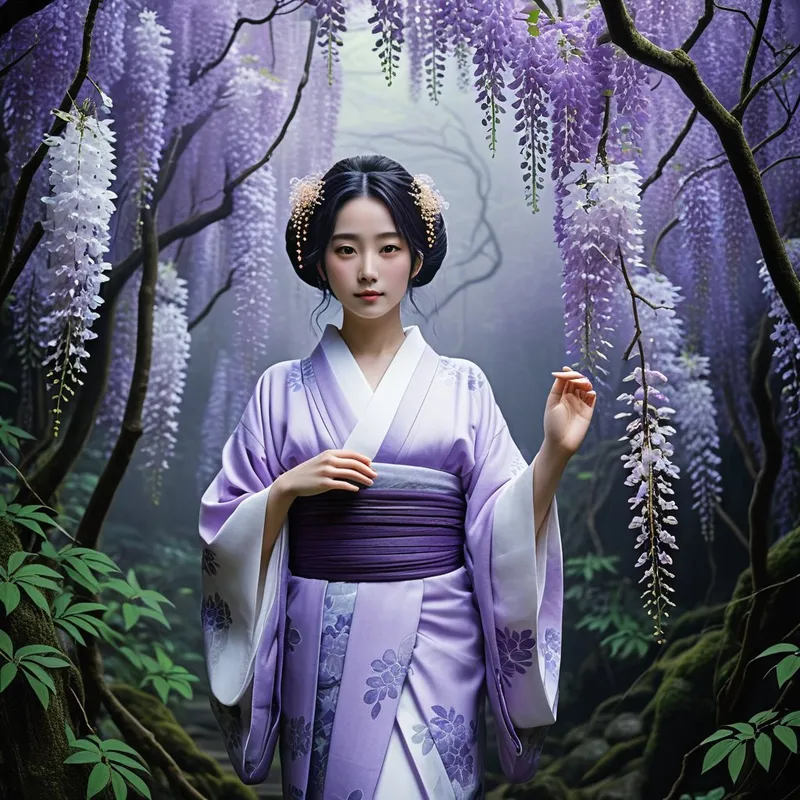
Fuji Musume Myth Meaning & Symbolism
A spirit maiden born from a wisteria vine embodies the soul's yearning for connection, weaving a tale of love, nature, and ephemeral beauty.
The Tale of Fuji Musume
Listen, and let the wind through the pines carry you to a time when the world was softer, its boundaries blurred like ink on wet paper. In a forgotten corner of the mountains, where mist clung to the cedars like a lover’s sigh, there stood a wisteria tree. But this was no ordinary vine. For a hundred springs, it had drunk the mountain’s tears and bathed in the moon’s cold milk. Its blossoms hung in clusters so heavy and fragrant they seemed to pull the very soul of the earth upward, a cascade of amethyst longing against the deep green silence.
From this living curtain of purple and green, she was born. Not with a cry, but with the soft unfurling of a petal. She was Fuji Musume. Her skin held the pallor of the moon, her hair the deep violet of twilight shadows. Her robes were not silk, but the very bark and blossom of her mother vine. She knew the language of the trickling stream and the secret names of the stones. Yet, for all her beauty, a profound solitude dwelled in her eyes—a solitude as deep and old as the mountain’s roots.
Her world was the glade, the company of foxes and silent, watching trees. But the human world called with a different music. One evening, as the sun bled into the western peaks, she heard it: the clear, plaintive notes of a shakuhachi floating up the valley. It was a melody of such piercing loneliness and beauty that it mirrored the ache in her own spirit. Drawn by a force stronger than root or vine, she drifted from her arboreal home, following the sound.
In a humble village at the mountain’s foot, she found the source: a young woodcutter, playing his flute outside a simple hut. His music spoke of hard work, of loss, of a quiet hope. Night after night, she would watch from the shadows, a spectral figure woven from moonlight and blossom. Her longing grew, a vine tightening around her own heart. She began to leave signs—a perfect sprig of wisteria on his doorstep, the scent of flowers on a windless night.
Finally, on a night when the moon was a silver bowl, she gathered her courage. She stepped into the circle of light from his window. The woodcutter looked up, and his breath caught. He saw not a monster, but a vision of unearthly, sorrowful beauty. For a season, a fragile happiness bloomed. He would play his flute, and she would dance, her movements like the sway of branches in a gentle breeze. She brought a strange fertility to his garden; flowers bloomed out of season.
But a spirit of the mountain cannot long endure the smoke of the human hearth. The very air of the village, thick with worry and toil, began to wither her. Her blossoms grew faint, her form less substantial. She was caught between two worlds, belonging wholly to neither. The conflict was not with a villain, but with the nature of her own being. The love that had drawn her out was the very force that was unmaking her.
The resolution came with the autumn winds. As the first chill swept down from the peaks, she knew. Standing with the woodcutter beneath her own mother vine, now turning gold, she smiled a smile of infinite sadness. “I am of the flower,” she whispered, her voice like rustling leaves. “And the flower must return to the root.” As he reached for her, her form dissolved into a shower of pale purple petals, carried away by the mountain wind, back into the heart of the forest from which she came. Only the haunting fragrance of wisteria remained, and the echo of a melody that would forever haunt his flute.
Cultural Origins & Context
The tale of Fuji Musume is not a myth enshrined in the ancient chronicles of Shinto like the stories of Amaterasu. Its roots are folkloric, springing from the rich soil of yōkai tales and kaidan. It belongs to a category of nature spirits—kami of a particular, localized sort—who embody the soul of a specific plant, tree, or place. These stories flourished during the Edo period, told by travelers, depicted in ukiyo-e, and performed in folk plays and dances.
The most famous artistic representation is the classical dance piece Fuji Musume (The Wisteria Maiden), where a dancer, holding a large branch of wisteria, portrays the maiden’s longing and elegant sorrow. This solidified her image in the cultural imagination. The myth functioned as a poetic explanation for the profound, almost painful beauty of wisteria blossoms—their brief, glorious bloom and swift fading. It served as a reminder of the permeable boundary between the human and natural worlds, a core tenet of Shinto animism, and cautioned about the dangers and inevitable sorrow of crossing that boundary, of loving what is inherently ephemeral.
Symbolic Architecture
At its core, Fuji Musume is an archetypal drama of the soul’s yearning for incarnation and connection, and the inherent tension in that desire. She is the anima in its most natural, untamed form—not a human woman, but the spirit of the feminine as it exists in nature: beautiful, nurturing, poetic, but ultimately bound to cycles beyond human comprehension.
The Wisteria Maiden is the soul of longing itself, a beautiful symptom of the divide between spirit and matter, eternity and the moment.
The wisteria vine is the perfect symbol. It is a climber, reaching for the sun, yet it must have a structure to support it—it cannot stand alone. This mirrors the maiden’s need for the woodcutter’s human world to give her longing a form. Her dissolution is not a tragedy, but a necessary return. She represents a love or a state of beauty that cannot be possessed, only witnessed and felt. Psychologically, she symbolizes a profound inner content—a creative inspiration, a spiritual insight, a deep emotional capacity—that emerges from the unconscious (the mountain forest) but cannot be permanently integrated into conscious, daily life without losing its essential, numinous quality.
The Dreamer’s Resonance
When the pattern of Fuji Musume emerges in modern dreams, it rarely appears as a literal maiden. Instead, the dreamer may experience a potent, beautiful connection that feels destined yet impossibly fragile. They may dream of a breathtaking but fleeting romance, a creative project that inspires then vanishes, or a deep sense of belonging to a place or person that is somehow always just out of reach.
Somatically, this can feel like a sweet ache in the chest, a literal “heartache.” Psychologically, the dreamer is navigating the process of connecting to an archetypal energy. The initial phase is enchantment and pursuit (the maiden hearing the flute). The conflict is the realization of incompatibility (the village air withering her). The process at work is the soul’s attempt to bring a piece of its own depth into relationship, and the subsequent, often painful, recognition of the limits of that integration. It is the dream-ego learning to hold beauty without clutching it, to love without needing to own.

Alchemical Translation
The myth of Fuji Musume models the alchemical stage of solutio—dissolution. The individuation process is not only about building up the ego and integrating the shadow; it is also about the conscious dissolution of certain identifications and the graceful surrender of what cannot, and should not, be made permanent.
The ultimate triumph in this myth is not union, but the conscious, bittersweet acceptance of sacred separation. It is the distillation of an experience into its pure essence—memory, fragrance, art—rather than its corpse.
For the modern individual, the “woodcutter” is the conscious mind, the part of us that seeks to structure, understand, and hold onto experiences. The “maiden” is a content from the Self, the totality of the psyche. The alchemical work lies in creating the space for her visitation—through art, meditation, deep relationship, or immersion in nature—and then, crucially, allowing her to leave when her season is over. To try to chain her to the hearth is to kill her spirit and impoverish our own soul. The transmutation occurs in the heart of the woodcutter after she is gone: his music is forever changed, deepened by sorrow and beauty. He does not possess the maiden, but he has been transformed by her visit. His conscious life is now irrigated by the memory of that transcendent connection, teaching him that the highest forms of love are often those that respect the autonomy and inherent nature of the beloved, even—especially—when it means letting go.
Associated Symbols
Explore related symbols from the CaleaDream lexicon: