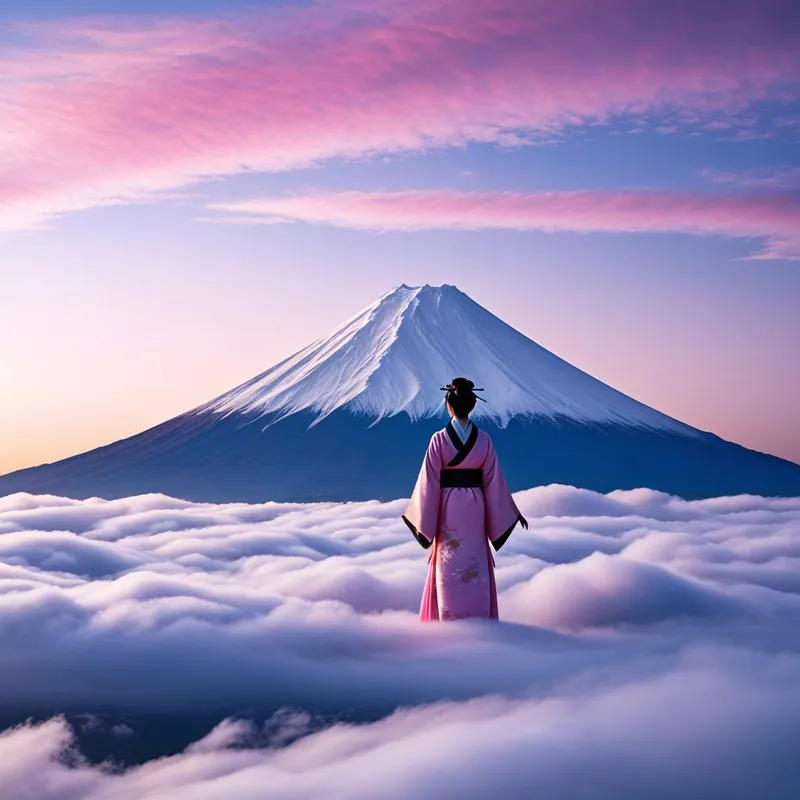
Fuji Myth Meaning & Symbolism
A tale of fire and ice, where a goddess's grief births a sacred mountain, a symbol of both cataclysmic power and eternal, watchful peace.
The Tale of Fuji
Listen, and hear the story of the mountain that breathes. In the age when the world was still soft and the gods walked close to the earth, there was a land of great fire and deep water. The Kami of fire roared beneath the soil, restless and hungry.
There lived a woodcutter, a man of simple heart named Viznu. He loved a celestial maiden, Konohanasakuya-hime, whose beauty was that of the cherry blossom at its peak—radiant and fleeting. Their love was a bright flame, and she descended to live with him in his humble hut at the foot of the great plains. But the earth-kami were jealous of this union between mortal and divine. They whispered to the fire beneath, stirring it to fury.
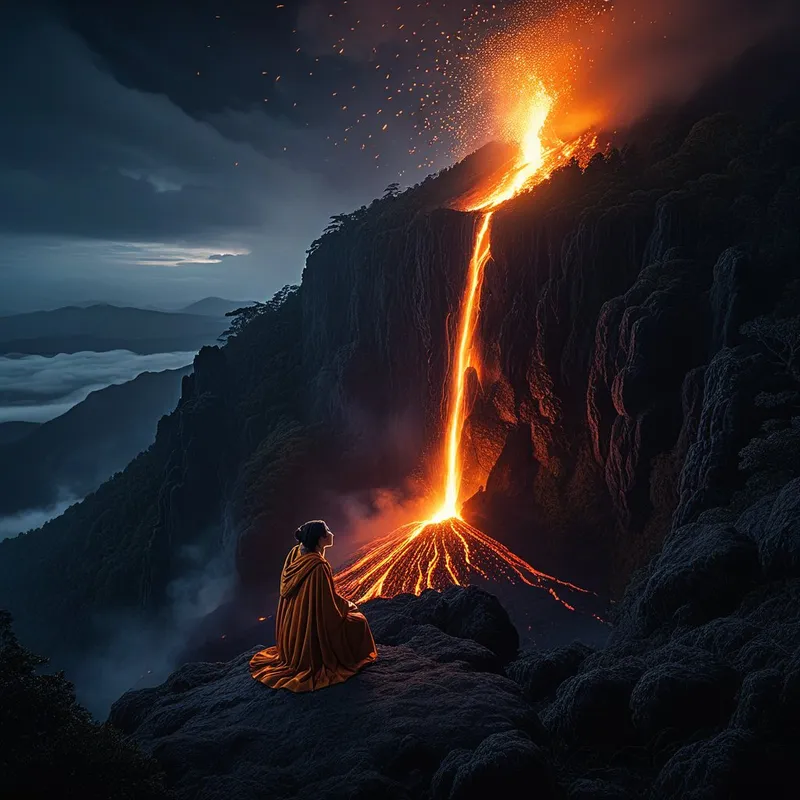
One night, as Viznu slept, the ground trembled. Not with a gentle shake, but with a deep, groaning roar that split the silence. From a great fissure, a pillar of fire and ash screamed into the sky, painting the night in hellish orange. The forests fled as rivers of molten stone began to crawl across the land. Viznu awoke to a world ending. He cried out for his love, but she was already standing at the edge of the cataclysm, her robes whipped by the scorching wind.
Her heart broke not from fear, but from a profound sorrow for the beautiful land being consumed. She saw the terror of the creatures, the destruction of the groves. Her tears, hot and endless, began to fall. But these were no ordinary tears. Each drop that struck the flowing fire hissed and cooled it, turning the raging river into dark, glassy stone. She wept not for herself, but for the world, and her grief became a power greater than the volcano's rage.
For days and nights, she stood her ground, a solitary figure against the inferno. Her tears became a blizzard of divine sorrow, a cold counter-melody to the earth's fiery song. The lava slowed, hardened, and began to pile upon itself, layer upon layer, cooled by her endless weeping. The eruption ceased, not with a whimper, but by being entombed in its own substance, shaped by her tears into a vast, silent cone.
Exhausted, her divine essence spent in the great work, Konohanasakuya-hime did not perish. She transformed. She became the mountain itself—its serene, snow-capped summit her eternal watchpost, its fertile lower slopes her enduring body. She named it Fuji, the Peerless One. And from that day, the mountain stood not as a tomb of fire, but as a guardian. It held the sleeping fire within, a promise and a warning, capped with the eternal peace of her snowy tears.
Cultural Origins & Context
The myth of Fuji's birth is not a single, codified scripture, but a living tapestry woven from Kojiki and Nihon Shoki references, local folk tales, and the profound Shinto understanding of kami. It belongs to the people who lived in its shadow—the farmers who feared its eruptions and revered its soil, the pilgrims who sought purification on its slopes, and the artists who saw in its perfect form a bridge to the divine.
The tale was passed down by village elders and kannushi, not merely as an explanation of geology, but as a foundational narrative of coexistence. It served a critical societal function: to frame a terrifying, uncontrollable natural force (a volcano) within a relationship of reverence and understanding. The mountain was not a mindless monster, but a being—a goddess who chose self-sacrifice to create order from chaos. This transformed fear into respectful awe, making the volatile landscape spiritually intelligible and ethically navigable.
Symbolic Architecture
Fuji is the ultimate symbol of contained potential. It is the perfect marriage of opposing elemental forces: the dynamic, masculine Yang fire trapped within the serene, feminine Yin snow. It represents the moment raw, destructive energy is alchemized into a stable, enduring form.
The greatest power is not in the eruption, but in the capacity to hold the fire and become the mountain.
Konohanasakuya-hime’s transformation is key. She does not defeat the fire through greater force; she transforms it through a different quality—sacrificial grief that becomes creative restraint. Her tears, an expression of profound empathy for the suffering of the world, are the agent of change. Psychologically, she represents the conscious ego that confronts a volcanic upwelling from the unconscious (the eruption). Instead of being annihilated by it or fleeing, she engages it with a different aspect of the psyche—the feeling function, deep compassion—and in doing so, gives it form and purpose. The mountain that results is the complex: a structured, permanent feature of the inner landscape born from the confrontation between consciousness and unconscious power.

The Dreamer's Resonance
To dream of Fuji is to dream of a profound inner pressure seeking form. The mountain in a dreamscape can appear as a perfectly still, majestic presence, or it can be rumbling, smoking, on the verge of eruption. The somatic experience is often one of awe mixed with deep anxiety—a feeling of something immense within the dreamer that is both beautiful and potentially overwhelming.
If the dream-Fuji is erupting, it signals a psychological event where long-contained emotional material (rage, passion, creative force) is breaking through conscious barriers. The dreamer may be experiencing a life crisis that feels destructive. If the mountain is serene, it may reflect a hard-won inner stability, or a warning that powerful forces are being repressed under a facade of calm. The dream asks: What fire are you sitting upon? What aspect of your being have you had to "freeze" or cap with snow to maintain peace, and is that sustainable? The mountain is the Self in its totality—the terrifying power and the sublime peace contained in one form.
Alchemical Translation
The myth of Fuji is a master blueprint for the alchemical process of individuation—the journey toward psychic wholeness. The initial state is chaos: the unconscious erupts violently into life, threatening to destroy the existing order (the woodcutter's world, the ego's stability). The old ways cannot continue.
The alchemical agent is not brute strength, but feeling—the goddess's tears. In psychological terms, this is the conscious, valuing engagement with the unconscious material. One must "weep" over it, fully experience the grief, fear, or passion it carries, without identification. This conscious suffering is the solve—it dissolves the rigid stance of the ego.
The transmutation occurs when the fiery content of the unconscious is cooled by the conscious acceptance of its reality, allowing it to coagulate into a new, permanent structure.
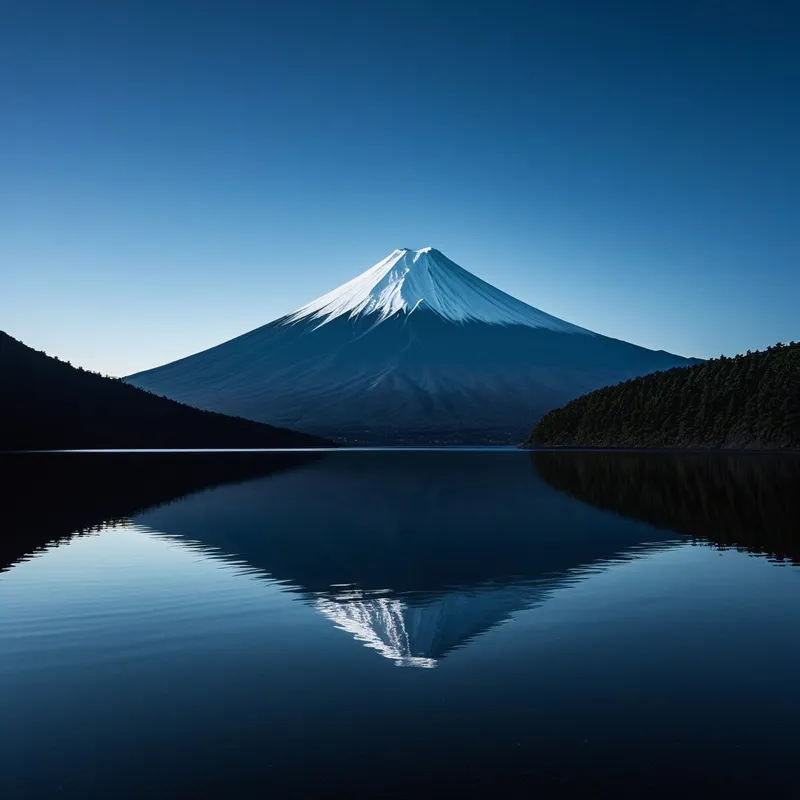
The final stage, the coagula, is the mountain itself. The once-destructive force is now the central, defining feature of the landscape—the Self. It is stable, majestic, and purposeful. The fire is not gone; it is integrated, providing warmth and vitality from within, while the snowy cap represents the conscious attitude of calm observation and reflection. For the modern individual, the myth teaches that our most volatile passions, traumas, or creative impulses are not enemies to be eliminated. They are primal energies that, when faced with the transformative power of conscious awareness and compassionate acceptance, can become the very foundation of our character—our own inner Fuji, peerless and whole.
Associated Symbols
Explore related symbols from the CaleaDream lexicon: