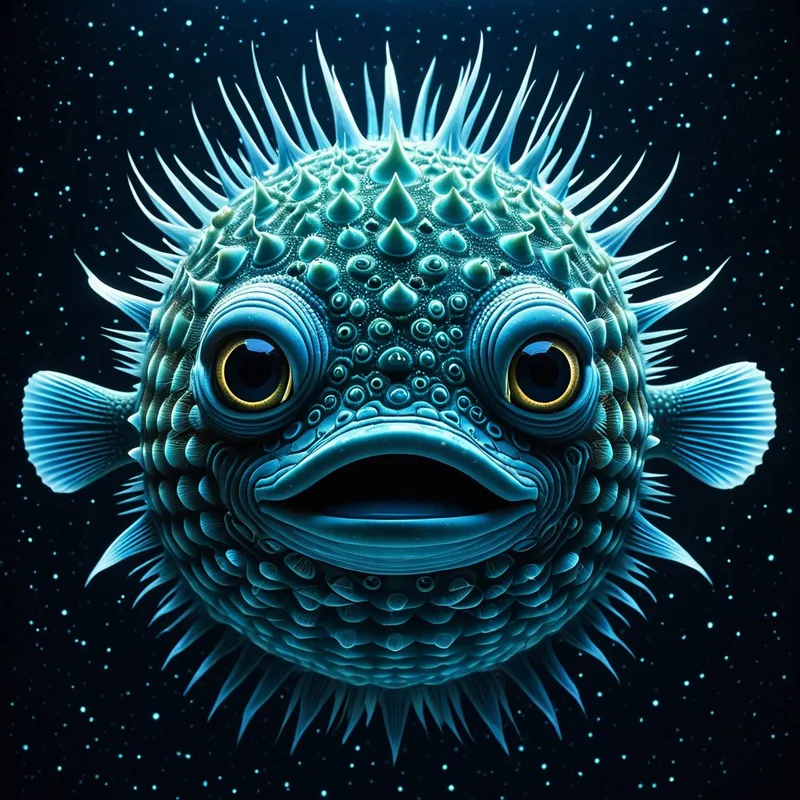
Fugu Myth Meaning & Symbolism
A myth of a humble fish, a vengeful god, and the human who dared to taste divine poison, transforming peril into a sacrament of life.
The Tale of Fugu
Listen, and let the salt air fill your lungs. Let the memory of the primordial sea rise within you. This is not a story of grand palaces or thundering war gods. It begins in the silent, crushing dark of the deep, where Fugu was born not as a mere fish, but as a vessel.
In the age when the kami still walked close to the waves, there dwelt a spirit of profound duality. Its form was that of a humble pufffish, yet its essence was a paradox. Its flesh was said to hold the sweetness of the moon’s own nectar, a taste so sublime it could make a mortal forget the world. But woven into every fiber, pooled in its liver, threaded along its spine, was a poison so absolute it was not of this earth. It was the distilled essence of divine wrath, a kegare so potent that to touch it was to invite oblivion. The sea itself held its breath around this creature.
For eons, Fugu swam the deep trenches, a forbidden treasure, a drifting sacrament. Fishermen would whisper of its ghostly glow in the abyssal black, a siren song that meant death. They would pull their nets and find it sometimes, its body bloating with a threat older than time, and with trembling hands, they would cast it back into the foam, offering prayers to the sea god for forgiveness. It was a law written in the soul: This is not for you.
But the human heart is a chamber that echoes with both fear and hunger. In a coastal village worn smooth by wind and sorrow, there lived a fisherman named Isamu. His life was one of meager catches and constant want. He had heard the elders’ warnings, had seen the graves of the foolish. Yet, in his dreams, the Fugu would come to him, not as a monster, but as a key. A voice on the wind, neither kind nor cruel, seemed to whisper: What is a barrier but a test? What is poison but power unrecognized?
One fateful night, under a sky ripped open by a silent storm of stars, Isamu’s net grew heavy not with a multitude, but with a singular, radiant weight. He hauled it aboard, and there it lay: the Fugu. It did not struggle. Its round eyes held the infinite black of the deep, and its skin pulsed with a soft, internal light. The divine poison within it felt like a pressure in the air, a static charge before lightning. The old terror seized him. To throw it back was wisdom. To keep it was madness.
But Isamu looked past the fish, to his sleeping village, to the empty bowls, to the relentless hunger of a fragile life. This was not mere curiosity; it was a desperate covenant. With a resolve that quieted the storm in his heart, he did not cast it back. He built a small fire on the lonely shore, its light a defiant echo of the Fugu’s glow. He took his sharpest knife—its blade an extension of his will. The world narrowed to his hands, the fish, and the razor’s edge between sustenance and annihilation.
He did not rush. His movements were a ritual, a slow, precise dance of dissection. He separated the sublime flesh from the sacs of venom, the edible from the eternal sleep. It was an act of supreme focus, a dialogue with death itself. When he was done, he held a few translucent slices, moon-pale and delicate. He knelt before the fire, offered a piece to the sea, to the Watatsumi, and then, closing his eyes, he brought a slice to his lips.
The taste was not of food. It was a memory of the first dawn, a coolness like mountain spring water, a texture like cloud. And then, a warmth spread—not the burn of poison, but the glow of life, fierce and vibrant. He had not died. He had passed through. He had taken the god’s challenge and, with steady hands and a respectful heart, had performed the first alchemy: turning certain death into a fleeting taste of heaven.

Cultural Origins & Context
The myth of Fugu is not preserved in the classical canon of the Kojiki or Nihon Shoki. Its origins are humbler, more visceral, born from the oral traditions of fishing communities along the coasts of the Seto Naikai and the Pacific. This is a folklore of the knife’s edge, passed down not by court scholars but by fishermen, chefs, and elders warning wide-eyed children.
Its societal function was multifaceted. On one level, it was a stark, necessary cautionary tale, a mythic reinforcement of a very real, mortal danger. It sacralized the taboo, making the blowfish not just a hazardous meal but a divine entity to be approached with ritual purity. On another level, it celebrated a very specific form of human mastery. The figure who could successfully prepare Fugu became a modern-day Isamu—a shokunin whose skill bordered on the sacerdotal. The myth thus provided a narrative foundation for the intense, years-long apprenticeships required to obtain a Fugu preparation license in Japan today. The chef’s knife is Isamu’s knife, and the restaurant kitchen becomes a sacred space where life and death are negotiated with every slice.
Symbolic Architecture
At its core, the Fugu myth is a profound map of the psyche’s relationship with the Shadow. The Fugu itself is the ultimate Shadow symbol: a container of both supreme desirability (the numinous, the transcendent taste) and annihilating toxicity. It represents those aspects of life, or of our own selves, that hold incredible potential but are wrapped in legitimate, terrifying risk—our repressed talents, our deepest griefs, our raw power, or our spiritual longing.
The greatest treasures of the soul are often guarded by its most potent fears.
Isamu’s journey is the hero’s journey in miniature, but its arena is not a battlefield; it is the focused arena of conscious attention. His "call to adventure" is hunger, both physical and existential. His "road of trials" is the meticulous, nerve-wracking act of preparation. The "boon" he brings back is not a golden fleece, but a new paradigm: that what is most forbidden can, with utmost respect and precision, become a source of profound nourishment. The myth does not advocate reckless consumption of one’s demons. It advocates for their sacred, skillful preparation.
The Dreamer's Resonance
When this myth stirs in the modern unconscious, it rarely appears as a literal fish. One might dream of a beautiful but terrifying gem that is also radioactive; a brilliant idea that feels too dangerous to speak; a relationship of intense attraction that carries the scent of ruin; or a locked box in one’s own chest that hums with both dread and promise.
The somatic experience is one of prickling anticipation—a tightness in the chest, a quickening pulse, a feeling of standing at a precipice. Psychologically, the dreamer is at the threshold of engaging with a core Shadow element. The Fugu in the dream is the psyche presenting the paradox: "Here is what you most need, and here is what you most fear. They are the same thing." The dream is an invitation to the work of Isamu: to stop reflexively throwing the perilous gift back into the unconscious sea, and to begin, with conscious focus, the delicate work of discernment.
Alchemical Translation
The individuation process, the journey toward psychic wholeness, is precisely the art of preparing the Fugu. We all contain inner "poisons"—traumas, complexes, rages, shames—that, left unprocessed, can paralyze or destroy us. We also contain the sublime "flesh"—our latent genius, our capacity for joy, our connection to the Self. The myth teaches that these are not separate; they are different aspects of the same potent substance.
Individuation is not the avoidance of poison, but the sacred surgery that separates it from nourishment.
The "knife" is the tool of conscious discrimination—therapy, meditation, artistic expression, honest reflection. The "steady hand" is the ego’s capacity to hold the tension of opposites without fleeing into denial or being overwhelmed. The act of "offering to the kami" is the essential step of acknowledging that this power is not entirely personal; it is transpersonal, archetypal, and must be approached with humility.
The final "taste" is the integration. It is not the elimination of the poison (the Shadow remains), but the successful drawing of sustenance from the encounter. One emerges not "cured" of one’s darkness, but empowered by having learned its contours and extracted its secret vitality. The modern individual, in their own life, performs this alchemy each time they face a deep fear with mindful courage, transforming a latent threat into a source of resilience and a more complete, authentic existence. The meal, in the end, is the richer, more nuanced flavor of a self that has dared to know its own depths.
Associated Symbols
Explore related symbols from the CaleaDream lexicon: