
Fue Myth Meaning & Symbolism
A haunting myth of a flute that becomes a spirit, forever playing a melody of loss and longing for its vanished master.
The Tale of Fue
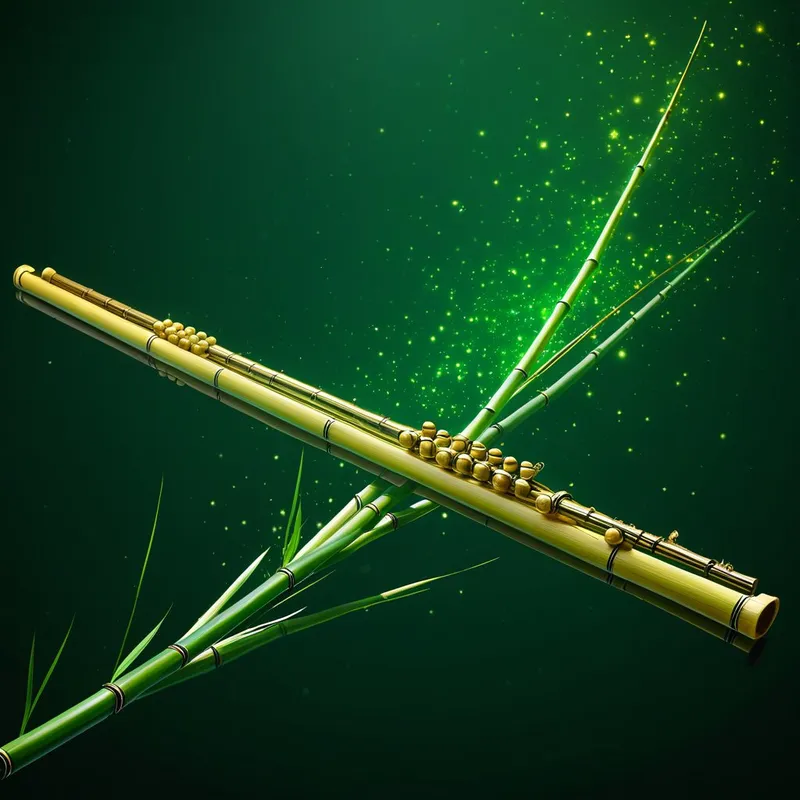
Listen, and let the wind through the bamboo carry you back. In a time when the world was closer to the kami, there lived a master musician. He was a man of the court, yet his soul belonged to the mountains and the whispering groves. His instrument was not a grand biwa or a booming taiko, but a simple, humble shakuhachi, crafted by his own hands from a single length of bamboo. He named it Fue, which simply means “Flute.”
Their music was not mere entertainment; it was a conversation with the unseen world. When he played, the foxes would pause in their hunting, the birds would fall silent to listen, and the local kami of the stream and stone would draw near. The melody was the sound of rain on leaves, the sigh of a distant waterfall, the loneliness of the moon on a winter night. The flute was his voice, and he was its breath.
But time, the relentless current, carries all things away. The musician grew old, his fingers stiff, his breath shortening. On his final evening, as the sun bled into the western hills, he took Fue to his favorite clearing. With a strength that came from somewhere beyond his frail body, he played one last, impossibly beautiful song. It was a melody of gratitude and farewell—to the earth, to the sky, to the spirit within the bamboo. As the last note faded, so did his life. He passed peacefully, the flute resting on his still chest.
The flute was placed in his family’s kamidana, an object of reverence. Yet, without its master’s breath, it was just hollow wood. Or so it seemed. For the musician’s soul, so deeply entwined with his art, had not entirely departed. His longing, his love for the music, and his profound connection to Fue lingered. This shōryō, this lingering spirit, did not possess a human form. Instead, it seeped into the very bamboo of the flute.
One night, under a full moon, a lonely traveler heard music from the abandoned house. Peering through the broken shutter, he saw no one. Only the flute, glowing with a soft, bioluminescent light, floating in the center of the room, playing its own mournful tune. The spirit of Fue had been born. It was not a ghost of the man, but the ghost of their union—the orphaned voice seeking its source. Forever after, on certain nights, the sound of a heartbreakingly beautiful shakuhachi melody would drift from forgotten places, a eternal serenade to a connection that death could not sever.

Cultural Origins & Context
The myth of Fue belongs to the rich tapestry of kaidan and yūrei tales that flourished particularly during the Edo period. These stories were not mere horror; they were a profound folk psychology, a way for a culture deeply animistic at its core to process the mysteries of life, death, and attachment.
Passed down through kōshaku-shi and later recorded in anthologies, the tale functions on several levels. In a society with strong Confucian values of loyalty and filial piety, the story reflects the tragedy of a bond broken by mortality. The flute’s devotion transcends death, mirroring the ideal of everlasting loyalty. Furthermore, it speaks to the Shinto belief in kami residing in natural objects (yorishiro). If a rock or tree could house a spirit, why not an object infused with a lifetime of artistic passion and human emotion? Fue becomes a tsukumogami—a tool that, after a hundred years, acquires a spirit. Here, however, the transformation is not born of age, but of the intensity of love and loss.
Symbolic Architecture
At its heart, the myth of Fue is a profound symbol of the psyche’s refusal to accept a catastrophic rupture. The flute is not merely an instrument; it is the vessel of relationship, the conjunctio between the inner world of feeling (the musician’s soul) and its expression in the outer world (the music).
The unplayed melody is the greatest burden of the soul. Fue represents the part of us that must sing, even when the singer is gone.
The musician symbolizes the conscious ego, the craftsman and performer. His death is any shattering loss: the end of a creative era, the death of a loved one, the loss of a core identity. Fue, the spirit, is the autonomous complex that survives this death—specifically, the anima (or soul-image) now detached and wandering. It is creative longing itself, orphaned and searching for its container. The eternal melody is the psychic energy trapped in a loop of memory, unable to be integrated or moved forward because the central organizing principle (the musician) has vanished. The music is beautiful, but its beauty is pathological; it is a memorial service that never ends.
The Dreamer's Resonance
When this mythic pattern stirs in the modern dreamer, it often manifests not as a literal flute, but as an object of profound personal significance that feels alive with absence. One might dream of a childhood home that breathes, a book that whispers, or a piece of jewelry that pulses with a warm light. The somatic sensation is one of poignant ache, a sweet-sadness located in the chest or throat—the regions of heart and voice.
Psychologically, this dream signals a process of mourning that has become static. The dream-ego is in the position of the traveler hearing the music: a witness to a beautiful, trapped energy. The dream is presenting the orphaned complex—a bundle of talent, love, memory, or identity—that has been “spiritualized” by loss but not yet liberated. It is a call from the depths to acknowledge that a part of the psyche has become a ghost, forever replaying the tune of “what was,” and that this ghost holds a key to future vitality.

Alchemical Translation
The alchemical journey modeled by Fue is the solve et coagula—the dissolution and re-coagulation—of a psychic attachment. The first, tragic step is the solve: the death of the musician, the necessary dissolution of an old form of consciousness or relationship. This is involuntary and painful. The spirit-Fue represents the product of this dissolution: the anima mundi (world soul) trapped in a specific, personal memory.
The work of individuation, the alchemical translation, is to perform the second, conscious operation: the coagula. This does not mean finding a new musician to play the old tune. That would be mere replacement. The transformation is more radical.
The flute must become the musician. The orphaned soul must learn to breathe itself.
The modern individual encountering this pattern must first listen deeply to the orphaned melody—to honor the grief, the love, the beauty of what was lost. This is the mortificatio, the acknowledgment of death. Then, the crucial shift: one must invite the spirit in, not as a ghost to be placated, but as a vital essence to be embodied. The creative longing (Fue) must cease to be an external phenomenon to be witnessed and become the internal breath that animates a new life. The individual learns to “play themselves,” to become the vessel and the breath, the creator and the creation. The melody changes then, from a lament for a lost past to a unique, living expression of a soul that has integrated its deepest loss. The music continues, but it is no longer a ghost song. It becomes the authentic voice of a psyche made whole, where memory fuels creation instead of haunting it.
Associated Symbols
Explore related symbols from the CaleaDream lexicon: