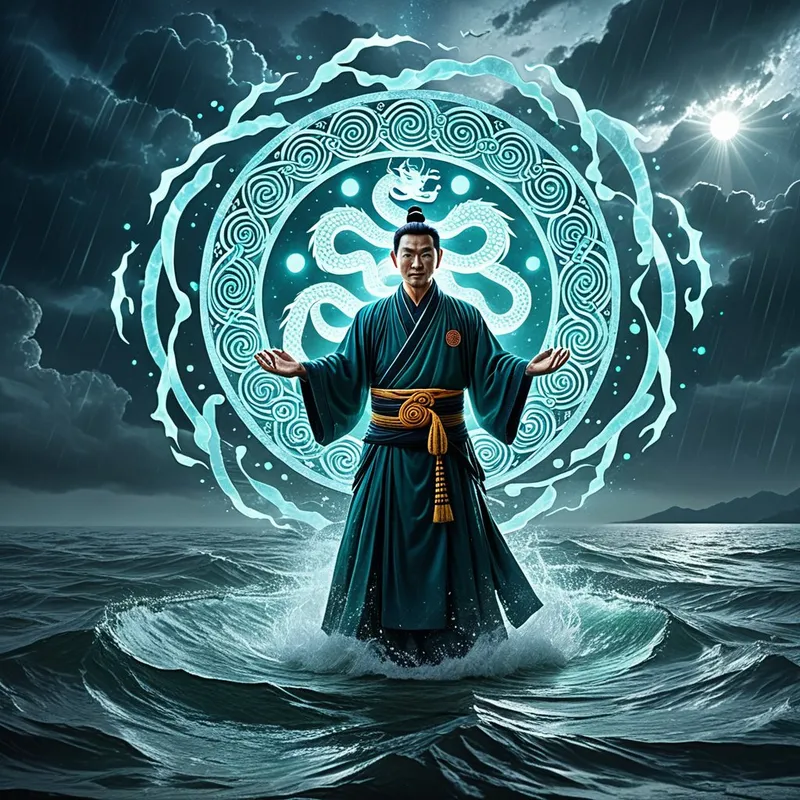
Fu Xi Myth Meaning & Symbolism
The myth of Fu Xi, the serpent-bodied sage who emerged from primordial chaos to establish the foundations of human civilization and cosmic order.
The Tale of Fu Xi
Before there were kings, before there were cities, there was only the great, formless water. The world was a vast, undifferentiated dream, a chaos of mud and mist where humanity huddled, knowing nothing but the raw terror of the elements. They ate their meat raw, their bellies cold; they knew no family, no names, no fire to push back the endless dark.
Then, from the heart of the Hundun, the waters stirred. Not with storm, but with a profound, coiling intelligence. From the depths of the Yellow River he rose—a being of impossible synthesis. His torso was that of a man, broad-shouldered and wise, but from the waist down, he was one with the serpent, a powerful, scaled body that moved with the fluid certainty of the river currents themselves. This was Fu Xi.
He did not conquer with spear or shout, but with a gaze that saw the patterns hidden within the chaos. Watching the stars wheel in their eternal dance, he saw a script written in light. Observing the tracks of birds and beasts in the riverbank's clay, he saw a language of form. He saw the mating of turtles, the division of families in the animal kingdom, and a great sorrow filled him for the scattered, kinless humans. So, he established the first rites of marriage, drawing order from the wildness of desire, weaving the first threads of society.
His greatest revelation came not from heaven, but from the river’s depths. A great dragon-horse, the Longma, emerged from the swirling currents, its scaled hide marked with a pattern of swirling dots—the Hetu. The pattern burned itself into Fu Xi’s mind. Later, from the Luo River, a divine turtle offered its shell inscribed with another mystery, the Luoshu.
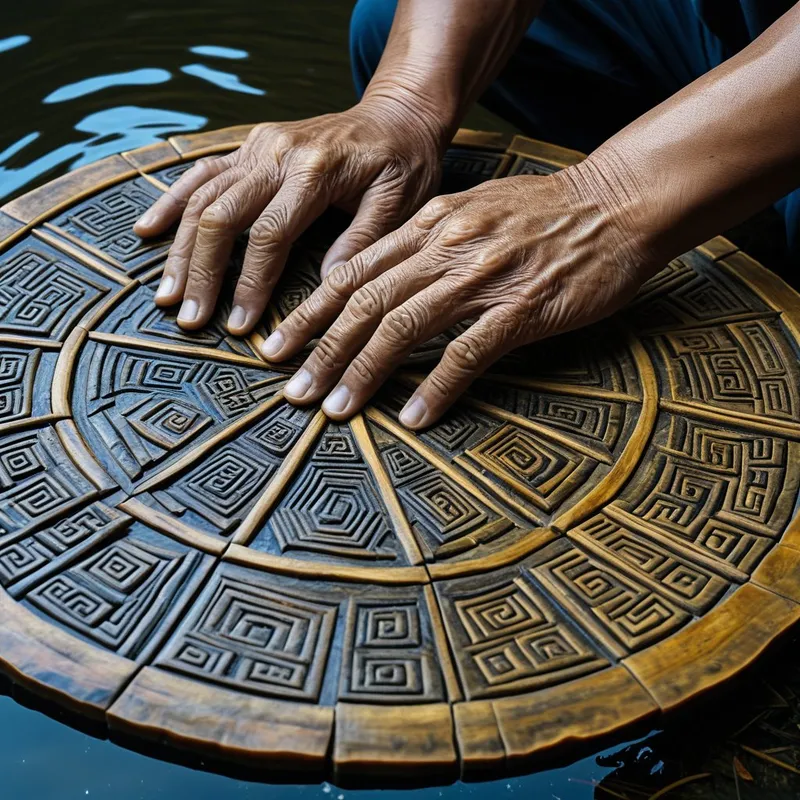
Sitting on the bank, with the mud of creation still upon him, Fu Xi entered a trance. With a sharp stone, he began to carve. Not pictures, but abstractions: solid lines for the dynamic, creative force of Yang, and broken lines for the receptive, nurturing force of Yin. He combined them, three lines at a time, until eight fundamental symbols emerged—the Bagua. Heaven, Earth, Fire, Water, Mountain, Lake, Wind, Thunder. In these eight trigrams was the blueprint of all existence, the code of the cosmos translated from the chaos. He taught the people to fish with nets, to tame beasts with husbandry, to cook with the first fire stolen from the heavens. He did not give them a kingdom, but a mind. He did not build a wall, but a world.
Cultural Origins & Context
The myth of Fu Xi is not the story of a single tribe, but the foundational narrative of a civilization’s self-conception. His figure coalesced during the formative periods of early Chinese philosophy, particularly the Zhanguo era, and was later systematized by Han dynasty scholars eager to construct a coherent prehistoric lineage for the imperial state. He is the first of the San Huang, positioned before the Wu Di.
The myth was passed down not as mere entertainment, but as sacred history, recited by ritualists and recorded by court historians like Sima Qian. Its function was profound: to explain the origin of culture itself (wenhua). Fu Xi’s acts answer the primordial question, "How did we become human?" He represents the moment of transition from a state of nature (ziran) to a state of culture (wen), establishing the models (fa) for society, technology, and cosmic understanding. He is the archetypal civilizing hero, but uniquely Chinese in his method—not through violent conquest, but through serene observation and symbolic synthesis.
Symbolic Architecture
Fu Xi is the psyche’s own capacity to create order from the inner chaos. His serpentine lower body roots him firmly in the chthonic, instinctual, and unconscious realms—the watery, formless potential of the psyche. His human torso represents emergent consciousness, the ego struggling to rise and make sense of the deep, primal self.
The creator does not emerge from purity, but from the muddy waters of undifferentiated experience. His first act is not to build, but to perceive the pattern hidden within the swirl.
The Bagua are the ultimate symbol of this psychic process. They are not things, but relationships; not fixed answers, but a dynamic system of interpretation. They represent the mind’s innate drive to categorize, relate, and find meaning in the flux of life. The Hetu and Luoshu are gifts from the deep unconscious—intuitions, synchronicities, or dreams that present themselves as coherent patterns, offering the raw material for consciousness to craft into understanding.
His establishment of marriage rules is equally symbolic. It represents the conscious structuring of libidinal and relational energy (Eros), transforming raw, undirected desire into a framework that creates kinship, responsibility, and social continuity.
The Dreamer's Resonance
To dream in the pattern of Fu Xi is to be in a state of fertile, anxious potential. The dreamer may find themselves in a featureless landscape—a foggy plain, an endless ocean, or a cluttered, meaningless room. There is a pressing need to make sense, but the tools are absent.
Somatically, this can feel like a coiled tension in the base of the spine (the serpent power), a creative energy that has not found its direction. Psychologically, it is the process preceding a breakthrough. The dream-ego is gathering disparate impressions, emotions, and memories, sensing a hidden connection between them. A modern Fu Xi dream might involve finding strange symbols on a computer screen that perfectly explain a personal dilemma, or discovering that the chaotic lines of a city map, when viewed from above, form a meaningful personal sigil. The dream marks the moment the unconscious begins to offer up its own organizing principles to a consciousness ready to receive them.

Alchemical Translation
The alchemical journey modeled by Fu Xi is the opus of bringing light to the primordial waters of the unconscious—the creation of the conscious personality (the caelum, or heavenly vessel) from the massa confusa. The first stage is immersio, the acceptance of one’s own chaotic, instinctual nature (the serpent body). One must not reject this muddiness, but emerge from it.
The central operation is inspectio and notatio—the profound observation of both the inner world (dreams, emotions) and the outer world (events, patterns) and the notation of their synchronicities. This is the patient carving of the trigrams. The "dragon-horse" and "turtle" are symbols of autonomous psychic contents—complexes or archetypal images—that spontaneously rise from the deep, bearing gifts of structure.
Individuation is not the discovery of a pre-made self, but the courageous creation of a living system—a personal Bagua—with which to navigate reality.
Finally, the stage of applicatio: applying this inner-derived order to outer life. This is Fu Xi teaching fishing and marriage—using the new psychic framework to structure one’s relationships, work, and understanding of the world. The triumph is not dominance, but the establishment of a sustainable, meaningful order that honors both the chaos from which it came (Yin) and the conscious principle that shaped it (Yang). The individual becomes, like Fu Xi, a sovereign creator in their own right, ruling the inner kingdom with wisdom drawn from the cosmic river itself.
Associated Symbols
Explore related symbols from the CaleaDream lexicon: