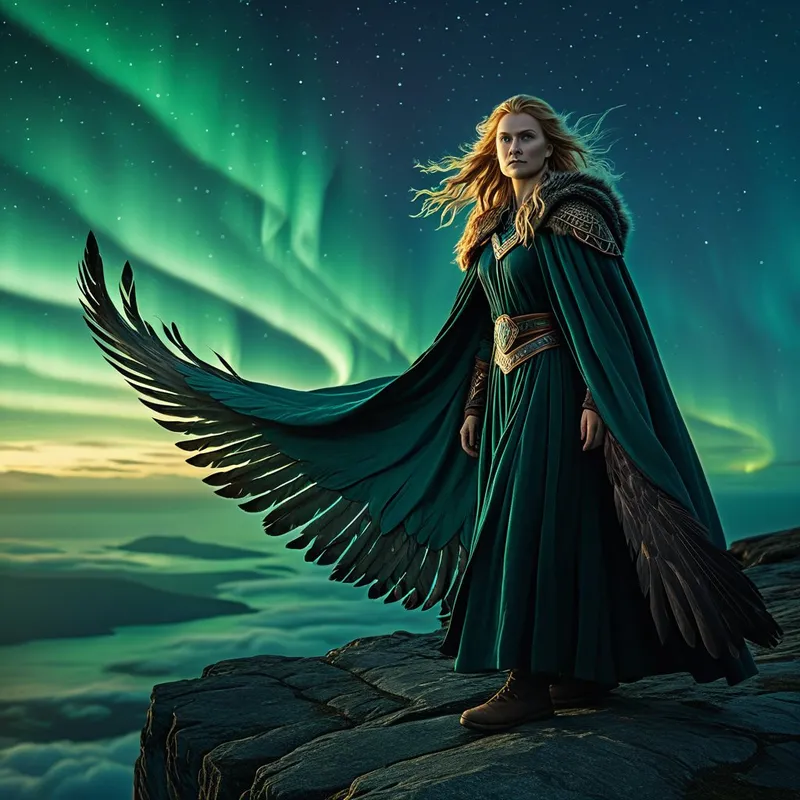
Freyja's Falcon Cloak Myth Meaning & Symbolism
The Vanir goddess Freyja dons a cloak of falcon feathers to cross worlds, a myth of sovereignty, desire, and the soul's transformative flight.
The Tale of Freyja’s Falcon Cloak
Listen, and hear the whisper of feathers on the wind. In the golden halls of Fólkvangr, where the apple trees bear fruit in eternal autumn, sits Freyja. She is the Lady of the Valkyries, Mistress of Seiðr, and her heart is a tempest. It is a heart that knows the weight of a missing husband, Óðr, and the fierce, unyielding burn of desire.
The story begins not with a shout, but with a silence—the silence of an empty place beside her. Óðr is gone, swept away on winds of his own restless spirit. Freyja’s tears fall, becoming gold and amber, but her sorrow is not passive. It is a forge-fire. When the need is greatest, when the boundaries between the worlds must be crossed not by force, but by subtlety, she turns to her most precious artifact.
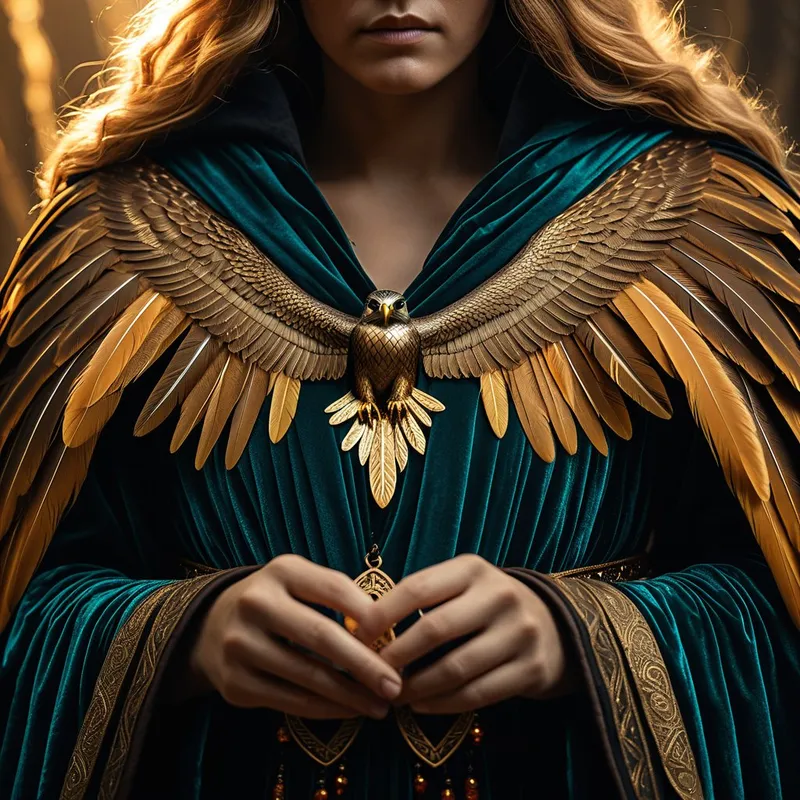
From a carved chest of oak, she draws it forth: the fjaðrhamr, the feather-cloak. It is not a garment of cloth, but of essence. Each feather is a pledge from the sky-hunters, a compact written in the silent language of flight. As she swings it over her shoulders, the air in her hall changes. The scent of hearth-fire and mead is replaced by the crisp, thin scent of high altitudes. The golden light of her home dims, replaced by the sharp, clear light that exists between cloud and sun.
The transformation is not a tearing, but a flowing. Her form, so profoundly of Midgard and Asgard, softens at the edges. Her keen eyes, already sharp with sight and foresight, become orbs of burning gold, seeing the thermal currents of the world’s breath. Her arms lengthen, folding into powerful wings. Her very consciousness shifts; the complex weave of love, grief, and strategy that is a goddess’s mind simplifies into a pure, razor-focused intent: find, seek, retrieve.
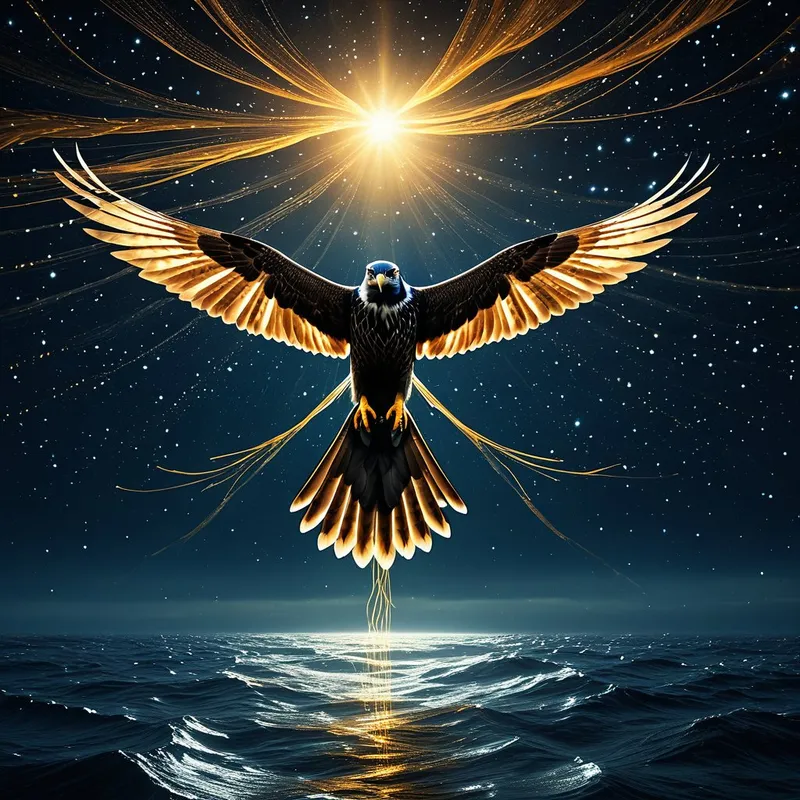
With a beat that sounds like a banner snapping in a gale, she is aloft. She leaves the gilded rooftops of the gods behind, piercing the veil of the sky. Below her, the great trunk of Yggdrasil falls away, its branches holding the nine worlds like fruit. She rides the winds over the misty forests of Jötunheimr, skirts the icy peaks where frost giants dwell, and dives into the shadowed valleys where secrets are kept. She is a golden streak against the twilight, a thought moving faster than speech, a feeling given wings. She is no longer just Freyja; she is the journey itself, the embodied will to cross impossible distances for what the heart demands. And when her quest is done—whether retrieving a lost treasure, spying on the giants for the Æsir, or seeking a whisper of her lost love—she returns. The feathers settle, the world’s solidity returns to her limbs, and she is Freyja once more, but changed, always changed, by the flight.
Cultural Origins & Context
This myth survives primarily within the Poetic Edda and the later Prose Edda. It was not a singular, canonical tale but a narrative motif woven into the larger tapestry of stories about the gods. The cloak, or fjaðrhamr, is a recurring magical item in Norse mythology, used by Freyja, the goddess Frigg, and even the trickster Loki.
Its telling would have occurred in the fire-lit halls of the Viking Age, a world where the boundaries between human, animal, and divine were permeable. The storyteller, a skald or elder, would use this tale not merely as entertainment but as a teaching about the nature of the gods and the possible reaches of the soul. Freyja, as a member of the Vanir, embodies a different kind of power than the warlike Æsir. Her power is one of connection, fertility, ecstasy, and—crucially—magic (Seiðr). The falcon cloak is the tool of that magic. In a culture that valued concepts like hamingja (familial luck or power) and fylgja (a follower spirit often in animal form), the idea of shape-shifting was a profound metaphor for the extension of one’s will and consciousness beyond the physical body. The myth functioned to illustrate Freyja’s unique sovereignty: her autonomy to move between realms and roles at will, answering to no one but her own immense desire.
Symbolic Architecture
At its core, the myth of the falcon cloak is a masterclass in symbolic shape-shifting. The cloak itself is the ultimate liminal object—a threshold between states of being. It does not destroy Freyja’s identity but temporarily transmutes it into another form perfectly suited for a specific task.
The cloak is not an escape from the self, but an extension of it; the soul trying on a different kind of perception to navigate a world that the everyday self cannot traverse.
The falcon is the perfect psychopomp for Freyja. It symbolizes piercing vision, the ability to see the larger pattern from a detached, elevated perspective. It represents swift, decisive action and freedom from earthly constraints. When Freyja dons the cloak, she is not running from her grief or desire; she is acting from it with supreme focus. The flight is the journey of the soul—the hugr—leaving the grounded body (hamr) behind to retrieve what is lost, to gain crucial intelligence, or to pursue a deep yearning. Psychologically, this represents the capacity for conscious introspection and the retrieval of lost or repressed parts of the psyche (what Jung might call soul retrieval). The cloak symbolizes the function of intuition in its purest form: a non-linear, soaring insight that bypasses rational obstacles.
The Dreamer’s Resonance
When this myth stirs in the modern dreamer, it often manifests as dreams of flight, of sudden transformation, or of discovering a magical garment. The somatic sensation is one of exhilarating weightlessness coupled with intense focus. To dream of finding or wearing such a cloak indicates a psychological process where the conscious ego is learning to access a broader, more intuitive perspective. The dreamer may be feeling trapped in a situation (the grief of Freyja) and the unconscious is presenting a tool for transcendence.
Conversely, dreams of losing the cloak, or of it being stolen (as happens in other myths), point to a fear of losing one’s connection to this intuitive, sovereign power. It may reflect a feeling of being grounded, stuck, or forced into a single, rigid identity. The flight in the dream is the psyche’s attempt to practice a necessary detachment—to rise above a complex emotional landscape to see the true shape of one’s life and desires. The dream is an invitation to identify one’s own “falcon cloak”: what practice, insight, or shift in consciousness allows you to see your life from a higher, more liberated vantage point?
Alchemical Translation
The alchemical process mirrored in this myth is that of sublimation: the transformation of a base, heavy emotion (like grief, longing, or frustration) into a vehicle for elevated consciousness and purposeful action. Freyja does not wallow; she volatilizes. Her tears become the fuel for her flight.
The individuation journey requires us to fashion our own fjaðrhamr—to take the raw feathers of our experiences, our pains, and our deepest yearnings, and weave them into a tool for traversing the inner worlds.
For the modern individual, the “cloak” represents the cultivated capacity for psychological shape-shifting. It is the ability to consciously step out of one’s habitual identity—the worried parent, the stressed professional, the wounded partner—and assume a different persona (in the Jungian sense) with a bird’s-eye view. This is the “magician” archetype in action: using symbolic tools (like meditation, active imagination, or creative work) to effect change in one’s inner reality. The flight over Yggdrasil is the journey of seeing one’s life as part of a vast, interconnected system. The return is integration; bringing back the intelligence, the retrieved “gold,” from that flight to enrich the grounded self. The ultimate triumph is not in staying aloft, but in mastering the transition—knowing when to be human, with all its vulnerable passions, and when to become the falcon, whose only law is the wind and the will to see what lies beyond the horizon.
Associated Symbols
Explore related symbols from the CaleaDream lexicon: