Freyja's Brísingamen Myth Meaning & Symbolism
The goddess Freyja acquires a dazzling necklace through a profound exchange, only to have it stolen, sparking a fiery quest that reveals the cost of power.
The Tale of Freyja's Brísingamen
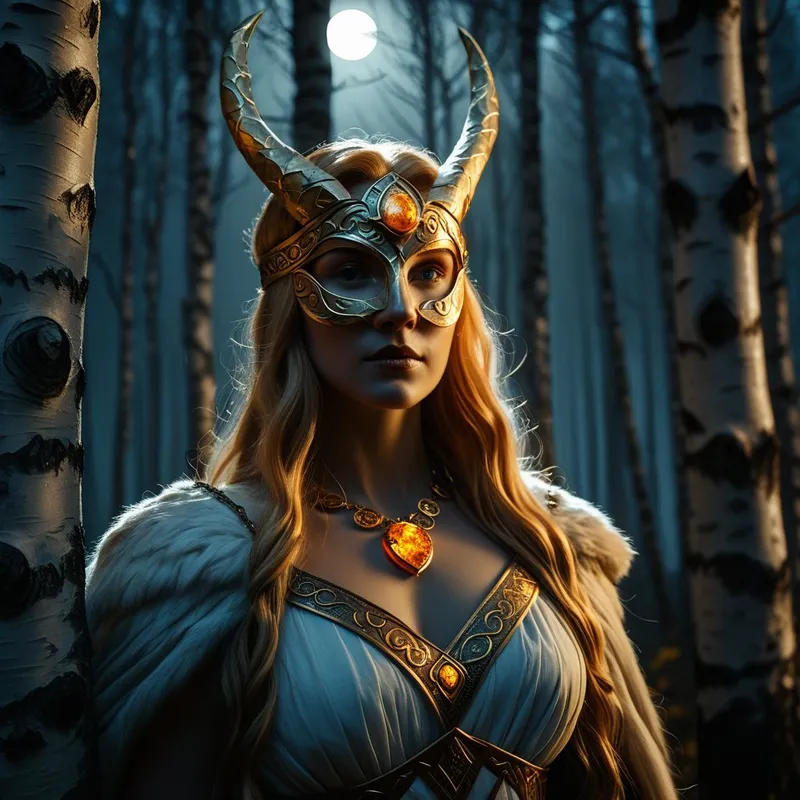
Listen, and hear a tale spun from moonlight and forge-fire, a story of the Lady of Fólkvangr. In the deep, dreaming heart of the world, where the roots of Yggdrasil drink from hidden wells, there lived Freyja. She was a sight to still the breath: hair like ripe wheat, eyes holding the summer sky and the winter storm in equal measure. Goddess of love’s ecstasy, of seidr magic’s whispers, and of the valiant dead. Yet, for all her sovereignty, a longing burned in her—a desire for a beauty not yet born into the world.
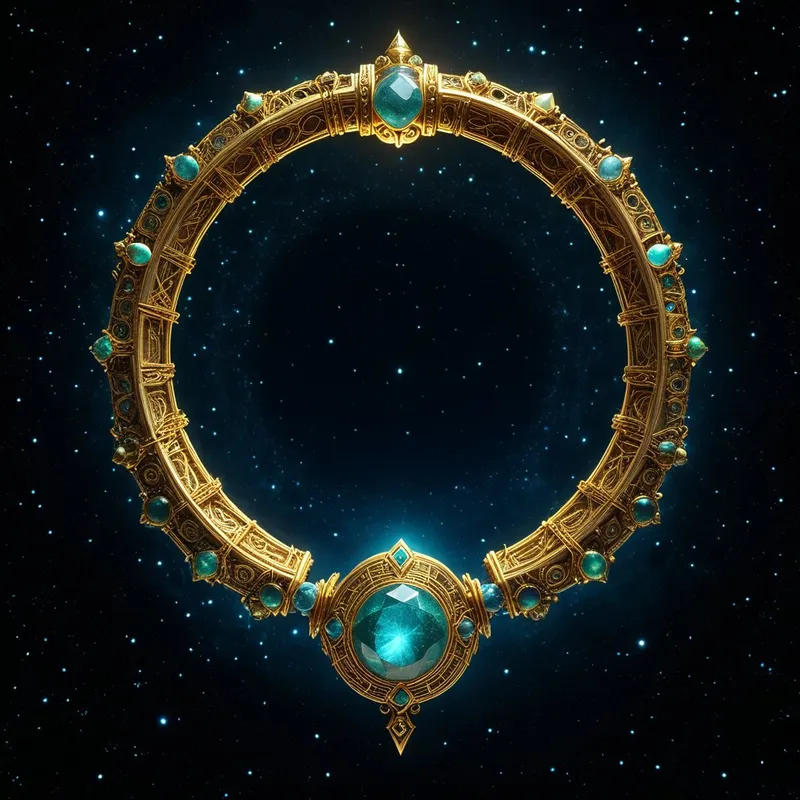
Her wanderings took her to a hidden cavern, its mouth breathing the heat of the earth. Within labored the Brísingar, four master-smiths whose hammers sang on anvils of star-iron. And there, upon a pedestal of black stone, it lay: the Brísingamen. It was not merely jewelry; it was a captured sunrise, a river of molten gold woven into a torc so perfect it seemed to hum with a life of its own. Amber like trapped honey, and gems that held the green of deep forests and the blue of glacial ice glinted within its coils. To see it was to want it, and Freyja’s want was a force of nature.
She offered gold from Odin’s hoards, lands from her own meadows. The dwarves merely shook their soot-streaked heads. Their price was not of metal or soil. Their price was her. A night with each of them, in turn, in their fire-lit forge. The air grew thick. This was a bargain that touched the very core of her being, a crossing of a threshold where value is measured not in coin, but in essence. Freyja, whose domain was the full spectrum of life’s fervor, did not hesitate. She stepped into the heat and the shadow, and for four nights, the goddess paid the dwarves’ price. When she emerged, the Brísingamen lay cool and heavy around her neck, a testament to a transaction of profound and ambiguous power. It became part of her, a second heart beating at her throat.
But in Asgard, eyes watched with envy and cunning. Loki, whose tongue was as sharp as his mind, saw the necklace and saw an opportunity. He went to Odin, lord of the gods, and whispered of Freyja’s bargain, painting it in shades of shame. Odin’s single eye gleamed. He commanded Loki to steal the necklace, to bring it to him.
So, when Freyja slept in her hall Sessrúmnir, her door sealed tight, Loki took the form of a fly. He buzzed and searched until he found a crack so slender it was almost a thought. Squeezing through, he came to her bedside. There, the Brísingamen rested, its glow painting her skin in soft gold. But the clasp was beneath her, and Freyja slept on her back. Loki the fly became Loki the whisper, shifting shape once more into a smaller, more desperate thing, to nudge and pry. With a click that echoed like a fateful decision, the clasp gave way. He snatched the treasure, a thief in the goddess’s own chamber, and fled into the night.
Freyja’s awakening was a silent cataclysm. The cold space at her throat told the story before her mind could grasp it. A fury, cold and pure, rose within her—a fury born of violation. She went to Odin, her gaze stripping pretense from the air. She knew the orchestrator. Odin did not deny it. The price for the Brísingamen’s return was not an apology, but another task: she must stir a war between two mighty kings, a conflict so great it would seed the earth with heroes for her hall and for Odin’s Valhalla. The cycle was complete. Desire led to acquisition, acquisition to theft, theft to a command that would unleash death. To reclaim what was hers, born of her own profound exchange, Freyja had to become the catalyst for divine destiny. She put on her cloak of falcon feathers, and with a heart holding both love and a terrible resolve, she flew to weave the threads of war.
Cultural Origins & Context
The myth of the Brísingamen survives primarily in the late medieval Icelandic texts, the Prose Edda of Snorri Sturluson and the Þrymskviða, though it is referenced fleetingly elsewhere. It is a myth that lived in the complex interstices of the Viking Age worldview, told by skalds and preserved by antiquarians. Its societal function was multifaceted.
In a culture that prized beautiful, well-wrought objects (like the intricate jewelry found in hoards), the story explained the divine origin of such splendor. More importantly, it engaged with deep societal tensions. Freyja is a deity of the Vanir, integrated into the Aesir pantheon after a great war. Her story often highlights the friction between these divine families and their values: her potent, independent sexuality and mastery of seidr (a magic sometimes viewed with suspicion by the warrior ethos) versus the more hierarchical, sovereignty-focused rule of Odin.
The myth was not a simple moral fable but a narrative crucible. It allowed the exploration of female agency, the nature of value and payment, and the ambiguous cost of possessing objects of immense power. It presented a goddess who operated outside passive archetypes—she was an active negotiator, a being of immense desire, and a force of vengeance and destiny. For its original audience, it reinforced the Norse understanding of the world: a place where beauty is inextricably linked to struggle, where even the gods are bound by cycles of desire, loss, and costly reclamation.
Symbolic Architecture
The Brísingamen is far more than a necklace. It is a symbolic nexus, a coniunctio oppositorum (union of opposites) forged in the underworld of the dwarven forge.
The treasure we most desire is always forged in the dark, and its price is always a piece of our wholeness.
First, it represents Feminine Sovereignty and Creative Power. It is not a gift or an inheritance; it is earned through a direct, embodied exchange. Freyja does not receive it through patronage or conquest, but through a personal, transformative engagement with the chthonic craftsmen (the dwarves), symbolic of the unconscious, instinctual forces of creation. The necklace becomes an externalized symbol of her integrated self—her sexuality, her magic, her worth.
Second, the myth dramatizes The Theft of Value. Loki’s theft is not merely of an object, but of the autonomy and power it represents. It is the exploitation or shaming of one’s deep creative acts by the trickster aspect of the psyche (or society), which seeks to control or commodify authentic expression. Odin’s role as the instigator underscores how structures of authority (the ruling consciousness) may conspire in this theft, demanding conformity.
Finally, it outlines The Cost of Reclamation. Freyja does not get her treasure back through simple retrieval. She must enact a profound, even destructive, transformation in the outer world (starting a war) to re-balance the scales. This speaks to the psychological truth that reclaiming a lost or stolen part of the self often requires us to engage with the world in a new, more powerful, and sometimes disruptive way. We must become warriors for our own wholeness.
The Dreamer's Resonance
When this myth stirs in the modern dreamer, it signals a profound engagement with the dynamics of personal value, creative power, and violation. To dream of a lost or stolen jewel of great beauty and significance often points to a felt experience of having one’s essence, creativity, or hard-won self-worth diminished, taken, or betrayed.
The somatic experience might be a tightness in the throat (the location of the necklace), a feeling of hollow vulnerability in the chest, or a hot, restless anger upon waking. Psychologically, the dreamer is processing a Loki moment in their life: an event, a criticism, or a systemic injustice that has made them feel their core value has been pilfered. This could relate to intellectual property stolen, credit not given, a relationship that exploited one’s generosity, or the inner critic shaming one’s authentic desires.
Conversely, dreaming of laboring in a forge to create something precious, or of making a difficult, ambiguous bargain for a beautiful object, indicates the active, often uncomfortable, process of building one’s Brísingamen. The dreamer is in the phase of paying the price for their wholeness, integrating shadowy or undervalued aspects of themselves (the dwarven crafts) to create something of authentic, sovereign value.
Alchemical Translation
The myth of the Brísingamen is a perfect map for the alchemical process of individuation—the journey toward psychological wholeness. It models the stages of psychic transmutation.
1. The Nigredo (Blackening) – The Descent and the Bargain: The journey begins with the recognition of a deep, burning lack or desire (Freyja’s longing). This pulls the psyche into its own underworld—the dwarven cave, symbolizing the unconscious. Here, the initial, often shocking, bargain is struck. The ego (Freyja) must consciously engage with the dark, instinctual, “unrefined” parts of the self (the dwarves). This engagement feels like a sacrifice, a “night” spent in unfamiliar, fiery territory. It is the dissolution of old structures to gain the raw material of the new self.
Individuation demands a descent. We must trade the comfort of the known self for the chaotic, creative fires where the true self is forged.
2. The Albedo (Whitening) – The Acquisition and The Theft: From the nigredo emerges a new formation: the Brísingamen, a symbol of integrated value. This is the albedo, a state of clarified, conscious possession of one’s power. But the process is never secure. The trickster-shadow (Loki), often in service to the rigid, ruling old king complex (Odin), will attempt to steal this hard-won treasure. Psychologically, this is the stage of self-sabotage, imposter syndrome, or external pressures that make us doubt our right to our own wholeness.
3. The Rubedo (Redening) – The Fiery Reclamation: The final stage is not passive recovery. It is the activation of the warrior. Freyja’s fury is not destructive rage, but focused, transformative energy. To get her necklace back, she must go out into the world and create a new reality (the war). In our lives, this translates to the courageous acts required to reclaim our power: setting boundaries, speaking truths, leaving stifling situations, or creating the work that fully expresses us. It is the psyche, having been stolen from, now engaging with the world from a place of fierce, reclaimed sovereignty. The gold of the Brísingamen, tested by theft and tempered by righteous action, becomes truly, unshakably ours.
Associated Symbols
Explore related symbols from the CaleaDream lexicon: