Freyja's Brisingamen Myth Meaning & Symbolism
The goddess Freyja pays a high price to four dwarves for a necklace of cosmic beauty, a tale of desire, sovereignty, and transformative power.
The Tale of Freyja’s Brisingamen
Listen. The tale begins not in the golden halls of the gods, but in the deep, humming dark beneath the roots of the [Yggdrasil](/myths/yggdrasil “Myth from Global/Universal culture.”/). It begins with a wanting.
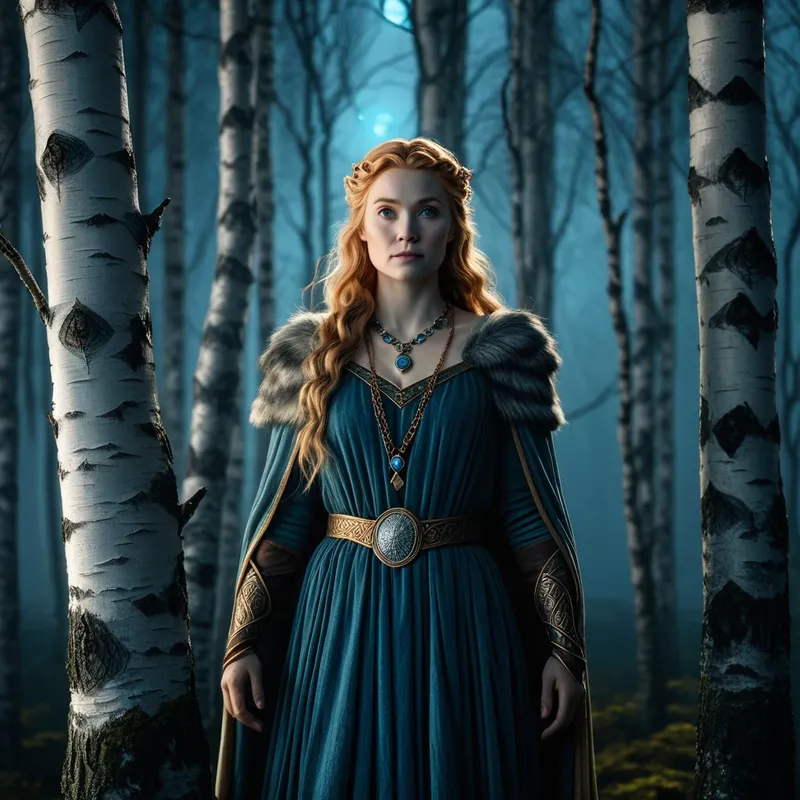
[Freyja](/myths/freyja “Myth from Norse culture.”/) of the Vanir, she who takes half the slain, she who rides in a chariot drawn by cats, felt a hunger. It was not for mead, nor for battle-glory, nor even for the love of her absent husband Óðr. It was a longing for a beauty so absolute it would be a power unto itself. A whisper came to her, carried on the breath of the rock and the sigh of the deep-earth rivers: [the dwarves](/myths/the-dwarves “Myth from Norse culture.”/) of [Muspelheim](/myths/muspelheim “Myth from Norse culture.”/)‘s shadow had crafted a wonder.
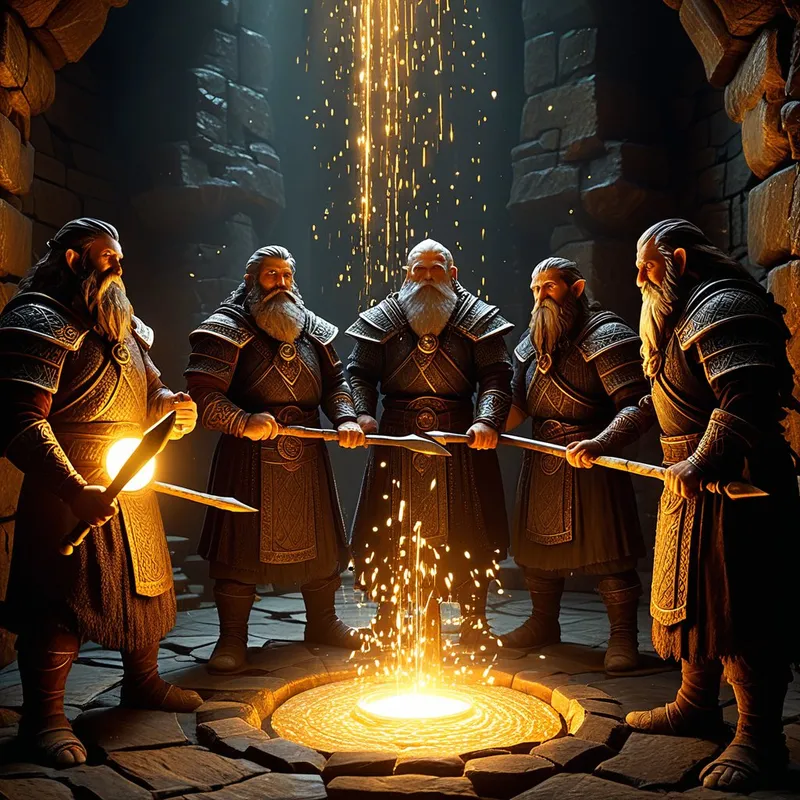
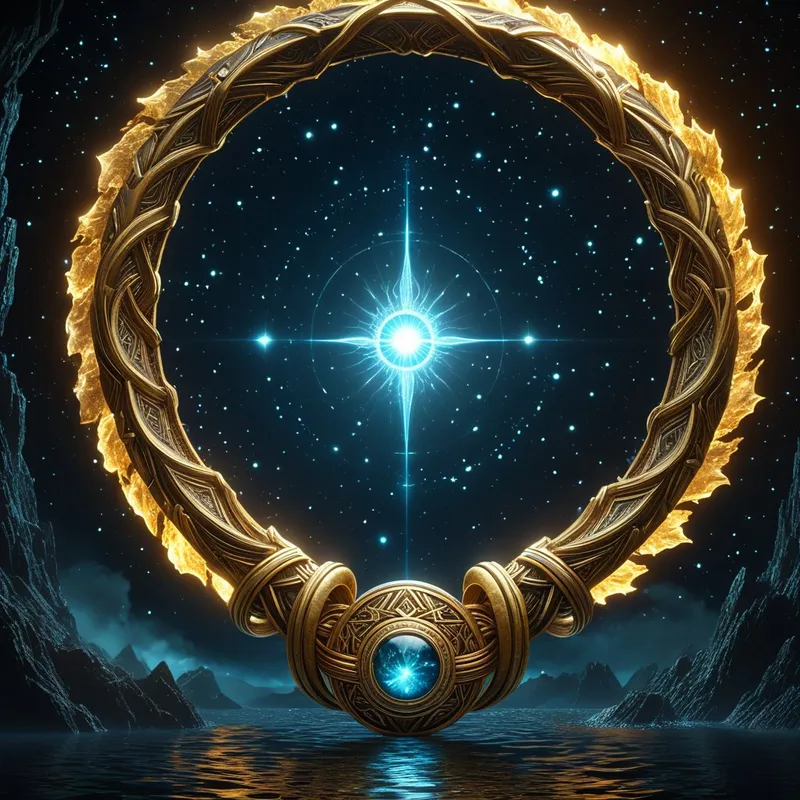
She went alone, leaving behind her falcon-feather cloak for a journey not of flight, but of descent. She found their forge in a cavern lit by the heart of [the world](/myths/the-world “Myth from Tarot culture.”/), where four masters of craft—Alfrigg, Dvalin, Berling, and Grer—stood before their creation. The Brisingamen lay on an anvil of black iron. It was not merely gold; it was captured sunlight, woven starlight, the essence of amber and flame given form. Its gleam filled the cavern with a warmth that had nothing to do with fire.
They saw her desire, sharp and clear as a spear-point. “Lady of [Fólkvangr](/myths/flkvangr “Myth from Norse culture.”/),” they said, their voices like grinding stones. “This work is beyond price. No gold of Asgard can buy it.” They named their price. Not gold, not silver. A night. Each. With her.
The air in the cavern grew still. Here was the crux: the goddess of sovereignty faced with a barter for her own. To possess the ultimate symbol of beauty and power, she must give of her very self, on terms not her own. She looked at the necklace, a circle of perfected desire. She looked at the dwarves, the makers from the dark. And Freyja, who is both lover and warrior, did not hesitate. She paid the price. Four nights in the smithy’s heat, and the Brisingamen was hers.
But a possession so won is never truly secure. Loki, the weaver of troubles, saw the new fire at her throat and burned with envy. He went to Odin, spinning tales of how the goddess had brought disgrace upon the gods for a bauble. Odin, ever the strategist, commanded Loki to steal it back, to prove her vulnerability.
So, when Freyja slept in her sealed hall Sessrúmnir, Loki transformed into a fly, finding a crack so small it was almost not there. He buzzed to her bedside, saw the Brisingamen clasped tight against her throat, and transformed again—into a flea. He bit her pale flesh. She stirred, turned in her sleep, and the clasp was exposed. In an instant, Loki was himself, undid the clasp, and fled with the prize.
Freyja awoke to a coldness at her throat, a void where power had hummed. Her rage shook the pillars of her hall. She went to Odin, her eyes blazing with a light that promised war. Odin laid out his terms: he would return the Brisingamen if she performed a service—to stir a war between two mighty kings, using her magic to ensure the battle raged eternally, so that the slain would forever feed the halls of the gods. A cycle of strife, to pay for a cycle of desire. And so it was done. The necklace returned to its place, but now it carried the weight of a double bargain: one with the dark of [the earth](/myths/the-earth “Myth from Hindu culture.”/), and one with the politics of heaven.
Cultural Origins & Context
The myth of the Brisingamen survives primarily in two later medieval Icelandic texts: the Þiðreks saga and, more notably, the Flateyjarbók. It is a story that feels older, rooted in the pre-Christian worldview of the Norse and wider Germanic peoples. It was not a tale for the public þing, but likely one shared in halls, a complex narrative exploring the ambiguities of divine figures.
Freyja herself is a deity of potent contradictions: Vanir, not Æsir; goddess of fertility and death; practitioner of seiðr, a magic that could blur the lines of gender and propriety. Her mythos is one of immense personal power and profound personal cost. The Brisingamen story functions as a key to understanding her nature. It reveals a cosmology where even the gods are not omnipotent but are subject to desire, negotiation, and consequence. The myth served as an explanation for the goddess’s potent, sometimes troubling, allure and her deep connection to both the earthly (the dwarves) and the martial (Odin’s war-demand). It taught that power—be it magical, sexual, or social—is always transactional, and that the most beautiful treasures often have the darkest origins.
Symbolic Architecture
The Brisingamen is far more than [jewelry](/symbols/jewelry “Symbol: Jewelry often symbolizes personal identity, social status, and emotional connections, reflecting how individuals curate their identities and express their values through adornments.”/). It is a symbolic nexus of immense psychological [depth](/symbols/depth “Symbol: Represents profound layers of consciousness, hidden truths, or the unknown aspects of existence, often symbolizing introspection and existential exploration.”/).
The treasure we most desire always demands a payment from a part of ourselves we would rather keep hidden.
First, it is a [symbol](/symbols/symbol “Symbol: A symbol can represent an idea, concept, or belief, serving as a powerful tool for communication and understanding.”/) of wholeness and the integrated self. Forged by four dwarves, it echoes [the four elements](/myths/the-four-elements “Myth from Greek culture.”/), the four directions, the process of uniting disparate parts into a perfected whole. Freyja’s desire for it is the [soul](/symbols/soul “Symbol: The soul represents the essence of a person, encompassing their spirit, identity, and connection to the universe.”/)‘s yearning for completeness. Yet, this wholeness cannot be bought with the [currency](/symbols/currency “Symbol: Currency represents value exchange, personal worth, and societal power dynamics. It symbolizes resources, control, and the abstract systems governing human interaction.”/) of the [daytime](/symbols/daytime “Symbol: Daytime often symbolizes clarity, awareness, and the active aspects of life, contrasting with night, which represents the unconscious.”/) ego (gold). It requires a descent into the “subterranean” [realm](/symbols/realm “Symbol: The symbol of ‘Realm’ often signifies the boundaries of one’s consciousness, experiences, or emotional states, suggesting aspects of reality that are either explored or ignored.”/) of the unconscious, represented by the dwarves—the master craftsmen of the deep [psyche](/myths/psyche “Myth from Greek culture.”/), our instincts, complexes, and latent potentials.
The price—a [night](/symbols/night “Symbol: Night often symbolizes the unconscious, mystery, and the unknown, representing the realm of dreams and intuition.”/) with each—is the crux. This is not merely a sexual [transaction](/symbols/transaction “Symbol: An exchange of value, energy, or information between parties, representing balance, reciprocity, and the flow of resources in life.”/), but a profound symbolic act of conjoining with the [shadow](/symbols/shadow “Symbol: The ‘shadow’ embodies the unconscious, repressed aspects of the self and often represents fears or hidden emotions.”/). To gain the integrated self (the [necklace](/symbols/necklace “Symbol: A necklace signifies personal identity, the connections we maintain, and the adornment of the self.”/)), the conscious [personality](/symbols/personality “Symbol: Personality in dreams often symbolizes the traits and characteristics of the dreamer, reflecting how they perceive themselves and how they believe they are perceived by others.”/) (Freyja) must engage with, and temporarily yield to, the autonomous, often “unacceptable” powers of the unconscious. It is an act of psychological courage, a willing immersion in the dark to bring forth light.
Loki’s theft represents the inevitable [crisis](/symbols/crisis “Symbol: A crisis symbolizes turmoil, urgent challenges, and the need for immediate resolution or change.”/) of [integration](/symbols/integration “Symbol: The process of unifying disparate parts of the self or experience into a cohesive whole, often representing psychological wholeness or resolution of internal conflict.”/). Any hard-won wholeness is perpetually threatened by the “[trickster](/symbols/trickster “Symbol: A boundary-crossing archetype representing chaos, transformation, and the subversion of norms through cunning and humor.”/)” [aspect](/symbols/aspect “Symbol: A distinct feature, quality, or perspective of something, often representing a partial view of a larger whole.”/) of the psyche—self-sabotage, doubt, envy, or the [judgmental voice](/symbols/judgmental-voice “Symbol: A disembodied voice in dreams that critiques, condemns, or evaluates the dreamer, often representing internalized moral standards or external spiritual authority.”/) of the inner [authority](/symbols/authority “Symbol: A symbol representing power structures, rules, and control, often reflecting one’s relationship with societal or personal governance.”/) (Odin). The final [condition](/symbols/condition “Symbol: Condition reflects the state of being, often focusing on physical, emotional, or situational aspects of life.”/), to perpetuate war, is chilling. It suggests that integrated power, once achieved, must be actively engaged with the world. It creates consequence, stirs conflict, and feeds the cycles of [life](/symbols/life “Symbol: The symbol of ‘Life’ represents a journey of growth, interconnectedness, and existential meaning, encompassing both the joys and challenges that define human experience.”/) and [death](/symbols/death “Symbol: Symbolizes transformation, endings, and new beginnings; often associated with fear of the unknown.”/). There is no passive ownership of [the self](/myths/the-self “Myth from Jungian culture.”/).
The Dreamer’s Resonance
When this myth stirs in modern dreams, the dreamer is at a pivotal point of individuation—the process of becoming psychologically whole. You may not dream of Freyja or dwarves directly, but the archetypal pattern will manifest.
Dreaming of coveting a breathtaking but unattainable object—a jewel, a key, a book—points directly to the Brisingamen longing. The object symbolizes a potential within yourself you feel is just out of reach: creative power, self-love, authentic expression. Dreams of making a fraught bargain or payment in a dark, enclosed space (a basement, a cave, a back room) mirror Freyja’s negotiation. This is the psyche negotiating with its own shadowy aspects.
The theft of a precious personal item, especially from a place of rest, is the Loki-theft. It signifies a feeling that a hard-earned personal truth, confidence, or relationship is being undermined, often by a part of yourself you disown (the inner critic, an old wound). Finally, dreams where you are tasked with an impossible or morally ambiguous chore to reclaim something lost reflect Odin’s demand. The psyche is stating that reclaiming your wholeness will require you to engage with the difficult, cyclical “wars” of your outer life in a new, more conscious way.
Alchemical Translation
The myth of the Brisingamen is a perfect map for the alchemical process of psychic transmutation, the opus of turning base metal into gold.
The forge of transformation is not in the bright sky of ideals, but in the dark earth of our unmet desires and un-faced shadows.
1. The [Nigredo](/myths/nigredo “Myth from Alchemical culture.”/) (Descent & Blackening): Freyja’s journey to the dwarven forge is the initial descent. In our lives, this is the crisis, the depression, the burning desire that forces us to look inward, away from the [persona](/myths/persona “Myth from Greek culture.”/) we show the world. It is the acknowledgment of a lack, a “blackening” of our old, complacent self.
2. [The Conjunction](/myths/the-conjunction “Myth from Alchemical culture.”/): The four nights with the dwarves represent the hieros gamos, [the sacred marriage](/myths/the-sacred-marriage “Myth from Various culture.”/) of conscious and unconscious. This is the most dangerous and crucial phase. We must consciously engage with what repels or frightens us—our anger, our grief, our “unacceptable” passions or vulnerabilities. We do not fight these dwarves; we sit with them in their forge. This engagement is the payment.
3. The Acquisition & Theft (Albedo & Citrinitas): Gaining the necklace is the albedo (whitening), a glimpse of purified, integrated self. But Loki’s theft is the citrinitas (yellowing), the trial by fire. Every insight is tested. The newly formed ego-Self axis is challenged by old patterns ([the trickster](/myths/the-trickster “Myth from Various culture.”/)) and super-ego demands (the Odin-figure). We “lose” the feeling of wholeness almost as soon as we find it.
4. The Return & Red Work ([Rubedo](/myths/rubedo “Myth from Alchemical culture.”/)): Odin’s demand—to stir eternal war—is the final stage, the rubedo (reddening). This is not a return to the old self, but a return to the world with the newly forged gold. The integrated self must now be lived. It must engage with the eternal conflicts of life—relationship, work, creativity, mortality—but now from a place of sovereignty and conscious choice, like Freyja directing the battle. The wholeness is no longer a static possession, but a dynamic process of continual creation and engagement. The Brisingamen, once a desired object, becomes the symbol of an active, costly, and glorious sovereignty over one’s entire being.
Associated Symbols
Explore related symbols from the CaleaDream lexicon: