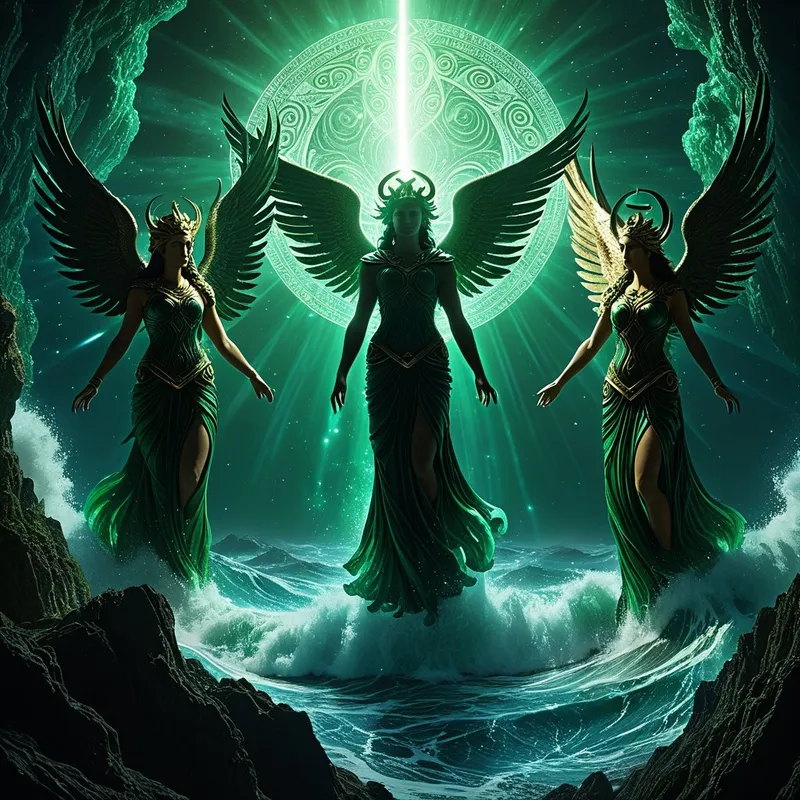
Four Elements Myth Meaning & Symbolism
The primordial story of Earth, Water, Air, and Fire, born from Chaos, forming the cosmos and the blueprint of the human soul.
The Tale of Four Elements
In the beginning, there was no beginning. There was no earth to stand upon, no sea to sail, no air to breathe, no fire to warm. There was only Chaos—a yawning, silent, formless abyss, a gaping maw of infinite potential and utter absence. It was not darkness, for there was no light to define it. It was not emptiness, for it was pregnant with everything that was not yet.
And from this great womb of nothing, the first things stirred. Not by will, but by necessity. Not by design, but by the sheer pressure of being.
First came Gaia, the broad-breasted one. She did not rise; she simply was, solid and vast, a foundation in the void. Her body was the first truth: firm, enduring, the mother of all that would have roots and weight. From her own deep flesh, without consort, she bore Uranus, to be her equal and cover her completely. She bore the tall mountains, where the mist clings, and Pontus, the sterile, deep-swelling sea, whose salt was her first tears.
But Chaos was not done. From its depths came other children, stark and fundamental. Tartarus came, a dank pit as far below Gaia as the sky was above, a place of future shadows. And then, most vital of all, came Eros. He was not the playful cherub of later tales, but a blinding, shapeless force—the golden pull of attraction, the ache that draws things together. With Eros pulsing through the void, the elements could no longer ignore one another.
The Sky, Uranus, rained upon the Earth, Gaia, and from that union sprang the first races: the Titans, the Cyclopes with their thunderous power, and the monstrous Hecatoncheires. But Uranus, horrified by his offspring, imprisoned them deep within Gaia, causing her immense pain. Her soil groaned; her mountains trembled. In her anguish, she forged a great adamantine sickle and conspired with her youngest Titan son, Cronus.
When Uranus descended to lie with Gaia, Cronus emerged from hiding and with one swift, terrible stroke, severed his father from the sky. The blood that fell upon Gaia bred the Erinyes, the Giants, and the Meliai nymphs. But from the foam that gathered around the severed flesh, cast upon the waves of Pontus, arose Aphrodite, a new synthesis of elemental forces—born of the Sky's seed and the Sea's water, propelled by Eros's primal law.
Thus the stage was set: Earth, Sky, Sea, and the binding force of Love. The raw, warring family of elements, born from Chaos and defined by conflict, now held the seeds of all order, life, and strife to come. The world was no longer a void, but a living, breathing, feeling body—a house divided, yet whole.
Cultural Origins & Context
This elemental cosmogony is not a single myth told around a campfire, but the foundational bedrock of Greek thought, primarily articulated in Hesiod's Theogony (c. 700 BCE). Hesiod, a poet-farmer, claimed the Muses themselves breathed this story into him. His work was a sacred text, a "song of origins" performed at religious festivals, serving to explain the world's nature and justify the divine order, the reign of Zeus.
The schema of four primary roots—Earth, Water, Air (implied in the void/Chaos and Sky), and Fire (implied in the lightning of the Cyclopes and the radiance of Eros)—was later formalized by pre-Socratic philosophers like Empedocles. For the Greeks, this was not mere metaphor but literal physics and theology intertwined. The myth provided a narrative container for observing natural forces: the solidity of land, the fluidity of water, the breath of wind and spirit, the transformative power of flame. It explained stability and change, conflict and harmony, as family drama among the very fabric of reality.
Symbolic Architecture
The myth presents a profound map of psychic emergence. Chaos represents the unformed, potential-laden state of the unconscious before the ego's birth.
The journey from Chaos to Cosmos is the fundamental act of consciousness: to differentiate, to name, to bring form to the formless.
Gaia symbolizes the foundational Self, the somatic and psychological ground of being—the body, the instincts, the undeniable reality of existence. Uranus represents the spirit, the higher mind, and the ordering principle that seeks to structure and comprehend. Their violent separation by Cronus is a necessary, if traumatic, act of differentiation. The ego (Cronus) must sever the unconscious identification between the earthly self and the overwhelming "sky-father" of parental complexes or inherited patterns to begin its own rule.
Eros is the libido, the psychic energy that drives all connection, creativity, and ultimately, transformation. He is the force that makes relationship—and thus, psychology—possible.
The Dreamer's Resonance
When this elemental myth stirs in modern dreams, it signals a process of foundational psychic reorganization. Dreaming of vast, empty voids (Chaos) may precede a major life transition, a feeling of dissolution before a new identity forms. Dreams of earthquakes or splitting land (Gaia's pain) often correlate with somatic symptoms or deep anxiety about one's stability and support.
A dream of a severed connection to the sky or a falling star (the castration of Uranus) can indicate the painful but necessary deconstruction of old ideals, beliefs, or authority structures. Conversely, dreams of emerging from water, especially with a sense of beauty or awe (the birth of Aphrodite), point to the synthesis of opposing forces within the psyche, birthing a new capacity for relatedness, creativity, or self-love. The dreamer is not just having a dream; they are participating in the ongoing cosmogony of their own soul.
Alchemical Translation
The individuation process mirrors this elemental drama. We begin in the massa confusa of our unconscious, undifferentiated lives (Chaos). The first step is the emergence of the earthly ego, a sense of "I am" that is solid yet isolated (Gaia).
The goal is not to return to Chaos, but to consciously hold the tension of the elements within, allowing Eros to forge a new, more complex unity.
We then encounter the "sky" of our aspirations, spiritual yearnings, and internalized parental commands (Uranus). A necessary crisis (the Cronus act) occurs: we must critically examine and often cut ourselves off from these imposed structures to claim our own authority. This is a violent, guilt-inducing internal act that creates shadows (the Erinyes).
The alchemical work is to gather the scattered, warring elements—the stability of Earth, the fluidity of Water (emotion), the intellect of Air, the passion of Fire—within the vessel of the self. This is guided by Eros, the directed energy of the psyche toward wholeness. The final stage is not a static balance, but the birth of the "divine child" of the Self—symbolized by Aphrodite rising from the sea. She is the transcendent function, a new attitude born from the conscious union of opposites (sky and sea, spirit and matter, conflict and attraction), embodying beauty, connection, and the creative love that now governs the inner cosmos. We become, at last, the conscious creators of our own world.
Associated Symbols
Explore related symbols from the CaleaDream lexicon: