Four Classical Elements Myth Meaning & Symbolism
A foundational myth of cosmic order, where primordial chaos is divided into the four essential substances that compose reality and the human soul.
The Tale of Four Classical Elements
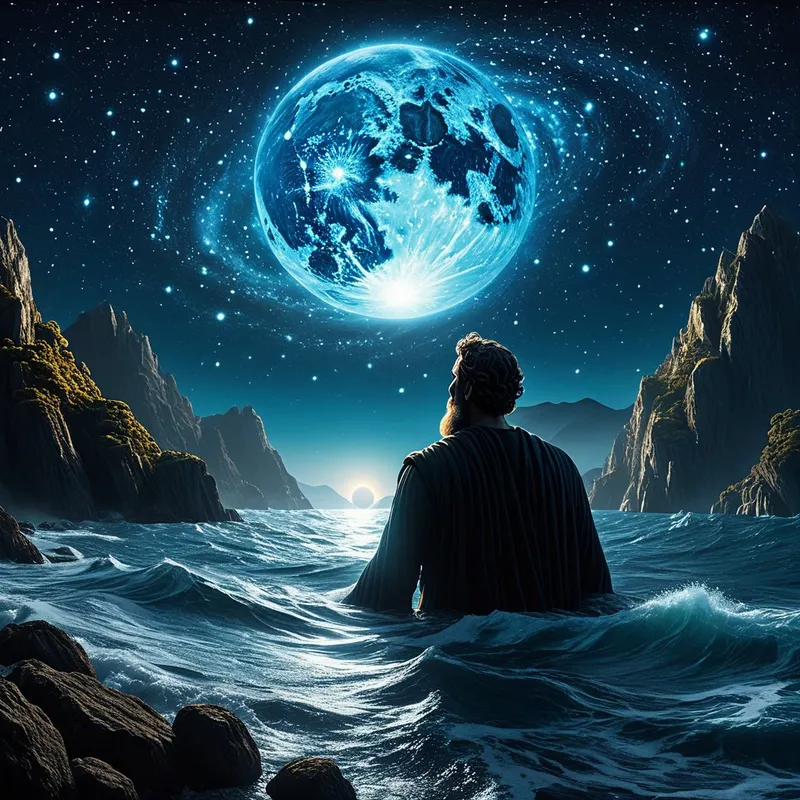
Before time had a name, there was only the Chaos—a yawning, silent abyss of potential, without shape or substance. From this womb of nothingness, the first beings emerged not as gods, but as principles. Gaia, the wide-bosomed Earth, solidified from the tumult, becoming the unshakable foundation of all that would be. From her depths welled Eros, the force of attraction that would set all things in motion, and gloomy Erebos with his sister Nyx.
But the world was still formless, a single, undifferentiated mass. Gaia, longing for order, gave birth to Ouranos, the starry Sky. He arched over her completely, a perfect, oppressive dome, and they lay together in a continuous embrace. From this union were born the Titans, monstrous and mighty, and other beings—but the world remained a fused, stagnant whole. Ouranos, fearing his children, would not allow them to be born, forcing them back into Gaia’s dark womb.
The pain within Gaia became a pressure, a creative rage. From her deepest flint, she forged a great adamantine sickle. She presented it to her youngest Titan son, Kronos, and whispered a plan born of desperation. When Ouranos next descended to envelop Gaia, Kronos emerged from hiding. With a single, terrible sweep of the curved blade, he severed Sky from Earth.
That cleaving was the first and greatest act of differentiation. As Ouranos recoiled upwards, howling, to become the distant firmament, the raw stuff of creation was spilled and separated. What was heavy and enduring sank, becoming the bones of Gaia—the mountains, the plains, the unyielding stone: this was the principle of Earth. What was fluid and seeking pooled in the hollows, becoming the rivers, the seas, the nourishing springs: this was the essence of Water. What was light and insubstantial rushed upwards, becoming the breezes, the storms, the breath of life: this was the substance of Air. And from the fiery spark of the act itself, from the passion of Gaia’s wrath and the flash of the adamantine blade, leapt the untamed, transforming power of Fire.
The cosmos breathed its first breath. The four brothers—solid Earth, flowing Water, gaseous Air, and radiant Fire—were now distinct, yet forever intertwined. They were not yet gods with thrones, but the fundamental states of being, the alphabet with which the universe would write all stories, from the flight of an eagle to the beat of a human heart.
Cultural Origins & Context
This is not a single myth told by one bard, but a foundational cosmology that permeated ancient Greek thought. It is the philosophical and poetic synthesis of earlier, fragmented creation stories, most notably from Hesiod’s Theogony (c. 700 BCE). Here, the separation of Gaia and Ouranos is the primal act that allows for the possibility of a structured world.
The theory of the Four Classical Elements as philosophical principles was later formalized not by poets, but by pre-Socratic philosophers like Empedocles of Acragas (c. 494–434 BCE). In his poem On Nature, he identified Earth, Water, Air, and Fire as the four rhizomata (“roots”) of all things, united by Love (Philia) and separated by Strife (Neikos). This framework was then adopted and expanded by Plato in the Timaeus and by Aristotle, who assigned each element fundamental qualities (hot/cold, wet/dry), cementing their place as the bedrock of Western science and medicine for nearly two millennia.
Its societal function was immense. It was a map of reality, explaining everything from the weather (the interplay of hot/dry Air and cold/wet Water) to human health (the balance of the four bodily humors) to the nature of the soul itself. It provided a coherent, elegant system for understanding a complex and often chaotic world.
Symbolic Architecture
The myth is a master narrative of consciousness itself. The undifferentiated embrace of Gaia and Ouranos represents the primal, unconscious unity—a state of potential with no distinction, no conflict, and no possibility for individual life. It is the womb, but one that has become a prison.
The birth of the individual psyche requires a sacred severance, a necessary violence that differentiates self from other, idea from instinct, order from chaos.
The act of Kronos is that necessary, traumatic cut. It is the moment of analysis, of naming, of bringing things into the light of awareness. Each element symbolizes a fundamental mode of being and perceiving:
- Earth is the principle of solidity, sensation, and stability. It is the body, the material world, foundation, and inertia.
- Water is the principle of emotion, intuition, and flow. It is the unconscious, the realm of feeling, memory, and psychic depth.
- Air is the principle of intellect, thought, and communication. It is the mind, abstraction, spirit, and the breath of life.
- Fire is the principle of energy, will, and transformation. It is passion, drive, the spark of consciousness, and the power to consume and purify.
Together, they form the complete human experience: we are grounded bodies (Earth), flowing feelings (Water), thinking minds (Air), and driven wills (Fire). The myth tells us that wholeness is not a return to undifferentiated chaos, but the conscious integration and balancing of these four sovereign realms within us.
The Dreamer’s Resonance
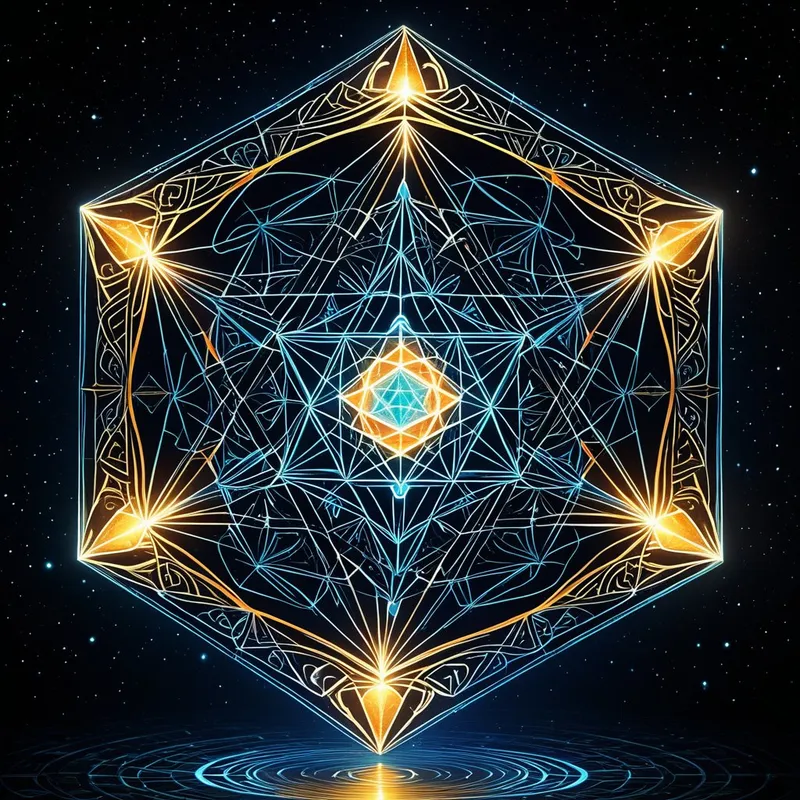
When this myth stirs in the modern unconscious, it often manifests in dreams of elemental imbalance or fusion. To dream of being trapped in hardening clay or sinking earth speaks to a psyche feeling burdened, stagnant, or overly identified with material concerns (Earth dominant, Water/Air/Fire suppressed). Dreams of drowning or tidal waves signal emotions overwhelming the conscious mind (Water flooding Air).
A potent modern dream is of a house—the classic symbol of the self—with one element run amok: a basement flooded, a room filled with suffocating smoke, walls cracking from dry heat, or foundations turning to mud. This is the psyche’s somatic report on its internal ecosystem. The dreamwork is to identify which element is in excess and which is lacking. Is there too much fiery anger scorching your emotional connections (Water)? Is too much airy analysis leaving you ungrounded (Earth)? The dream calls for a re-balancing, a re-negotiation of the primordial treaty between these inner Titans.
Alchemical Translation
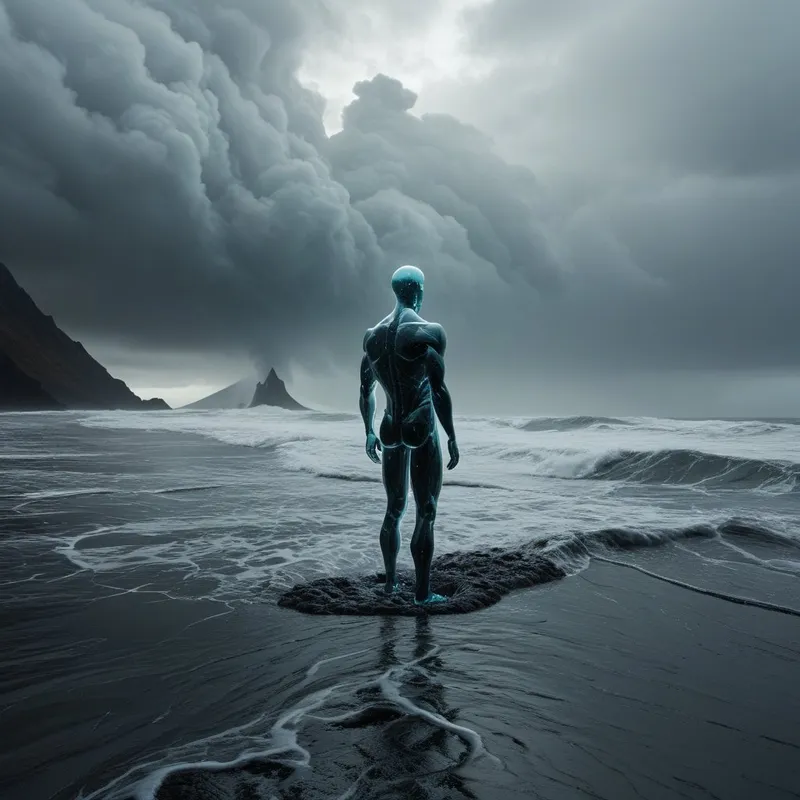
The individuation process, the journey toward psychological wholeness, is the modern alchemy of the four elements. We begin in a state of inner chaos or one-sidedness—perhaps a person who is all Air (intellectual) and Fire (ambition), but cut off from the grounding of Earth (body) and the depth of Water (feeling).
The alchemical opus is not to destroy any element, but to transmute each through contact with its opposites, forging a fifth essence—the Quintessence—which is the integrated Self.
The work is cyclical. First, we must separate (separatio), like Kronos’s sickle, bringing our unconscious components (our earthy habits, our watery moods, our airy thoughts, our fiery impulses) into conscious distinction. This is often painful, a cutting away of old, fused identities.
Then comes conjunction (coniunctio). We consciously bring Earth into dialogue with Air (embodying our ideas), Water with Fire (tempering passion with compassion, fueling action with feeling). We learn that solid Earth needs Air’s breath to avoid becoming a tomb, that flowing Water needs Fire’s heat to avoid stagnation, that Airy thought needs Earth’s gravity to become wisdom, and that Fire needs Water’s vessel to become purposeful warmth, not destruction.
The triumph of the myth is not the victory of one element, but the establishment of a dynamic, creative tension between all four. The mature soul is not a bland homogeneity, but a cosmos in miniature—a stable, living system where mountain, ocean, atmosphere, and sun exist in perpetual, generative conversation. We become, at last, the conscious stewards of the primordial world that was born from a single, necessary wound.
Associated Symbols
Explore related symbols from the CaleaDream lexicon: