Foundation Deposits Myth Meaning & Symbolism
A myth of sacred objects buried beneath temples, binding human ambition to divine memory and ensuring cosmic order through ritualized forgetting.
The Tale of Foundation Deposits
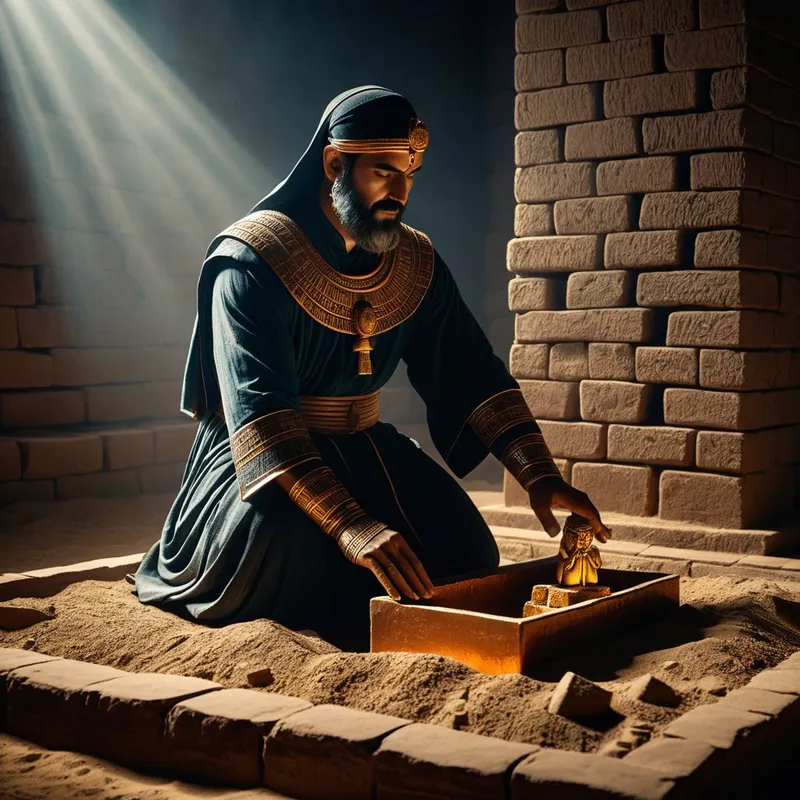
Listen, and hear the story not of a hero who walks, but of a king who kneels. The sun is a hammer on the plain of Shinar, baking the mud bricks of a city yet unborn. The air shimmers with dust and ambition. In the cleared heart of the city, a rectangle has been cut into the flesh of the earth—a foundation trench, deep and dark, smelling of damp clay and ancient silence.
Here stands the Lugal, the “Big Man.” He is not clad for war, but for a quieter, more profound battle. His robes are heavy, his brow furrowed not with anger, but with the weight of a covenant. Around him, the murmurs of priests and the scent of cedar incense rise. This is the moment before the first brick of the new temple, the Ziggurat, is laid. But a temple is not just stone; it is a prayer made solid. And a prayer must have roots.
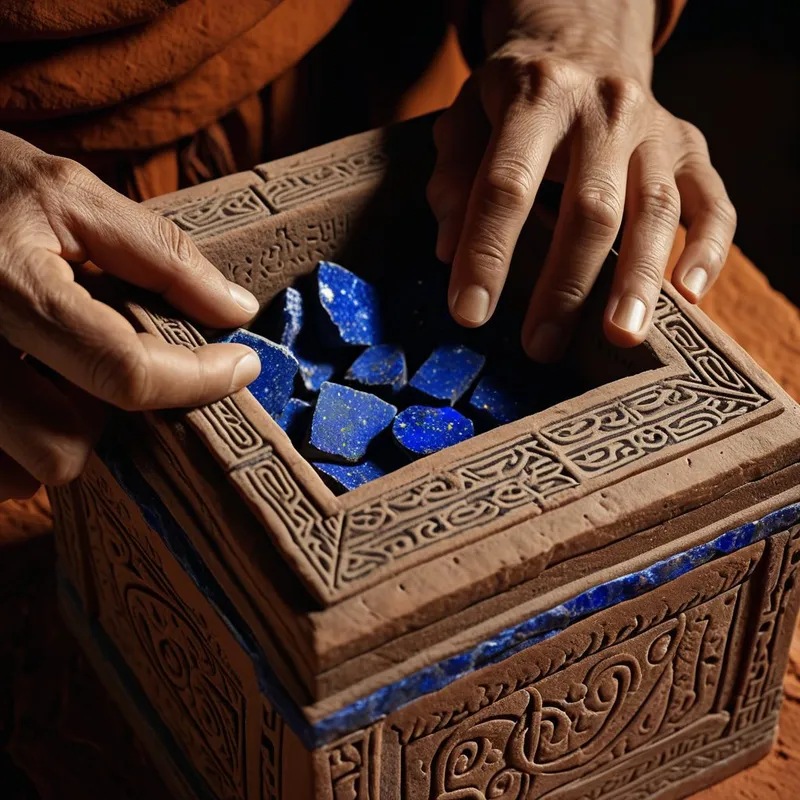
A priest hands him a small box of baked clay. Inside, resting on a bed of clean sand, are the sacred deposits: a figurine of the god Nanna, cast in precious copper, its eyes wide in eternal witness. Beside it lies a tablet of fine clay, inscribed with the king’s name and his purpose: “For Nanna, my lord, I built his temple.” There are also a few grains of gold, a lapis lazuli bead—tokens of the earth’s wealth returned to the earth.
The king descends into the trench. The world of light and sound shrinks to a square of sky above. The coolness of the deep ground embraces him. This is not the underworld of Ereshkigal, but a different kind of deep—the foundational darkness from which order springs. With ritual precision, he places the clay box into a specially prepared niche in the trench wall. His hands, which command armies and decree laws, now perform this delicate, hidden act.
He covers the box with a brick, sealing the covenant. Then, he pours a libation of sweet oil over the spot, anointing the darkness. The oil seeps into the earth, a fragrant promise. As he climbs out, the first course of bricks is laid directly over that sacred spot. The temple begins to rise, its very weight a seal, its soaring height a consequence of that which is buried and forgotten. The gods have been given a seat in the darkness so that their presence might dwell in the light. The memory of the act is entrusted to the earth itself, so that the work above may endure.
Cultural Origins & Context
This was not a single myth told in epic verse, but a pervasive ritual practice spanning millennia across Sumerian, Akkadian, Babylonian, and Assyrian cultures. The “myth” is embedded in the action itself, recorded on the very tablets buried and on commemorative cylinders and foundation stones. It was performed by every king who sought to legitimize his rule and ensure the favor of the gods through monumental construction—of temples, palaces, and city walls.
The story was passed down not by bards, but by scribes and priests, through ritual manuals and royal inscriptions. Its societal function was multifaceted: it was a act of cosmic anchoring, tying human architecture to divine approval; a legal and historical document, proving the king’s pious labor; and a magical act, using symbolic objects to transfer protective power into the building’s very bones. It transformed construction from a mere engineering feat into a cosmological event, a re-enactment of the ordering of chaos.
Symbolic Architecture
The Foundation Deposit is a profound symbol of the necessary relationship between the hidden and the manifest, the forgotten and the remembered, the sacrifice and the structure.
To build a lasting edifice in the world, one must first make an offering to the world below. The visible glory is forever mortgaged to an invisible debt.
The Foundation Trench represents the unconscious, the chaotic yet fertile ground of being. Placing the deposit is an act of sacrificing consciousness—burying a part of one’s intention, wealth, and identity (the king’s name) into the unconscious. The figurine of the god symbolizes the archetypal power or value that the conscious endeavor (the temple) seeks to serve. By planting this archetype in the depths, the builder ensures that the structure is not a mere ego-project, but is aligned with a transpersonal, ordering principle.
The sealing of the deposit is a ritual of sacred forgetting. The contents are not meant to be retrieved; they are meant to be trusted to the keeping of the earth and the gods. This creates psychological integrity. The stability of the conscious personality (the temple) depends on its connection to, and respectful burial of, its foundational commitments and debts.
The Dreamer's Resonance
When this myth stirs in the modern psyche, it may manifest in dreams of burying precious objects in basements, under house foundations, or in backyard soil. One might dream of hiding a time capsule, sealing a box of photographs into a wall, or discovering a hidden compartment in one’s own home.
Somatically, this can correlate with a feeling of “grounding” a new endeavor, or a deep, often anxious, need to establish stability before a life change. Psychologically, the dreamer is in the process of “laying a foundation.” This could be for a new relationship, career, creative project, or stage of identity. The dream signals that this process requires a sacrifice—not of something bad, but of something precious: a former self-image, a cherished ideal, a piece of one’s history, or a quantity of one’s energy (the gold, the lapis). The act of burial is the psyche’s ritual to make this sacrifice meaningful and integral, ensuring the new structure is built on sacred, not merely utilitarian, ground.

Alchemical Translation
The alchemical process mirrored here is the negredo—the blackening, the descent into the prima materia—followed by the coagulatio, the making solid. The individuation journey requires us to build a stable, enduring consciousness (the temple of the Self). This myth provides the blueprint.
First, we must consciously descend into our own foundational trench—our personal and collective unconscious. There, we must identify and willingly “deposit” or sacrifice that which our ego clings to but which must be given over to a greater order. This could be our need for total control (depositing the figurine of the “Ruler”), our untamed passions (depositing the “Lover”), or our intellectual pride (depositing the “Sage”).
Individuation is not merely building upward; it is the sacred contract between the height we aspire to and the depth we agree to honor.
The “libation” poured is the affect, the genuine feeling of reverence and surrender that accompanies the sacrifice. Then, and only then, can the conscious work of “brick-laying”—the daily efforts of building a life, a personality, a work—begin with legitimacy and strength. The deposited archetype, now hidden in the foundation, acts as a stabilizing talisman. It means our conscious structure is no longer a hollow monument to the ego, but a living temple, forever connected to and supported by the dark, fertile, sacred earth of the soul from which it sprang. The myth teaches that true creation is always a covenant, a vow made in the dark, remembered by the very stones of our being.
Associated Symbols
Explore related symbols from the CaleaDream lexicon: