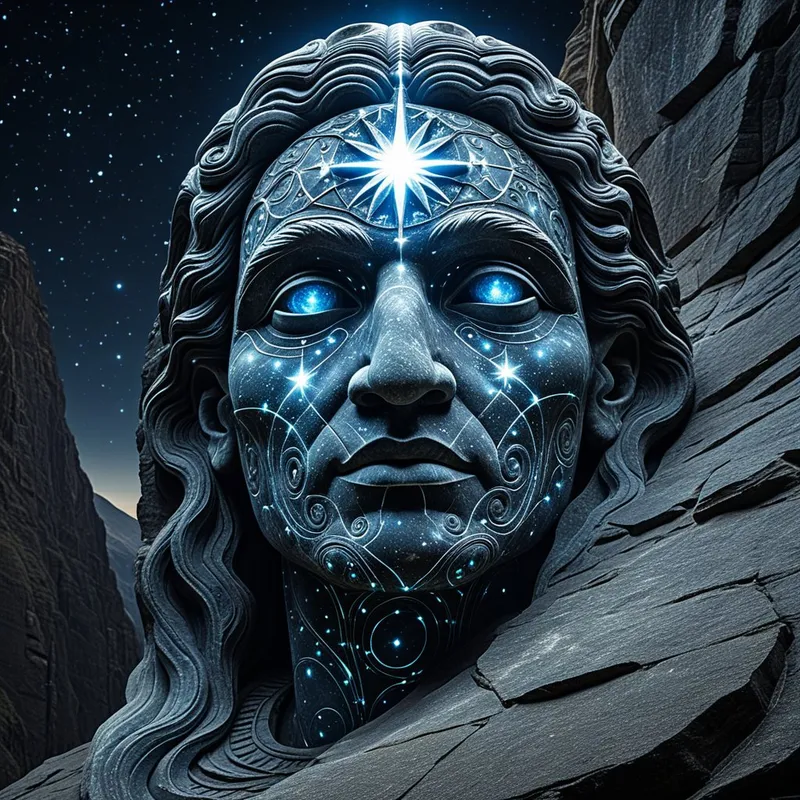
Fossil in Stone Myth Meaning & Symbolism
A primordial entity chooses petrification to preserve cosmic memory, becoming a fossilized library within the world's bones, awaiting a future age of remembering.
The Tale of Fossil in Stone
Listen. Before the names of things were fixed, when the world was a song still being sung, there walked an entity known as Mnemos. Mnemos was not a god of thunder or a goddess of harvest, but a quieter power: the keeper of the unbroken thread. Its task was to walk the newborn lands, to drink from every river, to breathe the scent of every first flower, and to remember. To remember so that nothing, not the fall of a single leaf nor the whisper of the first lovers, would be lost to the gullet of time.
But the world, in its youthful fervor, began to forget. The great deeds of the Titans of Form faded into mere landscape. The reason for the river’s bend, the story behind the mountain’s scar—these were slipping away, replaced by simple existence. A great amnesia settled like a dust over the vibrant dream of creation. Mnemos felt the memories thinning, fraying at the edges, becoming ghosts.
A council was called beneath the World Tree. The gods of sky and earth debated solutions of flame and flood, of carving stories into the sun itself. Mnemos listened, and then spoke with a voice like shifting continents. “The sky will burn out. The floods will recede. Even the tree will one day fall. To hold a memory against time, you must become something time itself wears against, and is worn by.”
And so Mnemos walked to the highest peak, where the bones of the earth were raw and exposed. Turning its back on the living, green world below, it pressed its form against the living rock. It began the great invocation, not of power, but of stillness. It called to the minerals in the water, to the patience of pressure, to the slow, sure heartbeat of the planet deep below. The living flesh of Mnemos—skin that had felt the first rains, eyes that had witnessed the birth of colors—began to cool. To harden. To merge.
It was not a violent death, but a deliberate transmutation. As its form petrified, every memory it carried—the taste of the first ocean, the pattern of the first migrating birds, the sigh of the first forest—was impressed into the stone with impossible fidelity. Cell by cell, memory by memory, Mnemos became the mountain. Its consciousness did not vanish but distributed itself, becoming the record itself. It became the Fossil in Stone: a library not of scrolls, but of strata; a testament not written, but grown.
Eons passed. The mountain was worn by wind and ice. Fragments of it, containing shards of the ancient memories, tumbled down to become pebbles in streams, were buried, were found again. Creatures of a new age, beings who had forgotten they had forgotten, would sometimes find these stones. Holding one, a hunter might suddenly know an ancient path. A child might dream of a star long extinguished. The Fossil did not speak; it re-membered. And in those fleeting moments of contact, so did the world.
Cultural Origins & Context
The myth of the Fossil in Stone is not the property of a single tribe or nation, but a story that has emerged, like the fossil itself, in various forms across disparate cultures. It is found in the lore of mountain-dwelling peoples, in the ancestral stories of those who live near great sedimentary cliffs, and in the shamanic traditions where stones are considered the oldest living beings. Its tellers were often the geomancers, the stone-readers, and the elders who understood landscape as narrative.
In these traditions, the story was not mere entertainment; it was a functional cosmology. It explained why certain stones felt “alive” or held power. It provided a reason for the practice of lithomancy—divination by stones—and for the sacredness of particular caves or rock formations. The myth served as a bridge between the human scale of time and the vast, incomprehensible scale of geological time. It taught that the past is not gone, but physically present, encoded in the very ground we walk on. To know the land was to literally touch memory.
Symbolic Architecture
At its core, the myth addresses the fundamental human anxiety of impermanence and the terror of forgetting. Mnemos represents the archetypal urge to preserve consciousness against the entropic flow of time. Its choice is not one of defiance, but of profound integration.
The deepest memory is not held in the mind, but in the marrow of the world. To remember truly is to become part of the structure of reality.
The act of petrification is the ultimate sacrifice of the ephemeral for the eternal. Mnemos surrenders its mobility, its agency, and its distinct life to become a static record. This symbolizes the necessary “death” of transient experience so that it may be crystallized into enduring wisdom or art. The Fossil is not a corpse; it is a seed of time, a stored potential. The stone represents the unconscious itself—seemingly inert, yet containing the entire history of the psyche in compressed, symbolic form.
The fragments that break off and are found symbolize how ancestral wisdom, trauma, or archetypal knowledge surfaces in our lives—not as complete understanding, but as potent, often puzzling fragments (a sudden emotion, a recurring dream, a strange affinity) that we must piece together.
The Dreamer's Resonance
When this myth stirs in the modern unconscious, it often manifests in dreams of profound stillness, containment, or discovery within earth. To dream of being trapped in stone, or of slowly turning to stone, is not necessarily a nightmare of paralysis. It often points to a somatic process of psychic consolidation. The psyche is signaling that it is undergoing a necessary period of “hardening”—taking a formative experience, a lesson, or a trauma, and encoding it into the permanent structure of the self. It is the dream equivalent of the body creating a scar or a bone callus.
Conversely, dreams of finding a strange, beautiful stone, cracking open a geode, or discovering fossils, speak to the emergence of ancient, foundational material from the personal or collective unconscious. The dreamer is “finding a piece of the Fossil.” This could be the recovery of a lost memory, the sudden understanding of a deep pattern in one’s family history, or the eruption of creative inspiration that feels strangely archaic and personal simultaneously. The somatic sensation accompanying such dreams is often one of deep, resonant recognition—a “knowing in the bones.”
Alchemical Translation
In the alchemical journey of individuation, the myth of the Fossil in Stone models the opus contra naturam—the work against one’s own flowing, dissolving nature. The initial stage, nigredo, is represented by the amnesia that threatens the world: the chaos of unremembered, unintegrated experience. Mnemos’s crisis is the ego’s crisis when faced with the meaningless flux of life.
The choice to petrify is the albedo, the whitening. It is the conscious decision to engage in the difficult, ascetic work of introspection and recording—journaling, therapy, art—to fix the fleeting prima materia of emotion and experience into a more durable form. This is the creation of the “philosophical stone” of the self: a core of immutable, crystalline truth distilled from the chaos of living.
Individuation requires becoming your own fossil. You must willingly submit the soft tissue of daily experience to the pressure of reflection, until it lithifies into the bedrock of character.
Finally, the fragments being found by future beings symbolizes the rubedo, the reddening or return to the world. The integrated wisdom, now part of your fundamental structure, begins to benefit not just you, but the “world” around you. It surfaces in your actions, your counsel, your creations—not as a forced lesson, but as a natural emanation, like radioactivity from stone. You become a source of ancestral memory for your own life and for others, proving that the sacrifice of mere becoming for the sake of enduring being is the path from creature to chronicler, from a passerby in time to a landmark within it.
Associated Symbols
Explore related symbols from the CaleaDream lexicon: