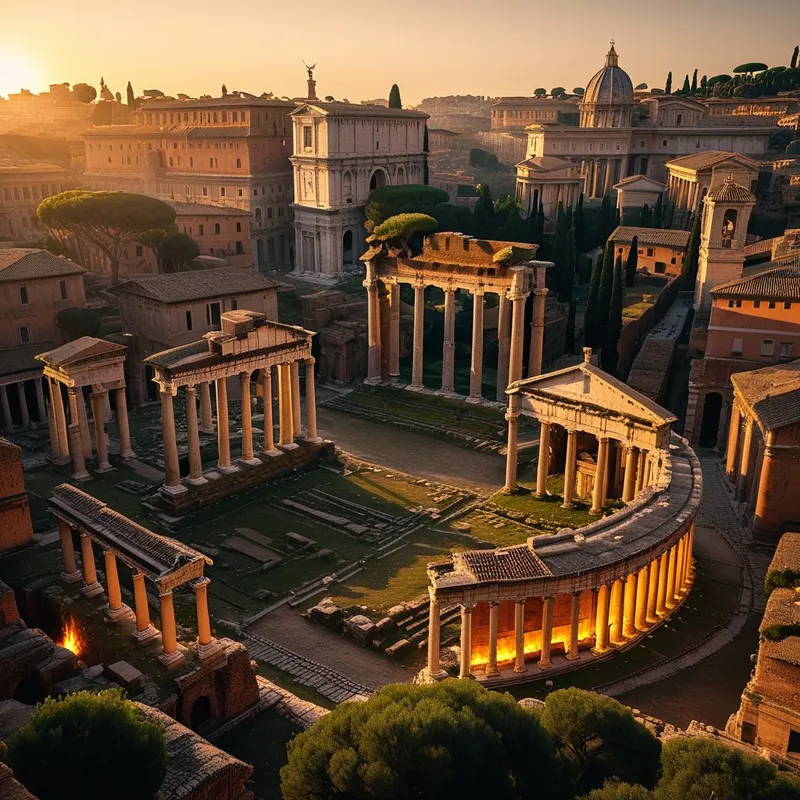
Forum Romanum Myth Meaning & Symbolism
The myth of the Forum's founding, where sacred order is carved from marshy chaos, establishing the world axis of Roman law, commerce, and divine speech.
The Tale of Forum Romanum
Listen, and hear the tale not of a hero, but of a place. Before the marble gleamed, before the voices of a thousand orators echoed, there was only the silence of the swamp. A low, wet land cradled between the seven hills, a place of reeds and whispering mud, of hidden waters and chthonic breath. It was a liminal space, belonging neither fully to the earth nor to the river, a forgotten throat of the world where spirits of the dead, the Manes, were said to drift.
Into this muted chaos came a king. Not with an army, but with a vision. He was Numa Pompilius, successor to the fiery Romulus. Where his predecessor built with sword and wall, Numa built with word and rite. He stood at the edge of the fetid water, the smell of decay and fertility thick in the air, and he listened. He heard not just the croak of frogs, but the potential for a different sound: the murmur of agreement, the clink of honest trade, the solemn prayer to the gods of the hearth and state.
His first act was one of sacred reclamation. He ordered the marsh drained, not with violence, but with a solemn canal, the Cloaca Maxima</ab title>, a vein to carry away the stagnant, formless waters. As the land emerged, dark and rich, it was not yet a forum. It was a void, a tabula rasa steaming under the sun.
Then came the demarcation. With priests and augurs, Numa traced the sacred boundaries. Here, he declared, pointing to a cleared patch of earth, would be the aedes Vestae, the hearth-fire of Rome itself, its flame an undying heartbeat. To the north, space was consecrated for the Curia, where grey-bearded wisdom would counsel. To the south, ground was set aside for the macellum and the tables of the moneylenders. At the center, he left an open space, a dusty plaza that would become the Rostra.
He did not build temples of stone, not yet. He built temples of intention. He invoked Vesta for sacred focus, Janus for good beginnings in all ventures, and Mercurius for the flow of goods and words. The conflict was not against a monster, but against chaos itself—the chaos of the undifferentiated, of the private, of the silent swamp. The rising action was the hum of activity that slowly, surely, replaced the swamp's silence: the strike of a deal, the drafting of a law, the pleading of a case. The resolution was not an end, but a perpetual beginning. The Forum was born—not as a finished thing, but as a verb, a space forever being forged by the collective life poured into it.

Cultural Origins & Context
The story of the Forum’s founding is not a single, codified myth from a sacred text, but a foundational narrative woven into the historical and antiquarian writings of Romans like Livy, Plutarch, and Varro. It belongs to the genre of aition (cause-origin stories), explaining not just how a place came to be, but why it held its specific, sacred character.
Passed down by statesmen, priests, and historians, this narrative served a critical societal function: it sacralized civic space. In a culture where religion was inextricable from public life, the Forum could not be merely a convenient marketplace. Its mythic origin as a consecrated void, transformed by pious kingly order, made every transaction, every speech, every election held there part of a sacred order. It elevated civic duty—arguing in court, voting in assemblies, conducting business—into a religious act that maintained the pax deorum. The myth taught that civilization itself is a sacred project, a deliberate ordering of primal, chaotic energies into a space for shared human endeavor.
Symbolic Architecture
Psychologically, the Forum Romanum myth is a master narrative of the individuation process applied to the civic—and by extension, the personal—psyche. The swamp represents the undifferentiated unconscious: fertile, potential-laden, but also murky, formless, and haunted by unintegrated contents (the Manes). It is the internal state of confusion, conflicting impulses, and unmourned pasts.
The act of draining the swamp is the courageous ego’s first commitment to consciousness—to bring light, order, and differentiation to the inner chaos.
Numa, the ruler archetype, represents the organizing principle of the conscious mind, not through tyranny, but through sacred law (fas) and human law (ius). The consecrated temples and designated spaces symbolize the creation of distinct psychic functions: the Vestal hearth (the sacred, enduring core of identity), the Curia (the inner council of wisdom and reflection), the marketplace (the function of relating and exchanging with the outer world), and the Rostra (the voice, the ability to articulate one’s truth). The Forum is thus the self—not as a monolithic entity, but as a dynamic, organized polis of the soul, where different inner parts have a designated, respected place to operate.
The Dreamer's Resonance
When this mythic pattern stirs in the modern unconscious, it often manifests in dreams of foundational spaces. One might dream of discovering a ruined plaza in their backyard, of trying to build a stage or a meeting hall on unstable ground, or of a vital community gathering that is disrupted by flooding or overgrowth.
Somatically, this can correlate with feelings of being "swamped"—overwhelmed by emotional or logistical chaos, a lack of internal structure, or a sense that one’s personal "public square" (one’s social persona or capacity for discourse) is non-functional or polluted. The psychological process is one of reclamation. The dream ego is tasked with the kingly/queenly work of surveying the inner landscape, identifying the stagnant "waters" (repressed emotions, outdated narratives), and beginning the laborious, sacred work of drainage and demarcation. It is the process of saying, "Here, in me, will be a place for my voice. There, a hearth for my values. In that corner, a space for commerce with the world." The anxiety in the dream is the fear that the swamp will reclaim the order, that chaos is the default state.
Alchemical Translation
The alchemical journey mirrored in the Forum myth is the transition from Nigredo (the blackening, the chaotic, swampy prima materia) to Albedo (the whitening, the purification and separation into distinct elements). Numa’s act is the separatio.
For the modern individual, the "Cloaca Maxima" is the psychological capacity for healthy drainage—the practices of journaling, therapy, meditation, or art that allow toxic or stagnant psychic contents to flow out and be processed, rather than festering. Consecrating the "Temple of Vesta" is the act of identifying and tending one’s immutable core values, the sacred flame that must not go out. Building the "Rostra" is the development of authentic self-expression, the courage to stand in one’s own central square and declare one’s truth.
The ultimate alchemical product is not gold, but a livable inner civitas—a well-ordered city of the soul where law (self-discipline), commerce (relationship), and sacred speech (authenticity) coexist in a dynamic, sacred balance.
The myth assures us that order is not a suppression of nature, but a higher collaboration with it. The fertile silt of the swamp remains beneath the marble, providing sustenance. The integrated self does not eliminate the unconscious; it builds a thriving, conscious life upon it, in respectful dialogue with the deep, fertile darkness from which it first emerged. The Forum, in the end, is the ongoing ritual of becoming a coherent self, repeated daily in the choices that order our chaos into a life of meaning and connection.
Associated Symbols
Explore related symbols from the CaleaDream lexicon: