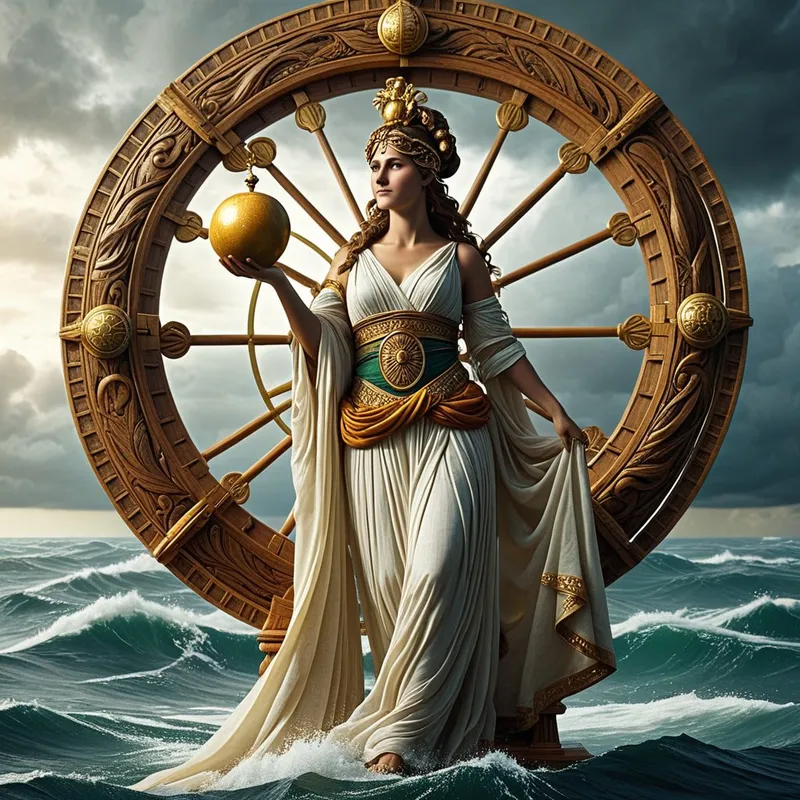
Fortuna Myth Meaning & Symbolism
The story of the capricious goddess who spins the wheel of fate, teaching that fortune is not a destination but the very nature of the turning world.
The Tale of Fortuna
Listen. Before the measured tread of the legion, before the laws were carved in stone, there was the whisper of the turning wheel. In the deep, numinous dark that cradles all beginnings, she stirred. Not born of a mother’s womb, but emerging from the primordial sigh of possibility itself—Fortuna.
Her first breath was the rustle of autumn leaves in a sudden gust. Her first footstep did not touch the earth, but found purchase on a sphere of polished onyx, forever rolling, forever unsteady. The gods of the firmament, with their domains of thunder and love, of the forge and the hunt, looked upon her and knew a quiet unease. For she answered to no covenant, bowed to no prophecy. She was the glint of chance in a soldier’s eye before the battle, the crack in the amphora that spills the precious oil, the unexpected wind that fills a barren sail.
She took her seat not on a throne, but at the hub of a great wheel, hewn from the world-tree’s heart. With a touch as light as a moth’s wing, she set it spinning. Its groan was the sound of empires being ground to dust and seeds being buried in the soil. Upon its rim, the fates of mortals and kings alike were fixed—now rising to the zenith, bathed in the gilded light of prosperity; now plunging into the nadir, wrapped in the shadows of loss.
Men built temples to her, not with pleas, but with a desperate, hopeful awe. They offered coins and garlands, whispering prayers into the incense-thick air. And she would turn her head—or perhaps she would not. For across her eyes was drawn a silken blindfold, richer than any royal purple. She did not see the worthy or the wicked, the pauper or the consul. She saw only the beautiful, terrible, impartial dance of chance.
In one hand, she held the Cornucopia, its bounty spilling forth in a cascade of grain, grapes, and gold coin—the sheer, unmerited gift. In her other, she grasped the Rudder, its blade cutting the currents of fate, steering the course of lives and histories toward harbors unknown. She stood upon her sphere, and the world rolled on beneath her, unstable, perpetual, alive.
This is her tale. It has no beginning, for she is coeval with risk. It has no end, for the wheel never ceases its turn. It is only the story of the spin, the rise, the fall, and the breath held in between.
Cultural Origins & Context
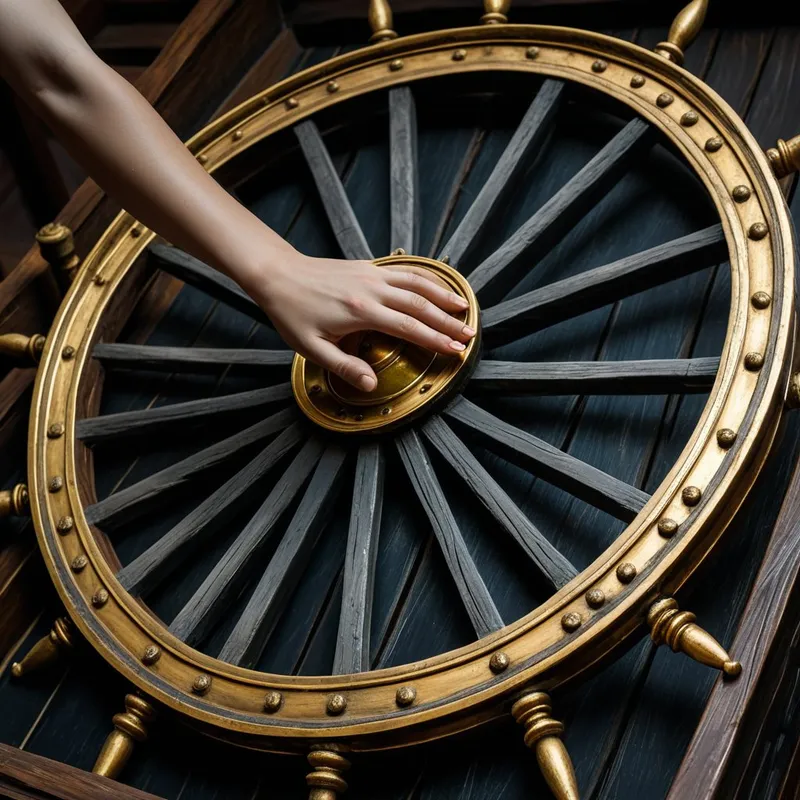
Fortuna was not a pristine import from the Greek pantheon, though she was later syncretized with Tyche. Her roots are quintessentially Roman, entwined with the soil, the family, and the state. Her earliest cult was likely as Fortuna Primigenia at Praeneste, where she was worshipped as the first-born daughter of Jupiter, the fated beginning of all things. This was a goddess of oracles, where seekers would draw sacred lots (sortes) to divine her will.
Her worship exploded in the Republican and Imperial eras, fragmenting into a hundred aspects to meet the anxieties of a complex society. There was Fortuna Huiusce Diei (Fortune of This Very Day), Fortuna Virilis (for men), Fortuna Muliebris (for women), and Fortuna Redux (for safe return from journeys). Every consul, general, merchant, and matron sought to court a specific facet of her favor. Her primary temple in Rome, the sanctuary of Fors Fortuna, was a place for the common people, reflecting her democratic nature—she could smile on anyone.
This proliferation reveals her societal function: she was the divine personification of a world the Romans knew to be fundamentally uncertain. Law and order (mos maiorum) could structure society, but victory, wealth, health, and love were ultimately in the hands of the blind goddess. Honoring her was an act of profound realism, a ritualized acknowledgment that human control has limits, and that life’s most transformative moments often arrive unbidden.
Symbolic Architecture
The symbols of Fortuna form a complete psychological system for understanding the nature of existence.
The Wheel is the central mandala. It represents cyclical time, the inevitable rhythms of ascent and decline, and the cosmic law of change. To be attached to any single point on the wheel—be it the peak of success or the pit of despair—is to misunderstand the nature of the ride.
The Blindfold is perhaps her most profound attribute. It is not a symbol of ignorance, but of radical impartiality. Fortune does not judge; it simply is. The blindfold severs the childish hope that the universe distributes rewards based on merit. It forces a confrontation with a reality that is random, neutral, and therefore free.
The Rudder and the Sphere together teach that while we cannot control the seas of fate, we must still learn to steer. And the ground of our being is not solid, but perpetually in motion.
The Cornucopia and the Rudder represent the dual gifts of the Magician archetype: abundance and agency. The cornucopia is the unlooked-for grace, the lucky break, the innate talent. The rudder is the capacity for choice, direction, and response within the flow of events. One is the gift received; the other is the skill to use it.
Finally, the Globe or Sphere upon which she stands is the world itself—inherently unstable, requiring perfect balance to navigate. It signifies that security is not found in stillness, but in learning to dance with instability.
The Dreamer's Resonance
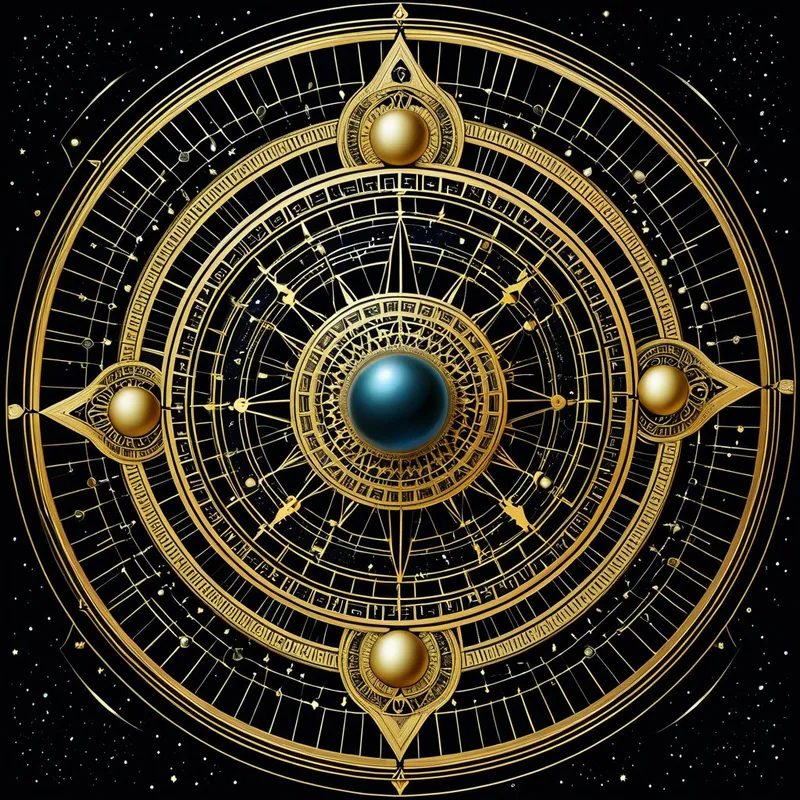
When the motif of Fortuna spins into modern dreams, it often signals a psyche grappling with forces that feel beyond its control. The dreamer may find themselves on a vast, turning wheel, experiencing dizzying elevations followed by terrifying drops. They may grasp a ship’s wheel that spins freely, refusing to hold a course, or they may discover a blindfold tied over their own eyes.
Somatically, this can manifest as vertigo, a loss of equilibrium, or the sensation of free-fall. Psychologically, it is the process of confronting the Shadow of uncertainty. We consciously build identities based on competence, planning, and merit. Fortuna’s dream imagery shatters this illusion, exposing the vulnerable self that exists at the mercy of economic shifts, health diagnoses, or the unexpected actions of others.
The dream is an initiation into a more mature relationship with life. It asks: Can you release the white-knuckled grip on the outcome? Can you find your center even as the wheel turns? The anxiety in the dream is the friction between the ego’s desire for control and the soul’s need to accept the full, unpredictable spectrum of existence.
Alchemical Translation
The individuation process modeled by Fortuna is the alchemy of transforming anxiety into awe, and victimhood into sovereignty. Her myth charts the path from being subject to fortune to being in relationship with it.
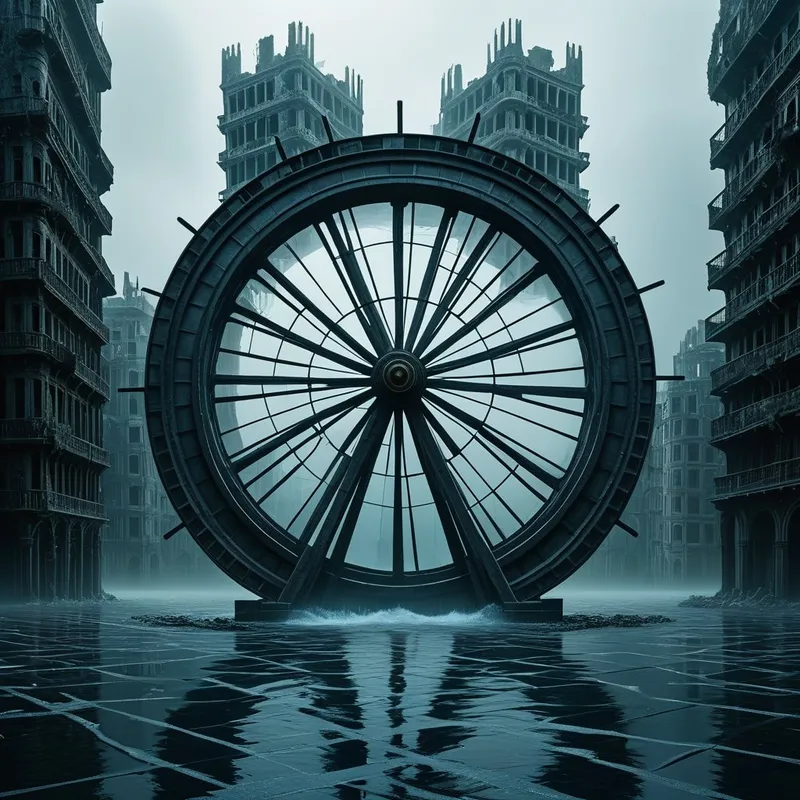
The first, brutal stage is Nigredo—the blackening. This is the plunge of the wheel, the loss, the failure, the moment when the blindfolded goddess seems cruel. It is the necessary dissolution of the ego’s fantasy of total control. One is stripped back to the rolling sphere, with no false stability to cling to.
The Rudder is not taken from the goddess’s hand; it is forged in the soul through the acceptance of the Blindfold.
From this dark night arises Albedo—the whitening. This is the clarity that comes from accepting the impartiality of fate. The blindfold is internalized; we see that good and bad fortune are not personal judgments, but aspects of a single turning process. We cease railing against randomness and begin to observe its patterns.
The final stage is Rubedo—the reddening, or golden dawn. Here, the cornucopia and rudder are integrated. The individual learns to recognize and receive the gifts of chance (serendipity, opportunity) while actively and skillfully steering their life with the rudder of conscious choice and values. They become the magician at the center of their own wheel, not controlling its spin, but finding perfect balance and poise within it. Fortuna is no longer an external force to be feared or placated, but an inner principle of creative adaptation and resilient grace. The wheel turns, but the soul, having made peace with the turn, is free.
Associated Symbols
Explore related symbols from the CaleaDream lexicon: