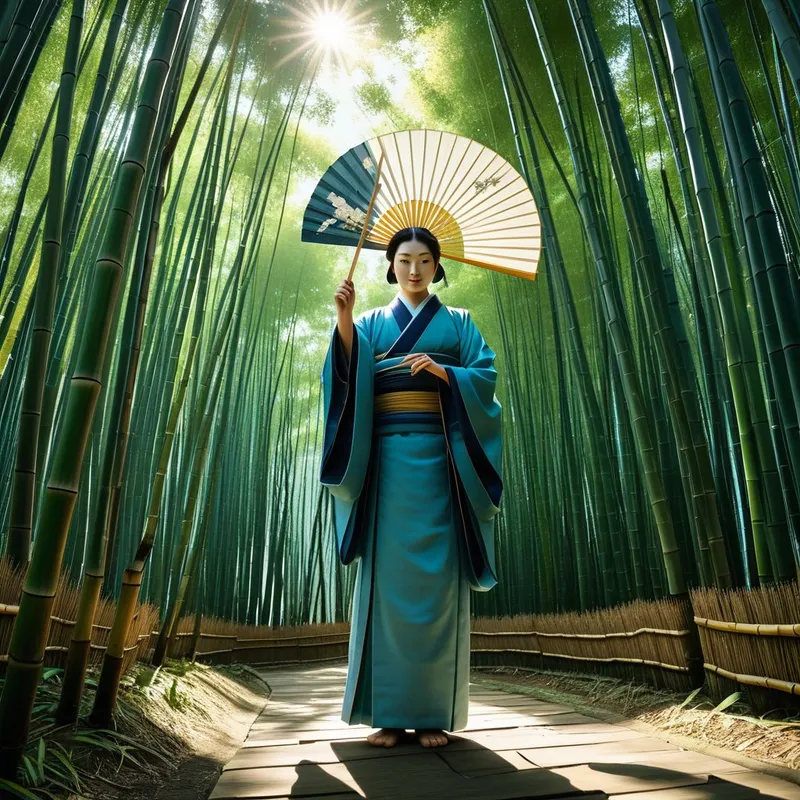
Folding Fan Myth Meaning & Symbolism
A kami, exiled from the sky, weaves the first folding fan from a sacred tree, gifting humanity the power of wind, art, and hidden potential.
The Tale of the Folding Fan
Listen, and hear the whisper of the wind through the bamboo. This is not merely air moving; it is the breath of a story, a tale folded and hidden, waiting to be opened.
In the time when the kami walked closer to the earth, there was one named Kazefumi. He was a spirit of the gentle breeze, the one who carried the scent of plum blossoms and stirred the leaves into soft conversation. Yet, in the celestial plains of Takamagahara, his art was seen as trivial, a mere decoration of the greater winds commanded by the thunder gods. In a moment of pride, Kazefumi challenged the tempest, claiming his subtle art could calm any storm. He failed. The raging winds mocked him, and the heavenly assembly, displeased by his hubris, cast him down. He fell not as a shooting star, but as a sigh, descending to the mortal realm of Ashihara no Nakatsukuni.
He found himself in a silent, stifling forest grove. The air was thick and still, heavy with the heat of summer. The people of a nearby village moved slowly, languid with the oppressive stillness, their prayers for a breeze going unanswered by the greater gods. Kazefumi, his divine power diminished, felt their silent suffering as his own. He wandered, a ghost of his former self, until he came upon a stand of slender hinoki and a grove of hardy bamboo.
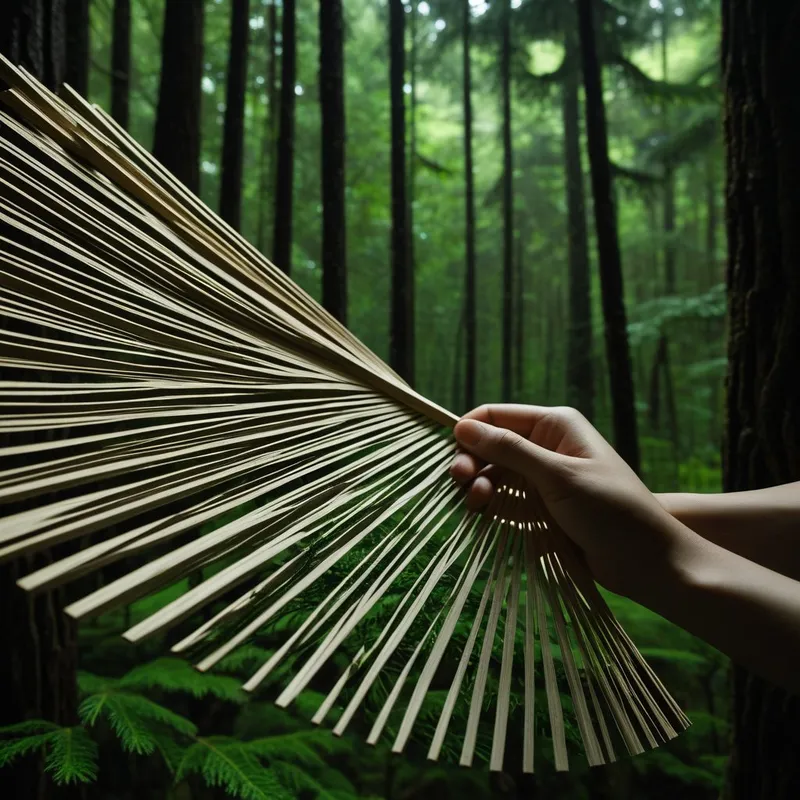
An ache, a memory of motion, stirred within him. He was Wind-Weaver, yet he had no loom, no thread. He looked at the straight, strong bamboo and the flexible hinoki. He remembered the folding wings of a crane descending to a pond. A vision unfolded in his mind—not of brute force, but of elegant potential. With hands that remembered creation, he carefully split the bamboo into fine, even ribs. He peeled the inner bark of the hinoki, pounding it until it became a sheet of strong, faintly aromatic paper. He painted it with a scene from his lost home: a single branch of cherry blossoms against an empty sky.
Then, the sacred act. He joined the ribs at one end with a rivet of polished river stone. He glued the paper to the frame, but only on one side. He folded the structure, pleat by precise pleat. What was a wide, painted landscape collapsed into a slender, unassuming stick of wood and paper. It held its secret close.
He approached the weary villagers and offered his creation. They looked at the closed fan with curiosity but little hope. Kazefumi took it back. With a soft snap, he flicked his wrist. The fan opened. Not with a roar, but with the sound of a page turning in a sacred book. And as he waved it, a cool, gentle breeze flowed forth—a breeze that carried the very scent of hinoki and the memory of high plains. It was not the wind of dominion, but the wind of gift, of art, of breath itself. The villagers gasped as the stifling air moved for the first time in seasons. In that moment, the exiled kami did not reclaim his heavenly power; he discovered a new one, folded within the heart of the mundane world.
Cultural Origins & Context
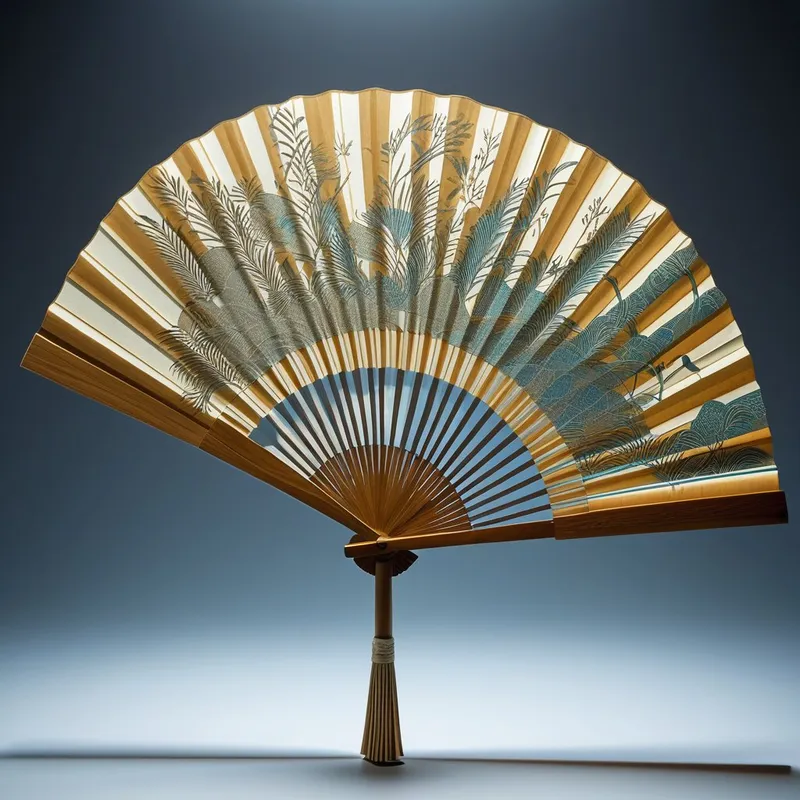
The myth of the folding fan, or sensu, does not belong to a single, canonical text like the Kojiki. Instead, it is a folk etymology, a kitsune story woven into the cultural understanding of a ubiquitous object. It emerged during the Heian period (794-1185 CE), a time of immense aesthetic refinement, when the sensu evolved from a practical implement into a core element of courtly etiquette, poetry, and hidden communication.
The tale was likely told by artisans—the fan-makers themselves—and by itinerant storytellers and monks. Its function was multifaceted. For the artisan, it sanctified their craft, linking it to divine origin. For the aristocracy, it encoded a philosophy: true power and beauty are often concealed, revealed only through deliberate, graceful action. The fan became a language in itself; its speed of movement, the angle it was held, the way it concealed the mouth, all conveyed unspoken messages in the highly ritualized court. This myth provided the spiritual backbone for that silent language, suggesting that every opening of a fan was a re-enactment of a kami’s revelation.
Symbolic Architecture
At its core, the myth is an alchemical parable of transformation through limitation. The fan is the perfect symbol of this process.
The greatest power is not in the unleashed storm, but in the breath held, folded, and deliberately given form.
Kazefumi’s exile represents the descent of a potential into a constrained, earthly reality—the movement from spirit to matter. The oppressive stillness of the mortal world is the felt sense of unlived life, of creativity blocked. The fan’s construction maps the human psyche: the rigid bamboo ribs are the necessary structures of life—routine, discipline, the bones of character. The washi paper is the receptive, sensitive soul, capable of bearing the imprint of memory and beauty (the painted blossom). The rivet is the central, immutable Self, the axis around which all experience turns.
The act of folding is the critical operation. It symbolizes compression, containment, and the hidden nature of the unconscious. Our deepest potentials, memories, and talents are not always on display; they are folded within us. The closed fan is the persona, the compact, socially acceptable face we present. The opening—the snap and the unfurling—is the moment of revelation, of authentic expression, of releasing the inner breeze that can change the atmosphere of a life.
The Dreamer's Resonance
When the image of a folding fan appears in a modern dream, it rarely arrives as a simple object. It is an active glyph of the psyche’s current process. To dream of frantically searching for a fan in a hot, airless room speaks to a somatic feeling of suffocation, perhaps in a job or relationship, where the dreamer feels the absence of a tool for self-advocacy or creative expression.
Dreaming of a fan that will not open, no matter how hard one tries, points to a profound psychological blockage. The mechanism of revelation is jammed. This often correlates with a conscious feeling of being “stuck,” where intellectual understanding exists (the painted scene is there), but the emotional or kinetic energy to manifest it is inaccessible. Conversely, dreaming of a fan that opens by itself, releasing a powerful, unexpected gust, can signal an imminent and perhaps involuntary emergence of repressed content—a sudden insight, a long-held emotion, or a creative surge breaking through conscious control.
The dream fan asks: What is folded within you that seeks to open? What breeze—what change in your inner climate—are you being called to generate?
Alchemical Translation
The journey of Kazefumi is a precise map for the modern individuation process. We all experience our own “exile”: the fall from the ideal self, the childhood sense of unlimited potential, into the constrained realities of adult life, with its failures, compromises, and “stifling heat.” The initial response is often grief and a sense of powerlessness.
The alchemical work begins with the conscious engagement with this limitation. We must go into our own “forest grove”—the raw materials of our lived experience, our inherited traits (the bamboo), and our cultivated sensitivities (the paper). The construction of the fan is the labor of analysis, of building a coherent structure from disparate parts of the self. But analysis alone creates a static artifact.
Individuation is not merely constructing the self; it is learning the sacred gesture of opening and closing it.
The final, crucial transmutation is in the use of the fan. This is synthesis. It is the conscious ego learning to wield the integrated self. To know when to fold (to withdraw, reflect, contain power) and when to open (to express, create, influence one’s environment). The breeze generated is the unique impact of an individuated person upon their world—not a chaotic storm of raw impulse, nor the stagnant air of total conformity, but a deliberate, life-giving movement. The myth teaches that our divinity is not lost in the fall; it is reconstituted, folded into a more intricate, beautiful, and human form. We become, like the first sensu, both the artifact and the artist, the container and the liberating breath.
Associated Symbols
Explore related symbols from the CaleaDream lexicon: