Flyting Contests Myth Meaning & Symbolism
A sacred contest of poetic insults where words are weapons, revealing hidden truths and forging identity through verbal combat.
The Tale of Flyting Contests
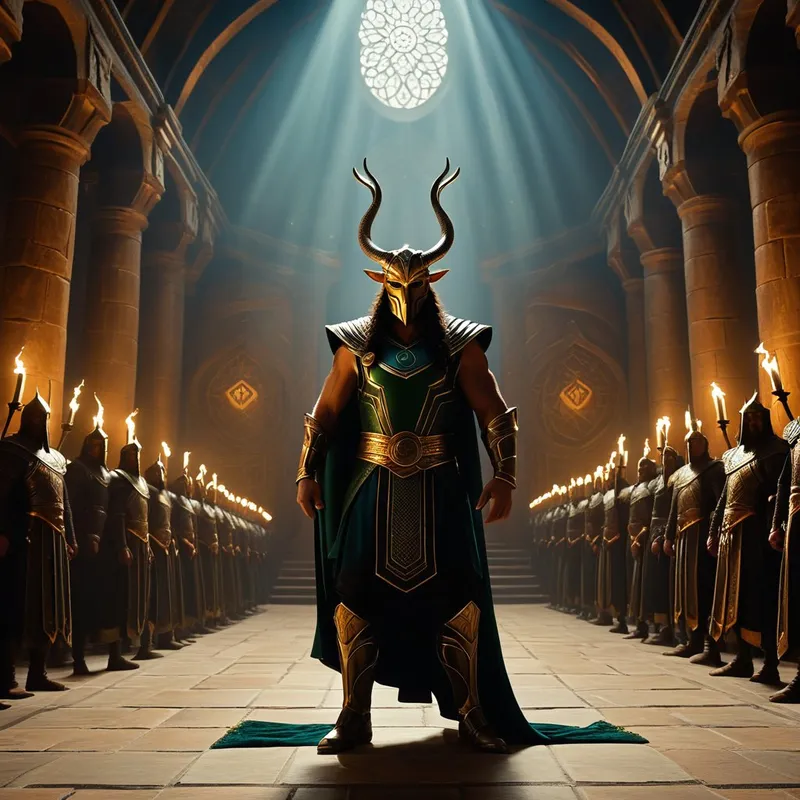
Hear now of the feast in Ægir’s hall, where the sea itself brewed the mead and the very walls were woven from frozen wave-light. The Æsir were gathered, their laughter a thunderous, comfortable thing. Gold gleamed, meat steamed, and the promise of a long, unbroken night of boasting and fellowship hung thick as the hearth-smoke.
But a serpent had coiled itself at their table. Loki, the shape-shifter, the bringer of gifts and grief, had come unbidden. His smile was a sliver of ice, his eyes holding the cold fire of a star about to fall. He drank deep, but the mead did not warm him; it only honed the edge of his tongue.
The turning began with a slight, a withheld cup. A spark in dry tinder. Loki rose, and the hall’s warmth fled before him. He did not draw a blade. He drew breath. And from his lips poured not a war-cry, but a poem—a poem of venom and devastating truth. He declared a flyting, a contest of insult, and named himself the challenger of all.
He began with the server, a minor deity, shredding his dignity with a few precise, cruel barbs. The laughter died. The air grew taut. Then, he turned his gaze upon the gods themselves. To Njörðr, he spoke of shameful, intimate origins. To Freyr, he whispered of a love that would cost a kingdom. Each verse was a needle finding the gap in the divine armor, a probe into the secret shame each god carried.
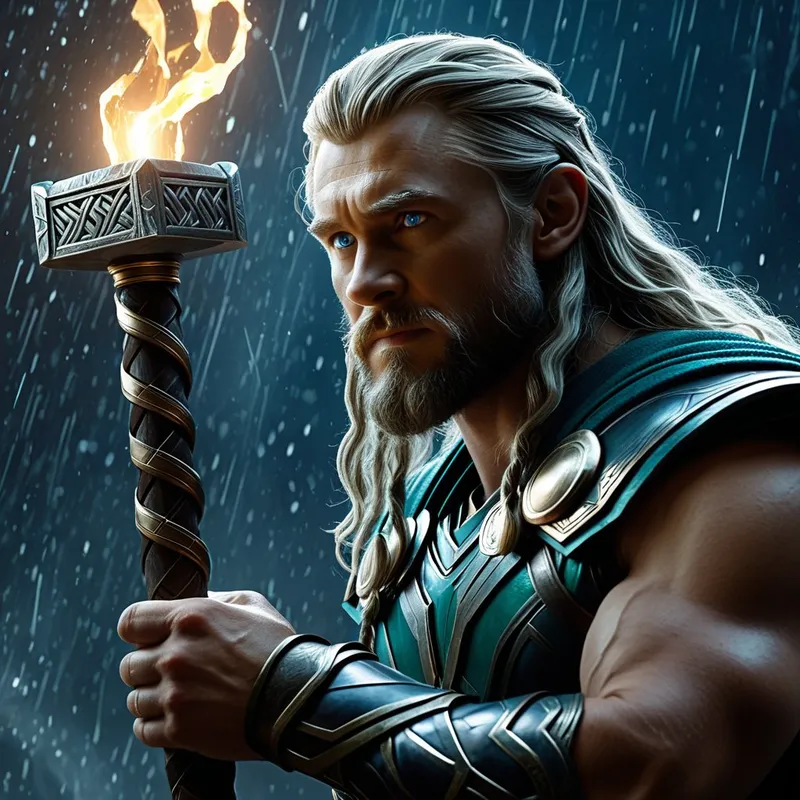
The gods roared, threatened, blustered. Thor brandished Mjölnir, his rage a palpable heat, but Loki’s words were a shield of ice. He mocked Thor’s strength, his simplicity, his near-fatal journey to the land of the giants. The insults were not lies; they were truths polished into weapons.
Finally, he turned to Odin himself. He spoke of broken oaths, of magic learned in a feminine guise, of wisdom stained with deceit. He laid bare the paradox of the Allfather—the ruler who gained his throne through cunning, the seeker of truth who was master of lies. The hall was a tomb of silence. In that moment, Loki was not a trickster at the feast, but a principle of chaos and revelation made flesh. He had, with words alone, turned the golden order of Asgard inside out, exposing its tangled, shadowed seams.
The tale ends not with Loki’s victory, but with his flight. The unleashed truth was too potent even for its speaker. As the gods moved to seize him, he transformed, slipping away into the night—but the echo of his verses remained, a permanent crack in the hall’s perfection, a whispered testament that even the gods must face the mirror of their hidden selves.
Cultural Origins & Context
The flyting, or senna, was not mere tavern brawling with words. It was a formalized, ritualistic verbal duel with deep roots in the Germanic world. In the sagas and eddic poetry, it functions as a crucial social and narrative mechanism. These contests were performed, likely in halls before an audience of peers, adhering to strict poetic meters like fornyrðislag or ljóðaháttr. The skalds, the poet-historians, were the custodians of this tradition, wielding words with the same lethal precision as a warrior wielded a sword.
Its societal function was multifaceted. On one level, it was a sanctioned outlet for aggression, a way to settle disputes or establish hierarchy without immediate bloodshed, though it often preceded it. More profoundly, it was a test of hugr—of mind, spirit, and composure. To lose one’s temper was to lose the contest. The flyter had to be a master of memory, improvisation, and psychological insight, crafting insults that were not just offensive, but poetically potent and undeniably true in some fundamental, often mythological, sense. It was a theater of identity, where a person’s deeds, lineage, and hidden flaws were dragged into the public sphere and defined through the crucible of poetic confrontation.
Symbolic Architecture
At its core, the flyting myth is not about humiliation, but about revelation. It symbolizes the necessary, violent confrontation between the conscious self (the ordered society of the gods) and the shadow (Loki, the uninvited guest).
The insult that lands is the truth you have refused to name.
Loki represents the archetypal trickster, the agent of chaos who, by disrupting order, forces consciousness to expand. His verses are not random malice; they are specific, archetypal accusations—cowardice, oath-breaking, sexual transgression, hidden dependency. Each god embodies a specific psychic function (strength, fertility, kingship), and Loki’s insults expose the flaw or cost inherent in that function. Thor’s strength borders on brute ignorance. Odin’s wisdom is rooted in self-mutilation and deceit. The flyting is a psychic drama where the repressed contents of the collective psyche demand acknowledgment.
The hall itself is a symbol of the curated persona, the bright, public self we present to the world. Loki’s intrusion shatters this container, forcing what is hidden in the rafters and cellars of the self to be seen in the central firelight. The contest has no “winner” in a conventional sense; its resolution is the irreversible expansion of awareness. The ordered self is wounded, but it is now more complete, more real, for having integrated the attack.

The Dreamer’s Resonance
When this myth stirs in the modern soul, it often manifests in dreams of intense verbal confrontation. You may dream of being in a meeting, a family gathering, or a public space where you are subjected to a torrent of criticism, or where you unleash one yourself. The language may be surreal, the accusations bizarre yet feeling eerily accurate. Somaticly, this can feel like a tightening in the chest, a heat in the face, a sense of exposure.
Psychologically, this is the psyche initiating its own flyting. One aspect of the self—often an internalized critical voice or a long-repressed creative or rebellious impulse—is confronting the dominant, ruling “god” complex of your current identity. It is insulting your achievements, mocking your carefully constructed persona, pointing out your hypocrisies and secret shames. This is not a nightmare to be merely escaped; it is a ritual in progress. The discomfort is the friction of truth against self-deception. The dream-ego’s task is not to win the argument, but to listen. What part of this invective, however painful, carries the sting of truth? What shadow aspect, your inner Loki, is demanding a seat at the table?

Alchemical Translation
The alchemical journey modeled by the flyting is the nigredo—the blackening, the putrefaction, where the base matter of the psyche is dissolved in its own poison. Our polite lies, our grandiose self-images, our hidden shames are the prima materia. Loki, the mercurial trickster, is the corrosive agent, the aqua fortis that eats away at gold.
Individuation begins not with self-affirmation, but with the insult that unravels you.
The process is one of brutal honesty directed inward. The modern individual must learn to host this internal contest. You must invite your own disruptive intelligence to speak, to challenge your inner Odin (your ruling principles), your inner Thor (your brute force), your inner Freyr (your cherished desires). This is not negative self-talk; it is poetic, precise shadow-work. You craft the verses against yourself, not to destroy, but to refine.
The goal is not to slay the trickster, but to integrate his function. The resolution of the psychic flyting is the birth of a more resilient, authentic consciousness—one that has faced its own verses and survived. The hall of the self is no longer a pristine, fragile place of illusion, but a sturdier, more complex structure that includes the knowledge of its own darkness. The transformed self holds the power of both the skald’s verse and the warrior’s resilience, having learned that the word that wounds is often the very word that initiates wholeness.
Associated Symbols
Explore related symbols from the CaleaDream lexicon: