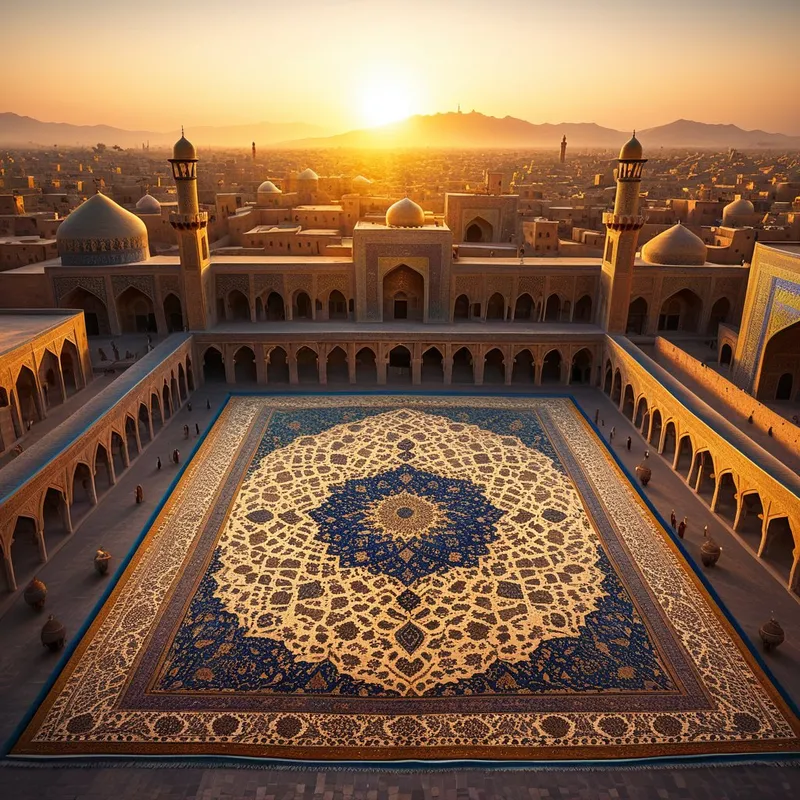
Flying Carpets Myth Meaning & Symbolism
A myth of a king's hubris, a weaver's genius, and a tapestry that defied gravity to teach the soul how to truly ascend.
The Tale of Flying Carpets
Listen, and let the dust of forgotten bazaars settle on your tongue. Let the scent of saffron and sandalwood guide you to a time when kings were as mountains and artisans were as the wind that shapes them.
In the golden age of King Solomon, whose ring commanded the jinn and whose wisdom stilled the hearts of beasts, there ruled a lesser king, a man of earthbound splendor. His name was lost to the wind’s gossip, but his desire was etched upon the world: he wished to sit upon his ivory throne and survey all his domains in a single morning. He commanded his architects to build a tower that would pierce the clouds. They built, and it fell. He commanded his shipwrights to craft a chariot borne by a thousand eagles. They crafted, and it failed.
His rage was a desert simoom, scorching the spirits of his court. Finally, his vizier, a man with a voice like cool water, spoke. “O King of the Age, the earth will not rise to meet you. But perhaps the earth itself can be taught to fly.”
The king summoned the kingdom’s master weaver, an old man whose fingers were knotted like ancient roots and whose eyes held the patience of the loom. “Weave me a throne that can fly,” the king demanded. “Weave it from the threads of sunset and the whispers of the wind. Do this, or your life is a thread I will gladly cut.”
The weaver bowed his head. He did not ask for gold or silk. He asked for solitude, a high tower room open to the four winds, and his simple tools. For forty days and forty nights, he worked. He did not weave scenes of conquest or gardens of paradise. He wove the pattern of his own yearning. Each knot was a sigh for the weightless freedom of a bird. Each pass of the shuttle was a memory of climbing the hills as a boy, feeling the world drop away. He wove the dizziness of looking up at the circling hawk. He wove the silent, lifting joy of a prayer that leaves the lips and ascends, untethered.
On the forty-first morning, he called for the king. The carpet lay in the center of the tower room, magnificent in its deep blues and golds, a complex geometry that seemed to shift if stared at too long. The king scoffed. “This is a rug. A beautiful rug, but earthbound.”
“A throne must have a king to give it purpose,” said the weaver softly. “Sit, and know your true desire.”
Suspicious, the king sat upon the center medallion. The weaver stood at the edge, placed a hand on the intricate border, and whispered a word not of language, but of feeling—the pure, unadulterated sensation of release.
The carpet shuddered. Then, with a sound like a vast, gentle inhalation, it lifted. Not with a lurch, but like a leaf caught in an updraft. It floated level, then drifted towards the great arched window. The king cried out, gripping the dense pile. They passed through the tower window and into the open sky. The kingdom lay below like an illuminated manuscript. The king’s fear melted, not into courage, but into awe. He was not a conqueror looking down. He was a mote in the eye of heaven, humbled by the expanse. He looked at the weaver, who stood calmly, his face turned not to the lands below, but to the horizon where the sky bleeds into infinity. The carpet flew not where the king commanded, but where the weaver’s silent heart directed—towards the unknown, towards the simple, terrifying freedom of the open sky.
Cultural Origins & Context
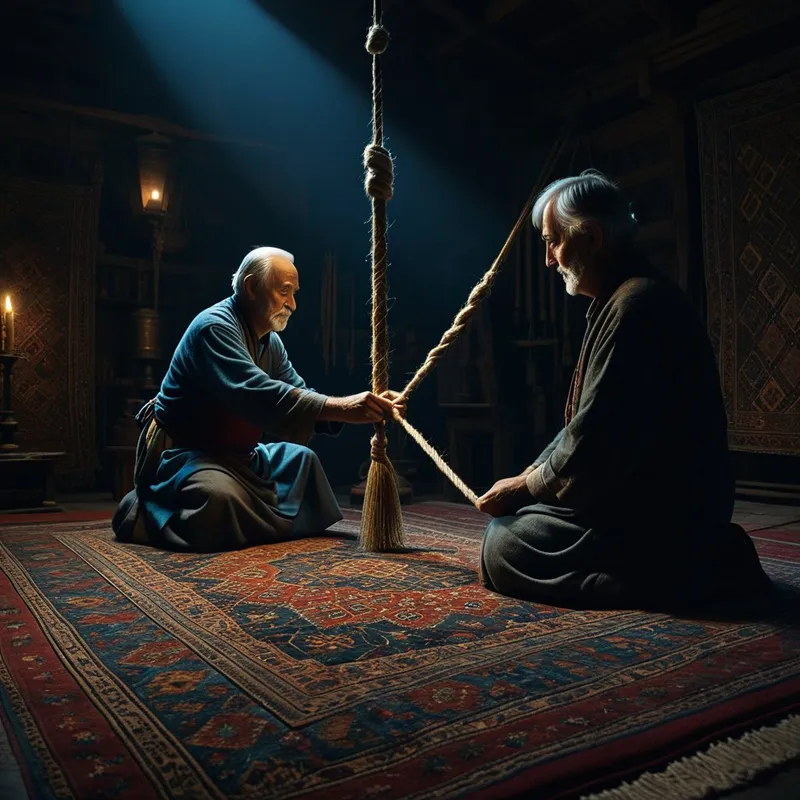
The flying carpet, or Farsh-e Havai, is a narrative motif woven deeply into the fabric of Persian storytelling, most famously crystallized in the One Thousand and One Nights. Its origins are not in religious scripture but in the secular, imaginative space of the naqqali (storyteller) and the coffeehouse. Here, epic poems like the Shahnameh were performed, a world where the magical and the heroic were intertwined.
The carpet itself was a pinnacle of Persian material culture—a functional object of immense artistry, a symbol of status, comfort, and beauty. To imagine it taking flight was to perform the ultimate alchemy on the everyday. This myth served a societal function beyond mere entertainment. In a culture with complex codes of honor, rigid hierarchies, and often autocratic rule, the flying carpet represented a psychological escape valve. It was a fantasy of agency, of transcending social and physical boundaries imposed by palace walls, desert sands, and royal decrees. It democratized the power of flight, suggesting that sublime transportation was not the sole province of prophets on their Buraq or heroes on magical steeds, but could be achieved through human artistry and a particular state of consciousness.
Symbolic Architecture
At its core, the flying carpet is an emblem of the liberated imagination. It is the concrete manifestation of a thought so light, so unburdened by doubt and literalism, that it achieves literal lift-off.
The carpet does not fly because it is magic; it is magic because it can fly. Its enchantment is the direct result of its function—the transcendence of the foundational law of its being: to lie upon the earth.
The carpet represents the body of the soul—intricately crafted, patterned with the experiences (the knots) of a lifetime, yet possessing a latent potential for ascension. The king symbolizes the ego, the identity that believes it must command and conquer to ascend. He fails with towers (rigid structures of pride) and forced animal labor (exploited instinct). His success comes only when he submits to sitting upon a creation born not of command, but of authentic feeling woven by another.
The weaver is the archetypal Self or the genius within. He works not for reward or from fear, but from a deep, inner necessity to give form to a profound inner truth—the yearning for freedom. His whispered word is the activation of that truth, the moment when an internal realization gains enough psychic energy to alter one’s external reality.
The Dreamer’s Resonance
When the flying carpet appears in a modern dream, it rarely comes as a simple vehicle for adventure. Its appearance signals a critical phase in a somatic and psychological process: the incubation of liberation. The dreamer is often in a life situation that feels heavy, patterned, and repetitive—a job, a relationship, a mental state that is beautifully crafted but utterly grounded.
The somatic sensation in such dreams is key: the gentle lift, the absence of violent propulsion, the panoramic view that diminishes personal worries to mere geography. This reflects a psyche beginning to dis-identify from a complex. The ego is starting to release its grip, allowing a broader, more transpersonal perspective (the view from above) to emerge. If the dreamer is afraid, it indicates a conflict between the desire for freedom and the terror of losing the “ground” of a familiar, if limiting, identity. If the dreamer feels exhilaration, it marks a conscious alignment with the weaver within—an acceptance of the self’s capacity to transcend its own woven patterns.
Alchemical Translation
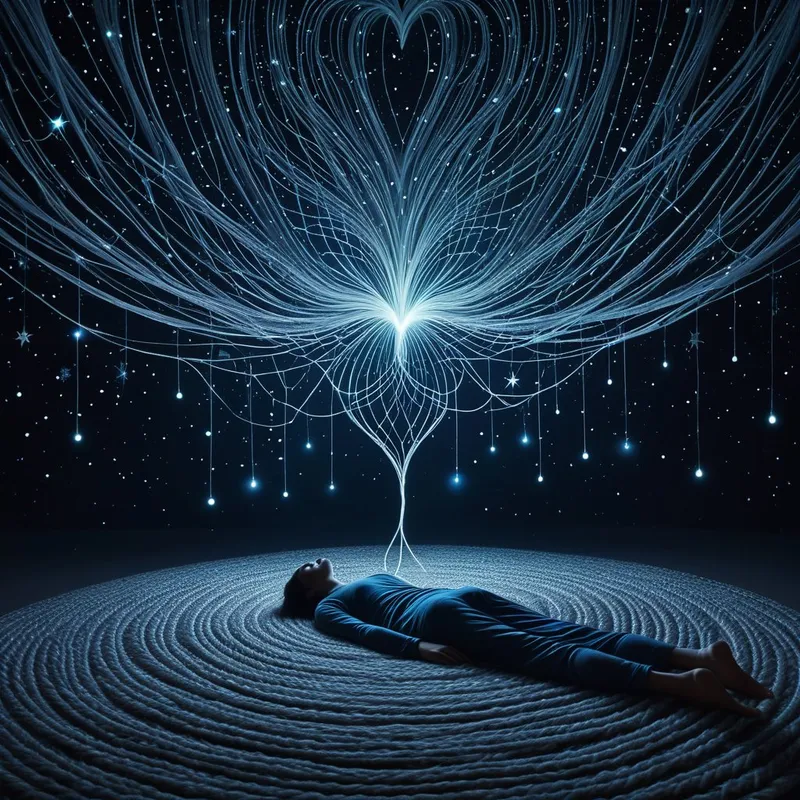
The myth models the alchemical process of individuation, specifically the stage of sublimatio—the transformation of the solid into the volatile, the raising of the earthly to the spiritual.
The king’s initial failed projects represent the ego’s futile attempts at spiritual bypassing—building towers of intellectual knowledge or harnessing eagles of forced enthusiasm to “get high.” These are willful, ego-driven, and ultimately collapse. The true process begins with the weaver’s retreat: the introversion and solitude necessary for inner work. The forty days of weaving are the meticulous, often tedious, work of self-examination—tying each knot of memory, desire, and trauma into the total pattern of one’s being.
The flying carpet is the integrated personality. Its flight is not an escape from the pattern, but the pattern achieving its ultimate expression. The threads are not discarded; they become the means of ascent.
The king must sit upon the weaver’s creation. This is the crucial moment where the conscious ego (the king) must relinquish control and place itself upon the tapestry of the unconscious (the weaver’s art) that has been patiently assembled. The flight that follows is the experience of psychic wholeness. The ego is not destroyed; it is carried. It gains a perspective where it is no longer the ruler of a small, bordered kingdom, but a participant in a vast, horizonless sky. The destination is not a place, but a state: the continuous, mindful journey guided by the heart of the integrated Self. The myth teaches that liberation is not seized by force, but woven with patience and ridden with surrender.
Associated Symbols
Explore related symbols from the CaleaDream lexicon: