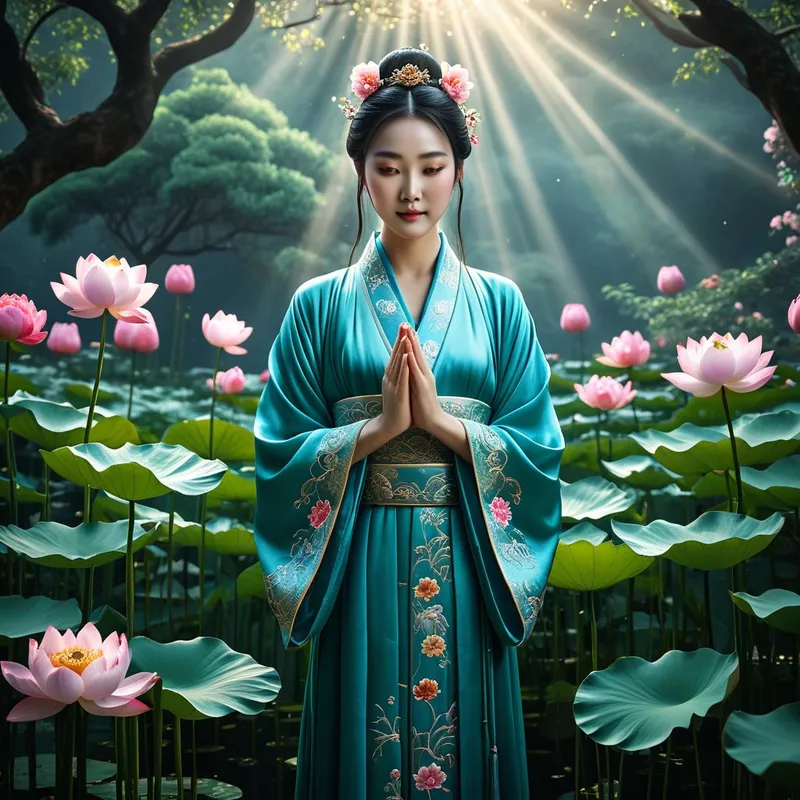
Flower Goddess Myth Meaning & Symbolism
A celestial being descends to tend the mortal world, her life force becoming the cycle of blossom and decay, teaching the alchemy of loss into beauty.
The Tale of Flower Goddess
In the time before time was measured, when the sky was a vault of freshly polished jade and the earth a sleeping dragon, there existed a realm of perpetual dawn known as Penglai. Here, in gardens woven from mist and sunlight, resided Nüxian Hua, the Flower Goddess. Her breath was the scent of the first plum blossom after winter; her laughter was the sound of petals unfurling. She was the keeper of all potential beauty, the architect of color and fragrance.
Yet, from her celestial perch, she gazed upon the mortal world below—a realm of stark seasons, where life was a brutal struggle. Flowers there were scarce, timid things, blooming briefly before being claimed by frost or drought. The people lived in a palette of dust and grey, their hearts as hardened as the barren soil. A profound sorrow, deep and root-like, took hold in the goddess's spirit. Her perfect, eternal garden felt like a gilded cage when such thirst existed beyond its walls.
Driven by a compassion that overruled celestial decree, Nüxian Hua gathered her essence. She did not merely descend; she unwove herself. Threads of her divine form—saffron from the chrysanthemum, crimson from the peony, the pearlescent sheen of the lotus—spiraled down like a silent rainbow. She took mortal shape in a forgotten valley, her feet touching the cracked earth. Where her tears fell, green shoots pierced the ground. Where her fingers traced the air, buds swelled and burst.
She walked the world not as a sovereign, but as a gardener. She taught the people the language of the soil, the song of the rain, the secret that every seed holds a universe. Under her touch, the wilderness erupted in glory: mountainsides blushed with azalea, rivers were framed by willows, and the night air grew heavy with the perfume of guìhuā. Joy, long dormant, bloomed in human hearts.
But the cosmos demands balance. The Yù Huáng</abì> observed the draining of her celestial light. Her life force was not infinite; it was being poured, drop by radiant drop, into the mortal clay. A mandate echoed from the heavens: return, or be consumed. The goddess stood at the edge of a cliff overlooking the now-vibrant world. She saw not her masterpiece, but her children—the fragile, fleeting blooms and the people who loved them.
She chose not to return. Instead, she spread her arms wide, a final, silent invocation. Her divine form dissolved not into nothingness, but into a million shimmering motes of light. Each mote became a seed, a spore, a promise. They fell like gentle snow upon the earth, sinking into its heart. From that day forth, the world knew the cycle: not eternal bloom, but the more profound magic of spring after winter, of life stubbornly rising from decay. Her sacrifice became the rhythm of the earth itself. She did not leave a monument, but a pattern—the pattern of the turning year, written in petal and leaf.
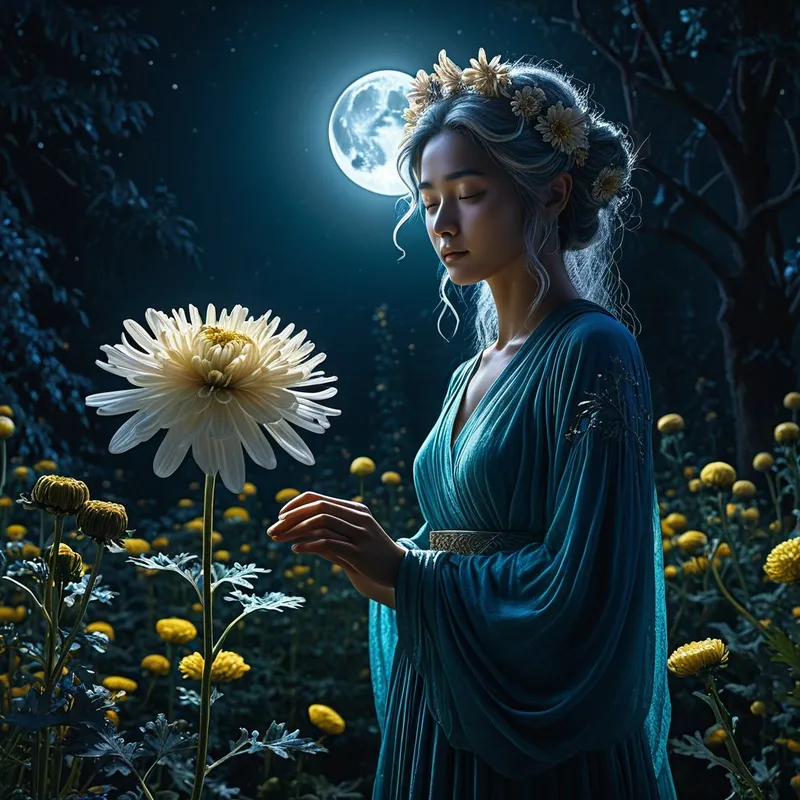
Cultural Origins & Context
The figure of the Flower Goddess is not anchored to a single, canonical text like the deities of the Shangshu or Shanhaijing. She is a folk deity, her roots tangled in the rich humus of agrarian life and local shénxiān worship. Her veneration was strongest among farming communities and flower cultivators, particularly in regions known for peonies, like Luoyang, or plum blossoms, like the Jiangnan area.
She was a deity of the periphery, celebrated in village festivals marking the blossoming seasons, her stories passed down by grandmothers, herbalists, and poets. Daoist traditions later absorbed her, aligning her with the forces of Yin and the transformative power of nature. She appears in classical poetry, often as an ephemeral muse, and in folktales where she might reward a kind gardener or punish a greedy one. This myth functioned as an etiological narrative, explaining the origin of seasons and flora, and as a moral compass, embedding values of selfless nurture, harmony with nature, and the acceptance of life’s beautiful, necessary cycles.
Symbolic Architecture
At its core, this myth is a profound allegory for the principle of nourishment through dissolution. The goddess is not a warrior who conquers but a caregiver who transfuses. Her power lies in vulnerability, in allowing her bounded, perfect form to scatter and become the process itself.
The ultimate act of creation is not to build a monument, but to become the fertile ground from which all things may rise and fall.
The celestial garden of Penglai represents a state of sterile perfection, a consciousness untouched by the grit and grief of earthly experience. The barren mortal world symbolizes a psyche devoid of feeling, beauty, or connection—a life lived only on the surface. The goddess’s descent is the soul’s courageous journey into the depths of its own humanity, into the shadow and the soil. The conflict is the eternal tension between self-preservation and self-giving, between maintaining one’s pristine identity and expending it for a greater, messy, living whole.
Her dissolution is the key symbol. It negates the ego’s desire for permanence and recognition. She does not become a statue to be worshipped; she becomes the cycle—the seed, the bloom, the withering, and the compost that feeds the next seed. This is the archetype of the Dà Mǔqīn in its most radical form: the mother who does not merely feed the child from her surplus, but whose very body becomes the sustenance for new life.
The Dreamer's Resonance
When this myth stirs in the modern unconscious, it often manifests in dreams of profound, melancholic beauty and poignant loss. One might dream of tending a garden that withers as fast as it blooms, of finding a single, impossibly beautiful flower that crumbles to dust upon touch, or of feeling one’s own energy draining away to nourish a project, a relationship, or a cause.
Somatically, this can feel like a deep exhaustion that is not merely physical but soul-level, a hollowing out. Psychologically, this dream pattern signals a critical phase in the process of sacrificial creation. The dreamer is likely in a life stage where they are pouring their essence—their time, creativity, emotional reserves—into something outside themselves. The dream asks the terrifying, necessary question: What part of my old self, my pristine identity, must die and scatter so that this new life can take root? It is the psyche working through the anxiety of depletion, reframing it not as a catastrophe, but as a sacred, alchemical dispersal.
Alchemical Translation
The individuation journey modeled here is not the hero’s quest for a golden trophy, but the caregiver’s path of radical ecological integration. The modern individual, often trapped in the Penglai of curated online identities or careerist ambitions, feels the call of the barren world—a deep, unmet thirst for authentic connection and meaningful contribution.
Individuation is the process of discovering that one’s true self is not a static statue to be defended, but a living, changing ecosystem to be tended.
The first alchemical stage is Descent: leaving the safety of known roles and self-images to engage with the raw, needy, "barren" parts of one’s own psyche and the world’s suffering. The second is Infusion: the conscious, often painful, expenditure of one’s energy, talents, and love without immediate guarantee of return or recognition. This is the nurturing of the "garden"—be it raising a child, creating art, building community, or healing trauma.
The final, most critical stage is Transmutation of the Vessel: the ego’s surrender. This is the dissolution of the goddess. In human terms, it is the moment we realize our identity is not diminished by what we give away, but transformed. The rigid "I" that began the journey scatters, and in its place arises a pattern of relationship, a cycle of care. The individual becomes less a discrete entity and more a node in a network of growth and decay, learning to find identity in the flow of giving and receiving, in the quiet dignity of being good soil. The triumph is not immortality, but legacy; not static beauty, but the enduring capacity to bring forth beauty, season after season, from the very substance of one’s spent and scattered self.
Associated Symbols
Explore related symbols from the CaleaDream lexicon: