Flint Knapping Myth Meaning & Symbolism
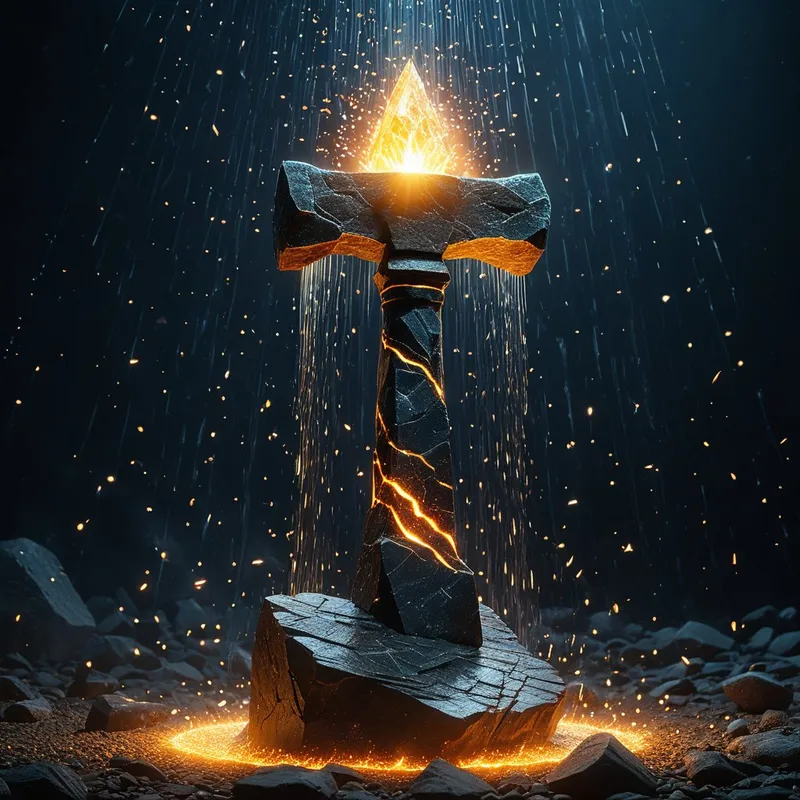
A myth where a primordial being sacrifices its own body, allowing its bones to be shattered into flint, giving humanity the sacred gift of fire and tools.
The Tale of Flint Knapping
In the time before time, when the world was soft and new, there walked a being of immense age and stillness. He was Old Man Flint, his body not of flesh, but of a dark, glassy stone that held the memory of the earth’s first fire. The people were young then, shivering in the long shadows, eating their meat raw, their hands empty and soft. They saw Old Man Flint on the ridge, a silent silhouette against the setting sun, and they felt a deep longing, though they knew not for what.
Old Man Flint watched them. He saw their vulnerability, their struggle against the tooth and the claw, the creeping cold of the night. A great sorrow moved within his stony heart, a sorrow as deep and patient as a mountain. He knew what must be done, but the knowing was a heavy weight.
He called the people to him on the high plain. The wind was cold. “Listen,” his voice spoke, not from a mouth, but from the very grinding of his substance, a sound like boulders talking in a deep canyon. “You need a weapon that bites sharper than the wolf’s tooth. You need a spark to call the sun down to live with you in the dark. You need a tool to shape the world, as the world shapes you.”
The people were afraid. “How can this be?” their leader asked. “The world is hard, and we are soft.”
Old Man Flint looked at his own hands, hands that could crush granite to powder. “The gift is here,” he said, “but it is locked within me. To free it, you must break me.”
A gasp went through the people. To strike a sacred being? It was unthinkable. But Old Man Flint knelt on the hard ground, presenting his back. “Take the hardest hammer stone. Strike true. Do not mourn the shattering. For in the breaking, I become more than I was. My fragments will be your teachers.”
Trembling, the strongest among them lifted a great, round river stone. The air grew still. The first blow fell with a crack that echoed off the distant hills. A shard of black glass flew from Old Man Flint’s shoulder, landing with a sharp tink. The people flinched, expecting a cry of pain. There was only silence, and then another command: “Again.”
Blow after blow fell. Each impact was a thunderclap of sacrifice. With every strike, Old Man Flint’s form diminished, and a growing pile of sharp, gleaming fragments gathered around him—arrowheads, knife blades, scrapers, each one born from a specific fracture. Finally, as the last of his great body was reduced, the final hammer blow struck the core of his being. A brilliant spark, white-hot, leapt from the point of impact and fell into a prepared nest of dry tinder. It smoldered, then caught, blooming into the first fire made by human hands.
Where Old Man Flint had knelt, there was now only a scatter of perfect tools and a small, warm fire. His voice was gone, but his presence was in every sharp edge, in every spark struck from stone. He had given them his bones, and in doing so, had given them a future.
Cultural Origins & Context
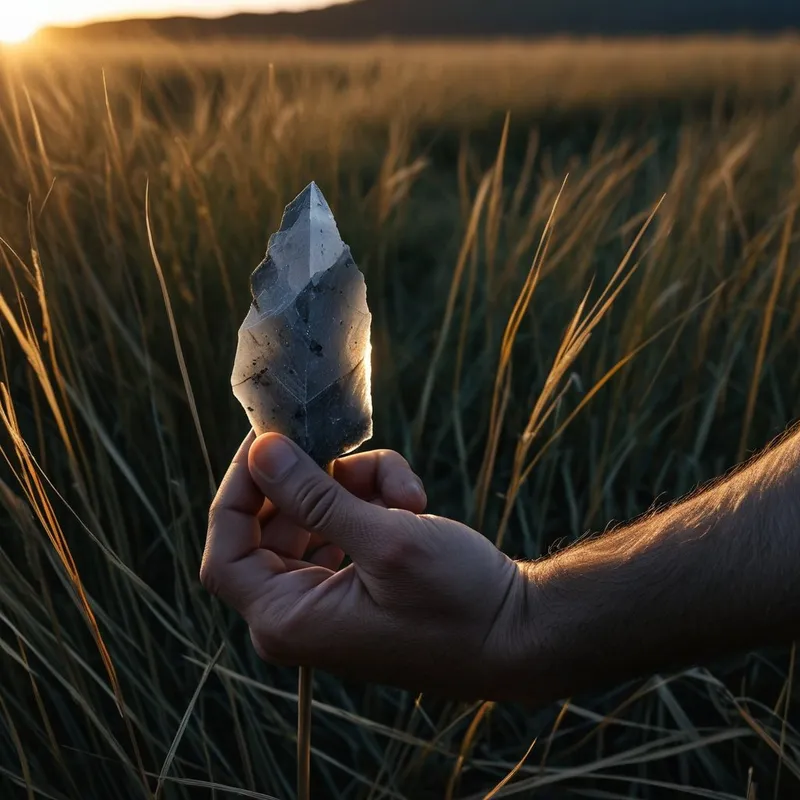
This myth, in its many variations, is found among numerous Native American nations, particularly across the Plains and Plateau regions. It is not a single, standardized story but a profound archetypal narrative that explains the origin of one of humanity’s most fundamental technologies: lithic toolmaking. The act of flint knapping was sacred, a ritual technology. Stories of Old Man Flint, or similar entities like Flint Boy or Stone Man, were told by elders and toolmakers not merely as history, but as a living charter.
The myth served multiple societal functions. It encoded the practical knowledge of selecting core stone and understanding its fracture mechanics into a sacred narrative, making the craft memorable and respected. More importantly, it established an ethical and spiritual relationship with the material world. The tools were not just taken; they were received through a sacred exchange of sacrifice. This story taught that the resources of the earth are a conscious gift, requiring respect, gratitude, and mindful use. It framed creation as an act born from self-sacrifice, embedding the values of generosity and responsibility toward community into the very artifacts of daily survival.
Symbolic Architecture
At its heart, this is a myth of transmutation. The immortal, static, and self-contained stone being chooses to become mortal, fragmented, and useful. His solidity is exchanged for utility, his wholeness for multiplicity.
The ultimate creative act is not about bringing something from nothing, but about consenting to the sacred break that releases potential from latency.
Old Man Flint represents the undifferentiated Self—potent but inaccessible. The people represent the emerging ego-consciousness: aware of need but powerless. The violent act of knapping is the necessary crisis that mediates between them. It symbolizes the painful but essential process by which latent psychic wholeness (the Self) must be “broken down” or differentiated to provide the sharp, focused “tools” (insights, skills, archetypal energies) the conscious personality needs to navigate the world.
The fire-born-from-spark is the climax of this symbolism. It represents the awakening of conscious spirit (Promethean fire) directly resulting from engaging with the hard, resistant material of reality (or the unconscious). The tool and the flame are twins: one to shape the external world, the other to illuminate the internal one.
The Dreamer's Resonance
When this myth pattern stirs in the modern dreamtime, it often manifests as dreams of breaking or being broken. One might dream of shattering a precious crystal, hammering a stubborn rock that suddenly yields a gem, or finding their own body is made of brittle glass. These are not necessarily dreams of destruction, but of necessary deconstruction.
The somatic feeling is key: the crisp, shocking crack of the break, followed not by pain, but by a sense of release and revelation. The dreamer is undergoing a psychological “knapping.” Some old, rigid structure of the personality—a long-held identity, a defensive posture, a monolithic belief—is being struck by the hammer of life circumstances or inner realization. The dream confirms that this breaking is not a meaningless failure, but a sacred, creative act. The fragments are not debris; they are the nascent tools for building a new, more capable way of being. The dream asks: What in you must be willingly broken apart to release its usefulness? Where is your latent fire waiting for the decisive strike?

Alchemical Translation
The alchemical journey mirrored in this myth is the Nigredo, the blackening, the solve (to dissolve). Old Man Flint’s dark, stone body is the prima materia—the unworked, heavy lead of the psyche. The conscious ego, armed with will (the hammer stone), must engage this dense, unconscious material. This is the hard, thankless work of shadow integration, of confronting one’s own resistant and stony aspects.
Individuation begins with the courage to strike oneself, to initiate the fracture through which the light can eventually enter.
The transformation is not gentle. It is a voluntary sacrifice of a former, static wholeness for a dynamic, functional complexity. The shattered flint pieces are the differentiated faculties—clear thinking (sharp edges), inspired action (arrowheads), the ability to refine and prepare (scrapers). The spark is the symbolic realization that ignites the entire process, providing the warmth of meaning and the light of consciousness.
For the modern individual, the myth models the path of individuation. We are both the people and Old Man Flint. We must find the courage to take up the hammer against our own ingrained patterns, to break the sealed, stony aspects of our psyche that hoard potential. And we must also learn to kneel, to consent to the breaking, trusting that our essence is not lost but multiplied and activated in service of a more conscious, capable, and illuminated life. The gift of fire and tool is not given from the outside; it is struck from the core of our own being, through an act of sacred, creative violence turned inward.
Associated Symbols
Explore related symbols from the CaleaDream lexicon: