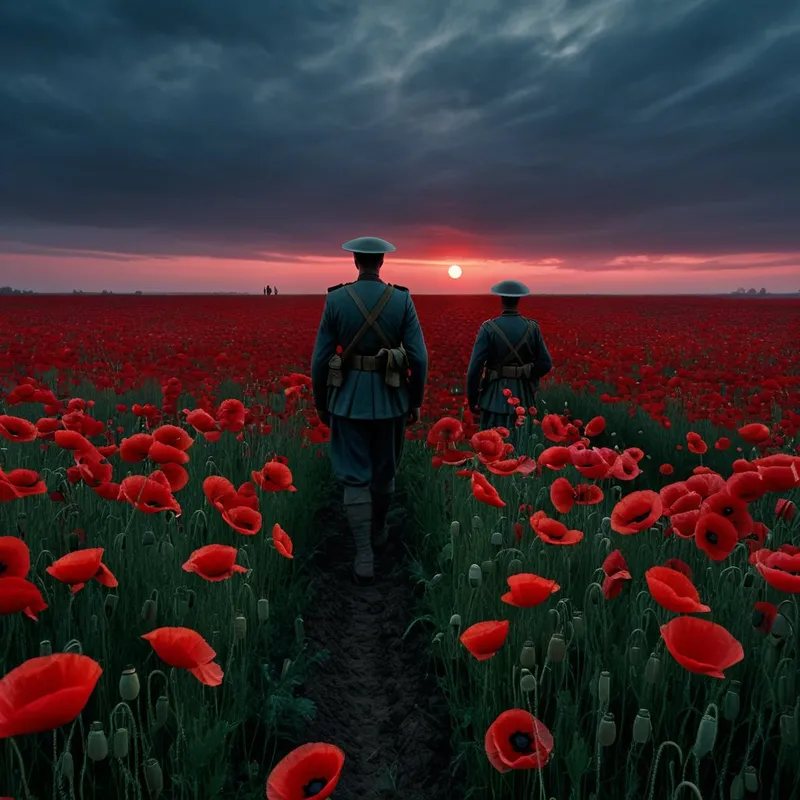
Flanders Fields Myth Meaning & Symbolism
A haunting elegy from the trenches, where the fallen speak from beneath poppies, binding the living to a sacred duty of remembrance and unfinished work.
The Tale of Flanders Fields
Listen. There is a place where the earth does not forget. It is a flat and shattered land, a kingdom of mud and mist, where the sky weeps iron and the ground groans with a memory older than bones. This is Flanders. Here, the great conflict of nations—a storm of fire and wire—raged until the very soil was baptized in blood and sorrow.
And from that sorrow, a new life was born. Not of flesh, but of flame. In the lulls between the thunder, in the craters where men fell, a miracle of crimson emerged. The poppy took root. It drank not water, but memory. It grew not towards the sun, but from the sacred darkness below, where an army of sleepers lay.
These sleepers were not dead, not truly. They were the Torch-Bearers, the ones who crossed the veil with their song unfinished. They felt the sun’s weak warmth on the earth above. They heard the larks, bravely singing amidst the guns. And they felt the profound, aching silence of their own absence.
One voice rises from that choral earth, a whisper woven from a million whispers. It speaks to you, the living, who walk in a world they can no longer see.
“In Flanders fields the poppies blow Between the crosses, row on row, That mark our place; and in the sky The larks, still bravely singing, fly Scarce heard amid the guns below.”
The voice is gentle, but its burden is the weight of epochs. It tells of life interrupted, of dawns seen and sunsets missed. It speaks of love and faith they held, now left behind like discarded kit. But this is not a song of self-pity. It is a passing of the watch.
“We are the Dead. Short days ago We lived, felt dawn, saw sunset glow, Loved and were loved, and now we lie In Flanders fields.”
Then, the tone shifts. The whisper becomes a charge, a sacred oath demanded by the very ground you stand upon. The torch—the torch of their cause, their hope, their unextinguished will—is thrust from the grave into your hands. You can feel its heat, a ghostly flame that does not burn the skin but the soul.
“Take up our quarrel with the foe: To you from failing hands we throw The torch; be yours to hold it high. If ye break faith with us who die We shall not sleep, though poppies grow In Flanders fields.”
The voice fades, leaving only the rustle of red petals in the wind. The choice is made. The duty is given. The field, now silent, watches and waits.
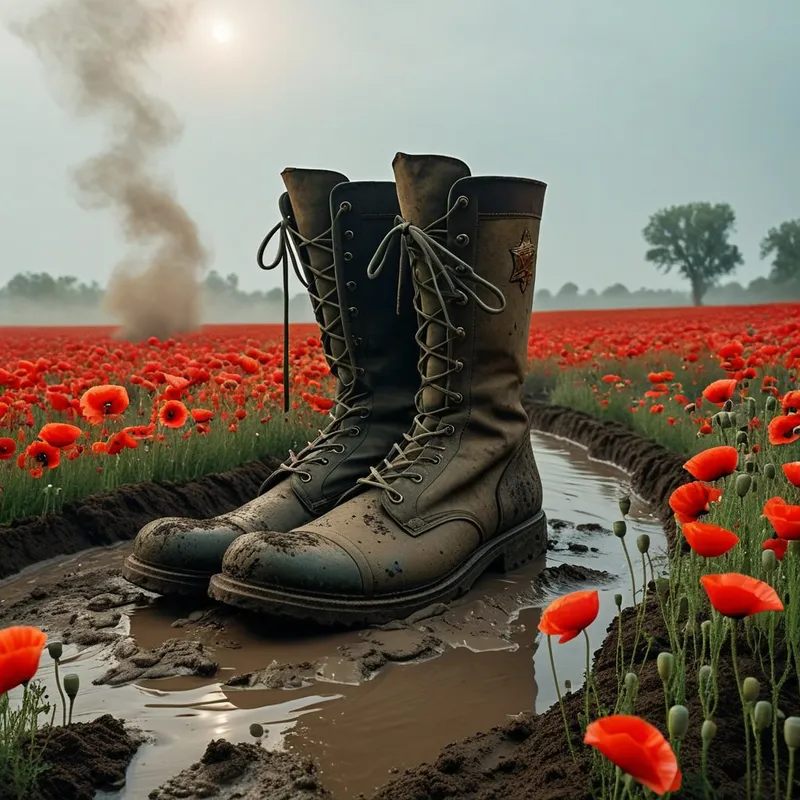
Cultural Origins & Context
This myth did not emerge from antiquity, but from the industrialized cauldron of the early 20th century. Its bard was John McCrae, who composed the fifteen-line poem “In Flanders Fields” in May 1915, following the death of a friend at the Second Battle of Ypres. He wrote it on a scrap of paper in the back of an ambulance. The poem was first published in Punch magazine in December 1915 and was rapidly disseminated through newspapers, pamphlets, and public readings across the British Empire and Allied nations.
Its societal function was immediate and profound. In a war characterized by anonymous, mechanized slaughter, the poem gave a collective voice to the fallen. It transformed the incomprehensible statistics into a personal plea. It was used for propaganda, yes—to sell war bonds and bolster resolve—but its deeper resonance was as a vessel for public grief and a creator of secular ritual. The poppy, championed by Moina Michael and Anna Guérin, became the symbolic artifact, a wearable piece of the myth itself. The act of remembrance on Armistice Day became the living performance of the poem’s final stanza: taking up the torch by vowing “never to forget.”
Symbolic Architecture
The myth’s power lies in its stark, tripartite symbolic architecture.
The Field: This is the liminal space, the wounded earth that is both grave and womb. It represents the traumatized psyche, the scarred collective unconscious of a civilization. It is not a peaceful resting place, but a place of active, unresolved tension.
The Poppies: They are the paradoxical symbol of life-in-death. Their red is the color of blood sacrifice, but also of vibrant, resilient life. They symbolize the memory that grows from trauma, beautiful but rooted in pain. They are the visible sign that the dead are not inert; they fertilize a new consciousness.
The Dead & Their Torch: The fallen are not presented as victims to be pitied, but as ancestors transferring authority.
The true torch is not vengeance, but the burden of consciousness itself—the duty to live with the full weight of memory and to make that memory meaningful.
Their “quarrel” transcends the historical enemy; it becomes the eternal human struggle against oblivion, cynicism, and the breaking of faith. The “sleep” they are denied is the peace that comes only when their story is integrated into the living world.
The Dreamer's Resonance
When this myth surfaces in modern dreams, the dreamer is often encountering what depth psychology calls the collective unconscious or grappling with a legacy of unresolved trauma—personal, familial, or cultural.
To dream of Flanders Fields is to dream of being handed an obligation you did not choose. The somatic feeling is often one of being weighed down, of solemn gravity. You may be walking through a familiar, modern landscape that suddenly transforms into the churned mud of the trenches. The silent, watching dead are not necessarily soldiers; they may appear as ancestors, past versions of yourself, or marginalized voices history has forgotten. They represent all that has been sacrificed, suppressed, or left unfinished in your psychic lineage. The dream is a call from your own psyche to stop walking over this buried ground unaware. It is an invitation to remember, to stop, to listen, and to acknowledge the cost of the ground you stand on.
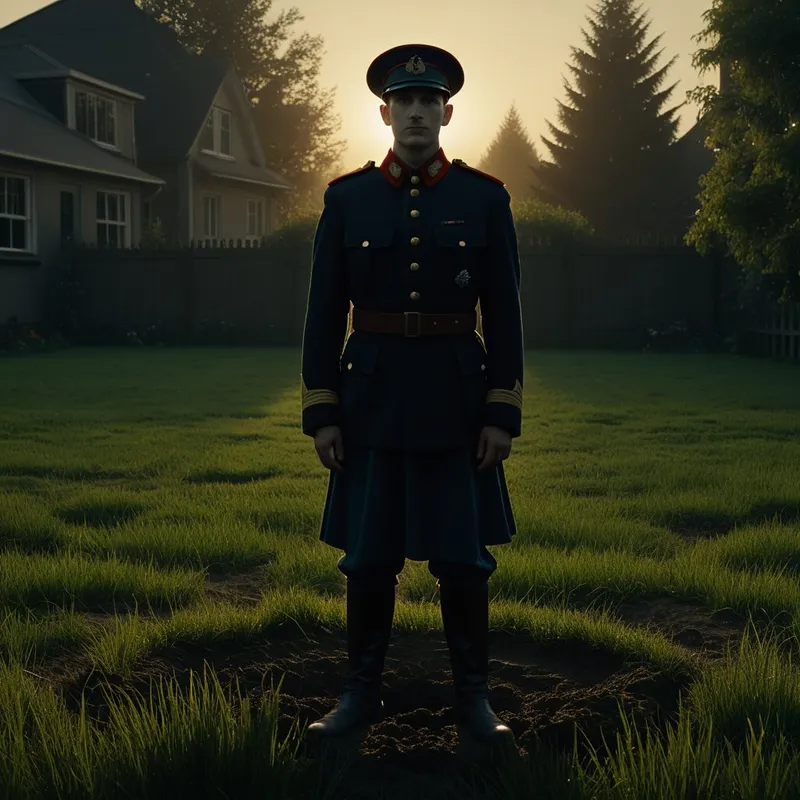
Alchemical Translation
The alchemical process modeled here is the transmutation of massive, collective trauma into individual and cultural meaning—a core facet of individuation.
The initial state is nigredo: the blackening, the mud, the utter ruin of the field after battle. This is the shock, the grief, the unbearable loss. The albedo, the whitening, is symbolized by the fragile larks singing in the sky—the first glimpses of beauty and hope amidst despair. But the crucial phase is rubedo, the reddening. This is not a return to bloodshed, but the flourishing of the poppy.
The alchemical gold is the integrated self who can hold the torch of memory without being consumed by its fire, who can honor the dead by living a conscious life.
The myth provides the formula: you must first fully acknowledge the dead and their unfinished state (We are the Dead). You must then consciously accept the transferred responsibility (Take up our quarrel… be yours to hold it high). Finally, you must understand that your fidelity to this task is what allows both the dead and your own psyche to find peace. To “break faith” is to succumb to collective amnesia, to live in a shallow present disconnected from the depths of history and soul. To “hold the torch high” is to live with ethical remembrance, allowing the lessons and sacrifices of the past to consciously inform your actions in the present. In doing so, you transmute the leaden weight of historical trauma into the gold of purposeful, connected being. You heal the field by tending its poppies.
Associated Symbols
Explore related symbols from the CaleaDream lexicon: