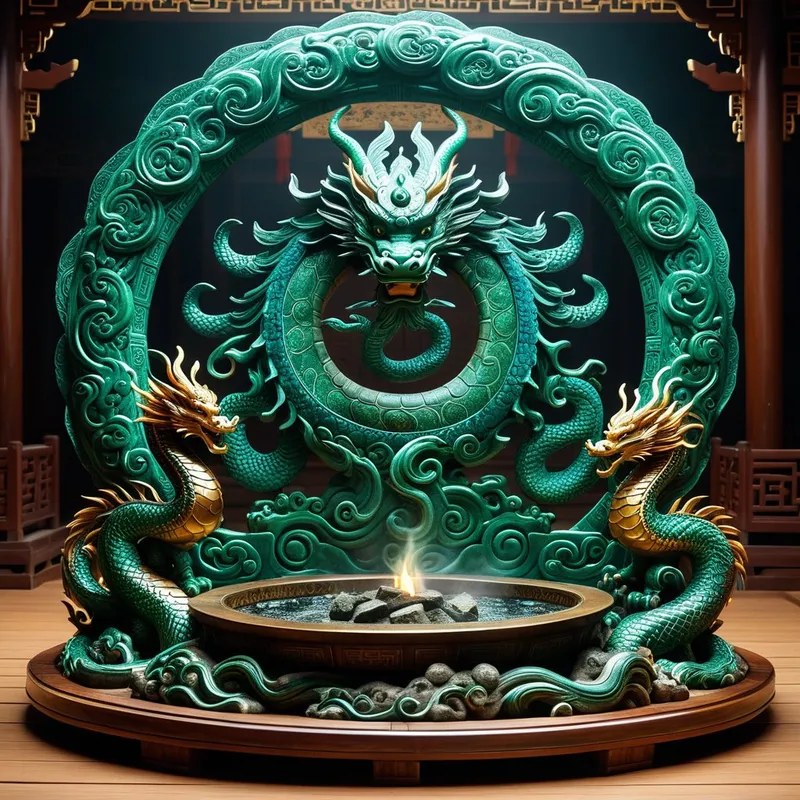
Five Elements Myth Meaning & Symbolism
A cosmic narrative of five primordial forces—Wood, Fire, Earth, Metal, Water—in an eternal, sacred dance of generation, conflict, and ultimate harmony.
The Tale of Five Elements
Before the Middle Kingdom had a name, before the first sage-king drew breath, the world was a broth of undifferentiated qi. From this primordial chaos, five sovereign wills awoke. They were not gods of mountain or river, but the very principles of becoming itself.
First, from the deep, silent potential, arose the Wood Sovereign. His form was that of a great, benevolent dragon, but woven of living bamboo forest and the tender push of new shoots breaking stone. His breath was the east wind, carrying the scent of rain on young leaves. His domain was the upward surge, the unfurling of all that seeks the light.
From the heart of this vibrant growth, passion was kindled. The Fire Sovereign manifested in a crackling corona of light, a phoenix of dancing, consuming flame. His laughter was the roar of the forge; his gaze, the noonday sun that bleaches bone and blesses the harvest. He was the south, the zenith, the brilliant transformation that leaves ash in its wake.
And from this ash, the patient one gathered herself. The Earth Sovereign took shape as a giant of fertile loam and steadfast mountain, her face serene as a yellow river plain. She stood at the center of all things, the pivot, the mother who receives all offerings and gives all sustenance. In her, the heat of fire cooled into possibility.
From her deep veins, the Metal Sovereign was drawn. He emerged like a blade being pulled from a sheath of ore—a stern warrior of white bronze and autumn frost. His voice was the ring of a struck bell, clear and cutting. His direction was the west, the time of harvest and judgment, of cutting away the old to refine the essential.
And from this hardness, the final sovereign wept. The Water Sovereign flowed into being, a serpentine form of midnight blue and abyssal black, her body the north winter and the hidden well. Her song was the endless plunge of the waterfall and the silent seep into roots. She was the descent, the return to source, the dissolution that precedes all new beginnings.
At first, each beheld the others with wonder. Wood fed Fire with a branch. Fire warmed Earth with its ashes. Earth bore Metal in its womb. Metal condensed Water on its cold surface. Water nourished Wood at its roots. A great, gracious cycle of generation turned, and the world blossomed.
But sovereignty knows pride. Fire, in his glorious ascent, saw not a partner in Water, but a threat. "You quench my spirit!" he roared, and turned his heat not to warm Earth, but to vaporize Water's streams. Water, in cold fury, retreated and then flooded, seeking to drown Fire's heart. Metal, admiring his own edge, turned it not to carve vessels but to hack at the limbs of Wood. Wood, in desperate growth, thrust its roots to break apart the firmness of Earth. Earth, feeling violated, grew barren and withheld her nurture from all.
The cosmos shuddered. Seasons froze in conflict. Growth warred with decay, heat with cold, structure with flow. The harmonious qi threatened to tear back into the chaos from which it came. The suffering of the nascent world echoed in the sovereigns themselves, for they were not separate from their creation. In the silence that followed their raging, a memory surfaced—the memory of their shared origin in the undifferentiated One. The Earth Sovereign, from her central place, let out a sigh that was both a lament and an invitation. She did not fight, but simply was, absorbing the blows, transmuting conflict into potential.
Seeing her steadfastness, a shame settled upon the others. Fire looked at the parched Earth and remembered his duty to warm, not just to burn. He offered a gentle, sustaining heat. Water, seeing this, did not flood it, but rose as a soft mist to temper the flame. Metal, seeing Wood weakened not by his blade but by drought, allowed dew to collect upon his surface and drip to the roots. Wood, nourished, did not attack, but provided shelter and fuel for the renewal of all.
They did not become one. Their natures remained, gloriously distinct. But they remembered the second, deeper law: the cycle of restraint, of respectful distance that allows the other to be. Fire melts Metal. Metal chops Wood. Wood parts Earth. Earth dams Water. Water quenches Fire. This was not a war, but a sacred check, a dance of boundaries. Generation and restraint, the creative and the controlling, wove together. The great cycle turned again, not as a simple circle, but as a dynamic, five-pointed star of eternal relationship. And within that stable motion, the ten thousand things—the entire manifest world—could safely come into being, live, change, and pass away.
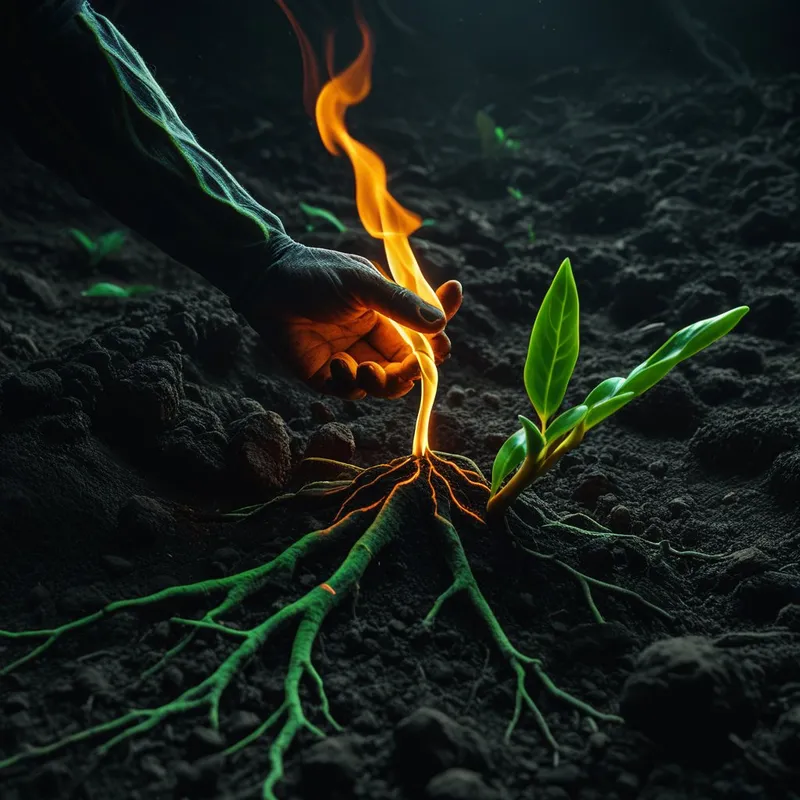
Cultural Origins & Context
This narrative of the Wuxing is not a single myth from a lost epic, but the foundational syntax of Chinese cosmological thought, crystallizing during the Zhanguo era. It was less "told" by bards and more "applied" by sage-kings, philosophers, doctors, and strategists. Its primary texts are not storybooks, but treatises like the Shangshu and the philosophical compendiums of the Yin-Yang scholars.
Its societal function was profoundly integrative. It was a master code used to diagnose illness in traditional Chinese medicine (where organs correspond to elements), to plan military campaigns and political rule, to design palaces and tombs in Feng Shui, and to understand history through dynastic cycles. Each ruling house was associated with an element, destined to be overcome by the next in the cycle of conquest. The myth provided a framework for seeing everything—from the seasons and stars to the emotions of the human heart—as part of a single, intelligible, living system of transformation.
Symbolic Architecture
The Five Elements are not literal substances, but five modes of energy, five verbs of existence. They map the fundamental processes of reality.
Wood is the archetype of birth and expansion. Psychologically, it is initiative, vision, and the anger that says, "I must grow." It is the liver's planning energy.
Fire is the archetype of peak and connection. It is joy, recognition, passion, and the consuming love that transforms identity. It is the heart's radiant spirit.
Earth is the archetype of transformation and nurturance. It is sympathy, stability, and the worry that comes from caring. It is the spleen's digestive capacity—turning experience into substance.
Metal is the archetype of decline and refinement. It is grief, value, integrity, and the necessary letting go. It is the lung's breath, taking in the essential, releasing the waste.
Water is the archetype of rest and potential. It is will, fear, wisdom, and the stored power of the unseen. It is the kidney's ancestral essence, the source of all life.
The two cycles—the generating (Xiang Sheng) and the controlling (Xiang Ke)—represent the fundamental psychic law: any force, unchecked, becomes its own destroyer. Creativity without discipline becomes chaos (Wood overwhelming Earth). Passion without boundaries consumes itself (Fire unchecked by Water). The myth teaches that harmony is not static peace, but the dynamic, tense, and respectful balance between these opposing, interdependent movements.
The Dreamer's Resonance
When the pattern of the Five Elements arises in modern dreams, it signals the psyche attempting to self-regulate a process of profound change. One does not dream of "Wood" per se, but of its qualities: dreams of being trapped in a dense, overgrown forest (Wood excess) may point to a life where one's plans and ambitions have become entangled and self-defeating. Dreams of a comforting, warm hearth (balanced Fire) could indicate a need for communion and celebration, while dreams of a raging, out-of-control house fire (Fire excess) often mirror consuming anxiety or unchecked anger burning through one's resources.
A dream of barren, cracked earth (Earth deficiency) might reflect a feeling of being unsupported or unable to "digest" a life experience. Finding a precious, sharp metal object (Metal) could symbolize a nascent capacity for discernment or a need to "cut away" something inauthentic. Dreams of deep, still, or flooding waters (Water) directly engage the realm of the unconscious, fear, and foundational energy reserves. The somatic experience is key: the dreamer may wake feeling parched (Water deficiency), rigid (Metal excess), or explosively restless (Wood excess), as the body echoes the elemental imbalance the dream portrays.
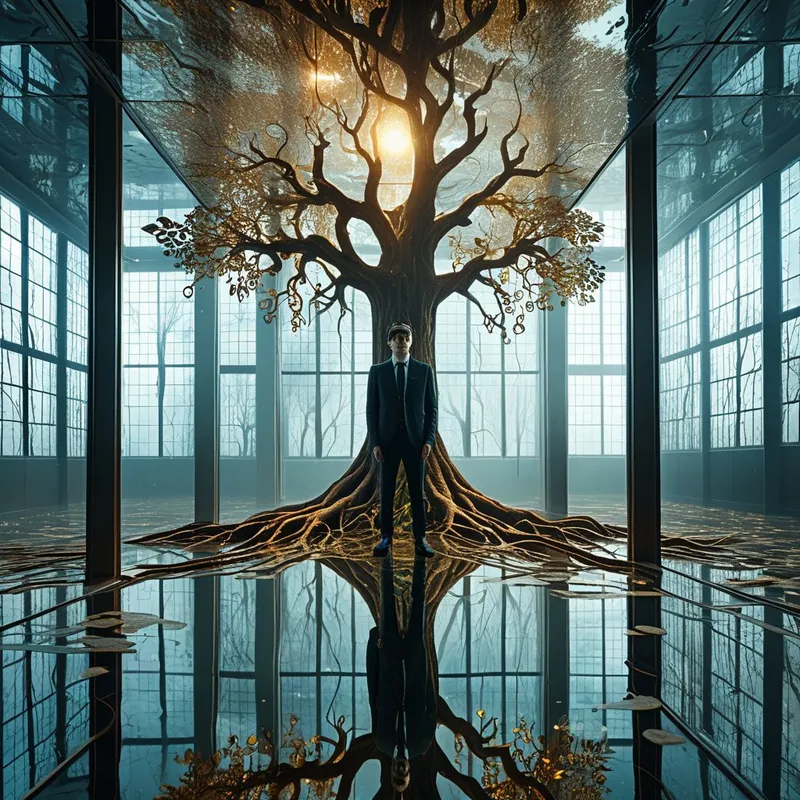
Alchemical Translation
For the modern individual, the myth models the alchemy of individuation—the process of becoming a balanced, whole self. We are not meant to be only creative (Wood) or only disciplined (Metal), only passionate (Fire) or only still (Water). The psyche's goal is to become the Earth Sovereign within—the stable, central self that can hold and transform all these inner energies.
The journey begins in Water: the unconscious, undifferentiated potential of who we might be. From this, a Wood impulse arises—a desire, a project, a new identity pushes toward the light. This requires the Fire of our passion and focus to give it energy and form. The endeavor then must be grounded in Earth—made practical, sustained, integrated into daily life. From this process, the Metal function assesses: What is of true value here? What must be let go? This refinement leads to a return to a deeper, wiser Water—a renewed sense of potential, informed by the cycle.
The "conflict" in the myth represents the inevitable neurosis when one element dominates the psyche: the workaholic (excess Fire/Metal) who burns out, the eternal dreamer (excess Water/Wood) who cannot manifest. Healing comes not by eliminating the "problem" element, but by invoking its "mother" in the generative cycle. Can't ground your ideas (Earth weak)? Nourish the visionary spark (Wood). Overwhelmed by emotion (Water flood)? Strengthen the capacity for structure and discernment (Metal).
The ultimate triumph is realizing we contain this entire cosmos. To be individuated is to become a skilled governor of this inner kingdom, allowing each sovereign its season and its sovereignty, ensuring that generation and restraint dance in perpetual, creative balance. We become, ourselves, a living manifestation of the Taiji—the One that expresses itself harmoniously as the Many.
Associated Symbols
Explore related symbols from the CaleaDream lexicon: