Firecrackers in Nian legend Myth Meaning & Symbolism
An ancient village, terrorized by a beast, discovers that light, sound, and community courage can banish primal fear and renew the world.
The Tale of Firecrackers in Nian legend
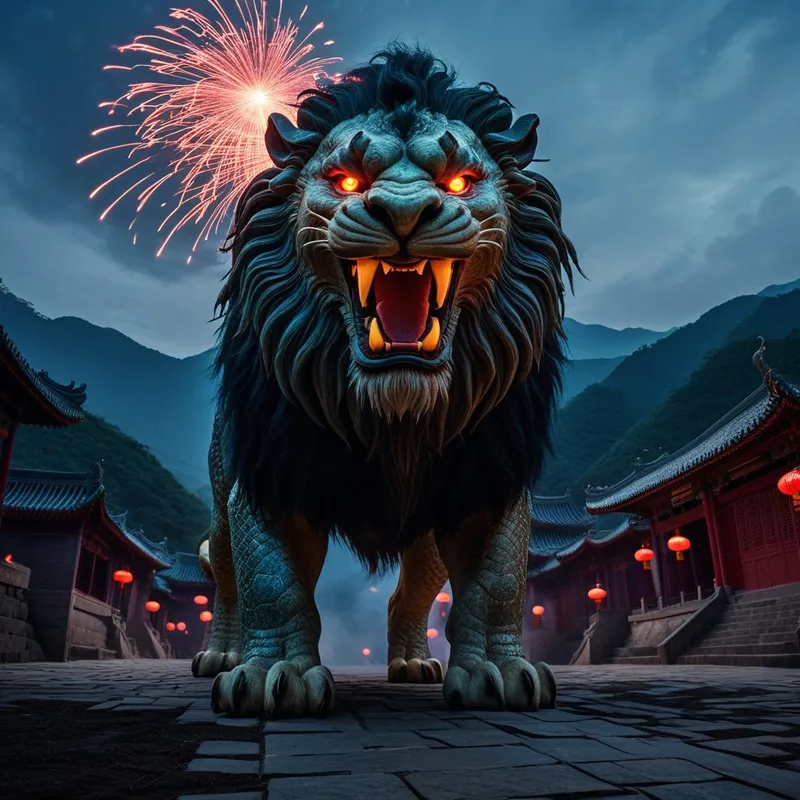
Listen, and let the old smoke of memory carry you back. In the deep folds of time, when the years turned not by calendar but by the shudder of [the earth](/myths/the-earth “Myth from Hindu culture.”/), there lived a terror. It was called Nian. It was not a creature of flesh as we know it, but a condensation of the long night, of winter’s final, biting breath. Its form was a nightmare of scales and horn, part lion, part dragon, with eyes like cold coals and a hunger that gnawed on more than grain or livestock. It fed on fear itself, on the quiet despair of a people held captive by the turning of the season.
Each year, as the last leaf fell and [the world](/myths/the-world “Myth from Tarot culture.”/) grew still and brittle, the Nian would descend from its mountain lair. It came with the deep dark, a shadow that swallowed the feeble light of hearth fires. Villages would empty, their people fleeing to the high hills, their homes left silent and cold. They could hear its approach—a rumbling in the ground like distant thunder, the crack of ancient trees pushed aside. It would pillage their stores, shatter their doors, and leave behind not just ruin, but a chilling silence, a psychic scar that lingered long after the beast had gone.
One year, as the time of its coming drew near, a different kind of whisper traveled on [the wind](/myths/the-wind “Myth from Various culture.”/). It spoke not of flight, but of a forgotten observation. An old woman, her eyes sharp with memory rather than dimmed by age, recalled that the beast had once flinched at the sudden, accidental flare of a cooking fire. A shepherd boy swore he saw it startle at the sharp crack of a bamboo stalk splitting in the winter cold. These were fragments, fragile as dried leaves, but in one village, a spark caught.
An elder, whose bones ached with the memory of countless retreats, stood before his people. “We run, and it feasts on our absence,” he said, his voice like stone grinding on stone. “What if we stay? What if we greet this shadow not with empty homes, but with everything it fears?” The plan was born of desperation and a sliver of hope. They would not hide. They would turn their village into a weapon of perception.
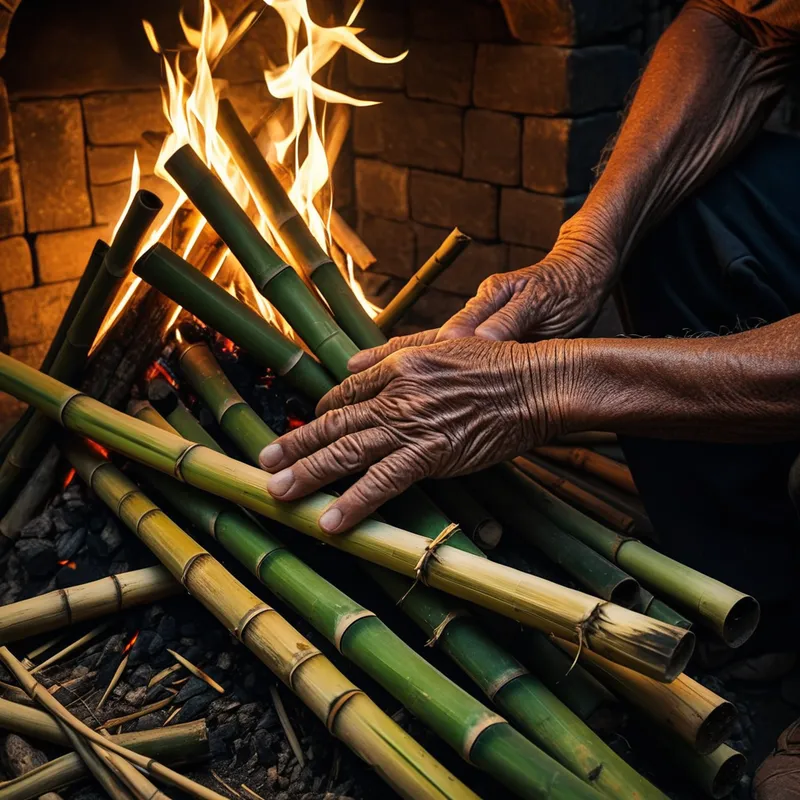
On the fateful night, when the air grew still and the stars seemed to retreat, the people did not flee. They stood inside their homes, hearts drumming against their ribs. They had pasted strips of red paper on every door and window, for red was the color of blood, of life, of the sun that the Nian abhorred. And in their hearths, they placed not just logs, but bundles of dry bamboo.
The Nian came. It slunk into the village square, a moving piece of [the void](/myths/the-void “Myth from Buddhist culture.”/), its breath frosting the air. It found no silence, no empty surrender. Instead, it was met with a blinding, shocking assault on its senses. From every house, flames were stoked to roaring heights, casting wild, dancing shadows that mimicked a legion of defenders. Then came the sound. [The bamboo](/myths/the-bamboo “Myth from Taoist culture.”/), heated in the fierce fires, began to explode. Pop! Bang! Crack! A cacophonous, terrifying symphony of sharp reports echoed through the valley, a sound like [the sky](/myths/the-sky “Myth from Persian culture.”/) itself shattering.
The beast, this ancient consumer of quiet fear, recoiled. The violent light seared its night-accustomed eyes. The deafening, unpredictable noise was a physical blow to its being. Confused, terrified of this bold, fiery defiance, the great Nian turned and fled, its roar now a whimper lost in the continuing celebration of cracks and flashes. The villagers emerged, not to ruin, but to a world reborn in the glow of their own courage. They had not slain the beast with sword or spear, but with the alchemy of light and sound, banishing [the shadow](/myths/the-shadow “Myth from Jungian culture.”/) of the year’s end. And so, to ensure it never forgot its defeat, they vowed to reenact this [triumph](/myths/triumph “Myth from Roman culture.”/) every year, with fire and noise and the vibrant, defiant color of red.
Cultural Origins & Context
The myth of the Nian is the foundational story of the Spring Festival. Unlike myths enshrined in canonical texts, this is a folk narrative, passed down orally through generations around hearths and family tables. Its tellers were grandmothers and village elders, its stage the collective anxiety that accompanied the deepest part of winter—a time when stores dwindled, the cold was deadly, and the natural world seemed dead. The myth served a profound societal function: it provided an etiology, a story of origin, for the festival’s most iconic rituals. The explosive firecrackers (evolved from bamboo to gunpowder), the ubiquitous red decorations (chunlian and hongbao), and the practice of staying up late on New Year’s Eve (“shousui”) are all directly dramatized in the tale. It transformed seasonal fear into communal ritual, giving people an active, prescribed role in combating the metaphorical “beast” of misfortune and welcoming renewal.
Symbolic Architecture
The myth’s power lies in its elegant symbolic [architecture](/symbols/architecture “Symbol: Architecture in dreams often signifies structure, stability, and the framing of personal identity or life’s journey.”/). The Nian is not merely a [monster](/symbols/monster “Symbol: Monsters in dreams often symbolize fears, anxieties, or challenges that feel overwhelming.”/); it is the psychological embodiment of the unresolved past, collective fear, and the stagnant [energy](/symbols/energy “Symbol: Energy symbolizes vitality, motivation, and the drive that fuels actions and ambitions.”/) of a closing cycle. It is the [shadow](/symbols/shadow “Symbol: The ‘shadow’ embodies the unconscious, repressed aspects of the self and often represents fears or hidden emotions.”/) that arrives predictably, feeding on passive [dread](/symbols/dread “Symbol: A profound, anticipatory fear of impending doom or catastrophe, often without a clear external threat. It manifests as a heavy, paralyzing emotional state.”/). The villagers’ initial [response](/symbols/response “Symbol: Response in dreams symbolizes how one reacts to situations, often reflecting the subconscious mind’s processing of events.”/)—[flight](/symbols/flight “Symbol: Flight symbolizes freedom, escape, and the pursuit of one’s aspirations, reflecting a desire to transcend limitations.”/) and [abandonment](/symbols/abandonment “Symbol: A dream symbol representing feelings of being left behind, isolated, or emotionally deserted, often tied to primal fears of separation and loss of support.”/)—represents [the ego](/myths/the-ego “Myth from Jungian culture.”/)’s [default](/symbols/default “Symbol: The baseline state, unaltered condition, or standard setting from which all variations and changes originate.”/) position: avoidance, [dissociation](/symbols/dissociation “Symbol: A psychological separation from one’s thoughts, feelings, or identity, often experienced as a journey away from the self during trauma or stress.”/), and the hope that the [problem](/symbols/problem “Symbol: Dreams featuring a ‘problem’ often symbolize internal conflicts or challenging situations that require resolution and self-reflection.”/) will simply pass by if we make ourselves small and absent.
The true confrontation begins not when we face the beast, but when we choose to stop offering it our fear as sustenance.
The tools of their victory are brilliantly symbolic. Red is the color of [blood](/symbols/blood “Symbol: Blood often symbolizes life force, vitality, and deep emotional connections, but it can also evoke themes of sacrifice, trauma, and mortality.”/), vitality, the [life](/symbols/life “Symbol: The symbol of ‘Life’ represents a journey of growth, interconnectedness, and existential meaning, encompassing both the joys and challenges that define human experience.”/) force (qi), and the yang principle—the very antithesis of the Nian’s wintry, yin [nature](/symbols/nature “Symbol: Nature symbolizes growth, connectivity, and the primal forces of existence.”/). Fire is pure transformative energy, [consciousness](/symbols/consciousness “Symbol: Consciousness represents the state of awareness and perception, encompassing thoughts, feelings, and experiences.”/), and spiritual [illumination](/symbols/illumination “Symbol: A sudden clarity or revelation, often representing spiritual awakening, intellectual breakthrough, or the dispelling of ignorance.”/). The cracking [bamboo](/symbols/bamboo “Symbol: A symbol of resilience, flexibility, and spiritual growth, often representing strength through adaptability and connection to nature.”/) represents the shocking, disruptive force necessary to break a paralyzing [pattern](/symbols/pattern “Symbol: A ‘Pattern’ in dreams often signifies the underlying structure of experiences and thoughts, representing both order and the repetitiveness of life’s situations.”/). Together, they form a triune [weapon](/symbols/weapon “Symbol: A weapon in dreams often symbolizes power, aggression, and the need for protection or defense.”/) of psychic [defense](/symbols/defense “Symbol: A protective mechanism or barrier against perceived threats, representing boundaries, security, and resistance to external or internal challenges.”/): the vitality of red asserts the will to live, the light of fire brings conscious [awareness](/symbols/awareness “Symbol: Conscious perception of self, surroundings, or internal states. Often signifies awakening, insight, or heightened sensitivity.”/) to the darkness, and the sound provides the disruptive, [boundary](/symbols/boundary “Symbol: A conceptual or physical limit defining separation, protection, or identity between entities, spaces, or states of being.”/)-setting force that says “no more.” The [hero](/symbols/hero “Symbol: A hero embodies strength, courage, and the ability to overcome significant challenges.”/) is not a single [warrior](/symbols/warrior “Symbol: A spiritual archetype representing inner strength, discipline, and the struggle for higher purpose or self-mastery.”/), but the [village](/symbols/village “Symbol: Symbolizes community, connection, and a reflection of one’s roots or origins.”/) itself—the [archetype](/symbols/archetype “Symbol: A universal, primordial pattern or prototype in the collective unconscious that shapes human experience, behavior, and creative expression.”/) of the integrated [psyche](/myths/psyche “Myth from Greek culture.”/), where all parts work in concert to defend the sanctity of the whole.

The Dreamer’s Resonance
When this myth pattern stirs in the modern dreamer, it signals a confrontation with a recurrent, fear-based complex. Dreaming of a looming, shadowy beast that returns periodically points to an unconscious recognition of a cyclic psychological threat—perhaps annual anxiety, a recurring depressive episode, or a pattern of self-sabotage that emerges under stress. The setting is often a version of “home” (the psyche) feeling vulnerable and under siege.
If the dreamer finds themselves hiding or fleeing, it reflects a somatic state of freeze or fawn—the psyche’s instinct to avoid the confrontation. However, if the dream shifts, and the dreamer begins to actively prepare, perhaps by turning on all the lights, making loud noise, or discovering a cache of red objects, it marks a critical turning point. This is the ego, however tentatively, marshaling internal resources (vitality, awareness, assertiveness) to face the complex. The explosive climax in the dream is not violence, but a cathartic release of pent-up psychic energy, a somatic shaking-off of the paralysis. The dreamer awakens not with fear, but with a sense of relief and reclaimed space.
Alchemical Translation
The journey from terrorized flight to triumphant celebration is a perfect map for the alchemical process of individuation—the forging of a conscious, resilient Self. The initial state is [nigredo](/myths/nigredo “Myth from Alchemical culture.”/), the blackening: the village in winter, dominated by the Nian’s shadow, representing a psyche ruled by an autonomous complex.
The decision to stay and fight is the first stirring of the ego’s conviction, the beginning of albedo, the whitening. This is the conscious gathering of one’s tools: the red of passionate engagement with life, the fire of introspection and conscious attention, and the “crack” of setting firm boundaries or speaking a difficult truth. The ritualized confrontation is the [rubedo](/myths/rubedo “Myth from Alchemical culture.”/), the reddening—not a battle to the death, but a transmutation. The psychic energy once locked in the complex (the Nian’s power) is not destroyed but reclaimed through the act of conscious facing.
The ultimate goal is not to kill one’s demons, but to integrate their energy by refusing to be their host.
The annual reenactment is key. It translates to the psychological practice of conscious ritual. We do not overcome our deepest patterns once and for all. The “Nian” of old wounds, fears, and habits will always threaten to return at the turn of our personal cycles. The alchemical work is to consciously, ritually, reassert our tools: to don our “red” (engage our vitality), light our “fire” (practice mindfulness), and create our “sound” (express ourselves boldly). In doing so, we do not live a life free of shadows, but we become the active author of our own renewal, turning what was a time of dread into a festival of the resilient, illuminated Self.
Associated Symbols
Explore related symbols from the CaleaDream lexicon: