Fimbulwinter's End Myth Meaning & Symbolism
The cataclysmic three-year winter ends with the final battle of Ragnarök, the death of gods, and the world's rebirth from the sea.
The Tale of Fimbulwinter's End
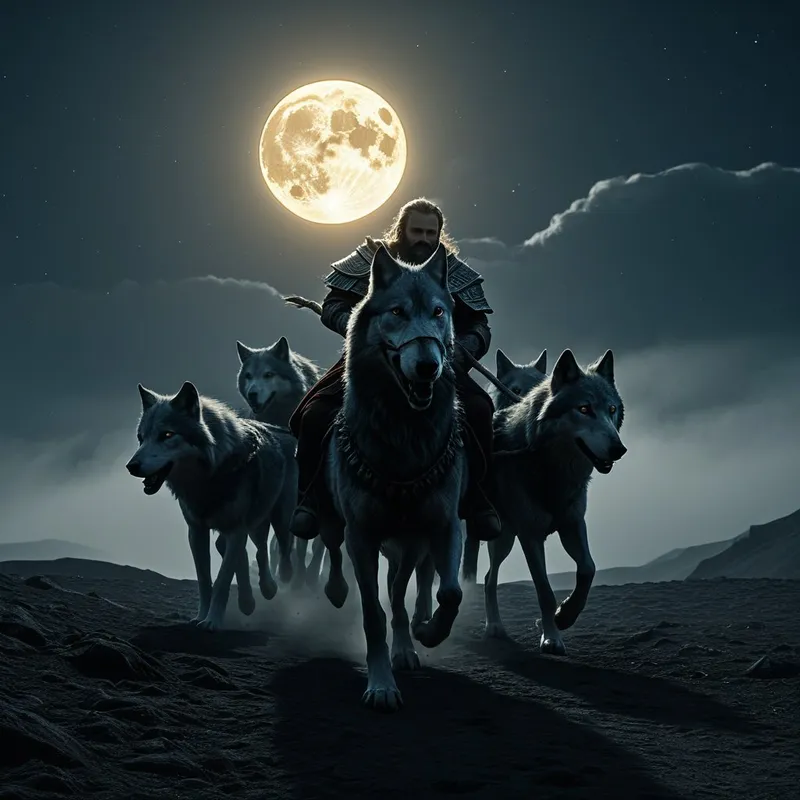
Listen. The wind does not whisper here; it screams. For three long years, it has screamed, carrying knives of ice and the ashes of dead summers. This is the Fimbulwinter, and it has no mercy. Brother turns on brother for a crust of frozen bread. The sun is a weak, pale ghost, and the moon bleeds a cold light that shows only desolation. The wolves, Sköll and Hati, run ever faster, their jaws snapping at the heels of the sky-chariots. The world holds its breath, brittle and waiting.
Then, the silence. A silence deeper than the snow. It is the silence before the breaking.
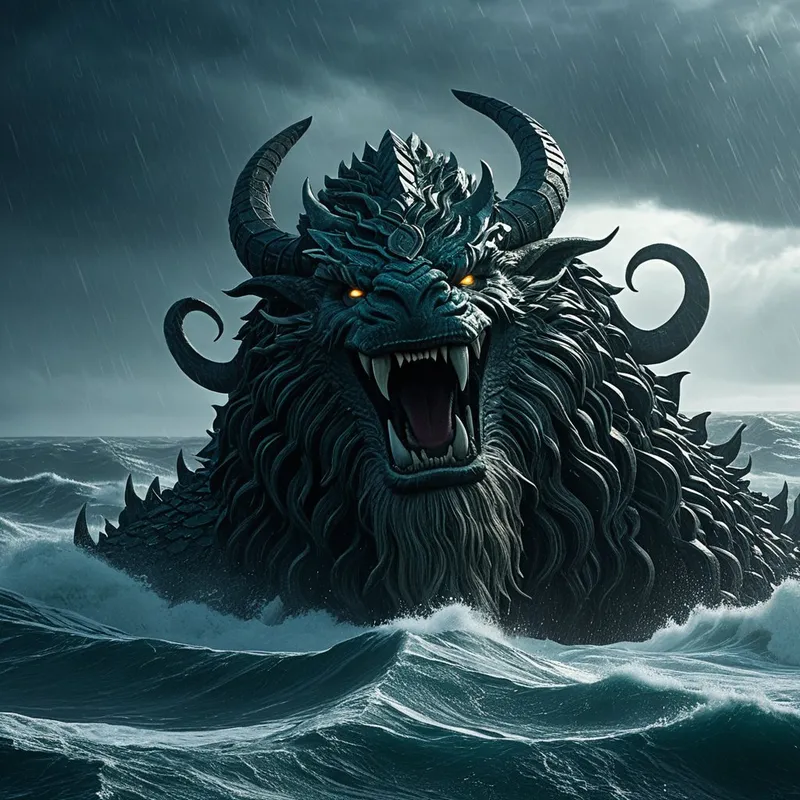
From the east, the ship Naglfar breaks free of its moorings, its hull a tapestry of nightmares, steered by the giant Hrym. From the south, wading through boiling seas, comes the fire-giant Surtr, his sword brighter than any sun that ever was. From all the roots of the Yggdrasil, the chains snap. The bound ones are loose. The great wolf Fenrir opens his maw, a cavern that could swallow the sky. The serpent Jörmungandr heaves its coils from the ocean depths, venom spraying like acid rain.
They march to the plain of Vígríðr. And the gods, knowing their fate, put on their helms and take up their weapons. This is Ragnarök. The doom of the powers.
The All-Father, Odin, rides to meet Fenrir. His spear Gungnir is a line of darkness against the hellish light. He is swallowed whole. Thor, his rage a thunderstorm given flesh, strides forth to meet the World-Serpent. He strikes the killing blow with Mjölnir, crushing the monster’s skull, and then staggers back nine paces, drowned in the serpent’s venom, and falls. One by one, the bright ones fall. Týr and the hound Garmr kill each other. Heimdallr and the trickster Loki, old enemies, trade final blows and perish together. Surtr swings his flaming sword, and the world itself catches fire. The stars go out. The great tree groans, and the seas rise to claim the ashes.
Then, in the silence after the fire… a sigh. A whisper of water. The seas, gentle now, recede. And there, green and pristine, the land rises again from the waves. A new earth, unsown, fertile. The sun, born anew, is followed by a daughter more beautiful than her mother. And in a high hall, the sons of the dead gods—Vidarr and Móði and Magni—find one another. Two human survivors, Líf and Lífþrasir, emerge from the wood of Hoddmímis holt. Their breath steams in the cool, clean air. They have no past, only a future. The wheel has turned. Fimbulwinter has ended.
Cultural Origins & Context
This cataclysmic narrative is not a singular story but the culmination of a vast mythological cycle, preserved primarily in two 13th-century Icelandic texts: the Poetic Edda and the Prose Edda of Snorri Sturluson. It is crucial to understand that these were Christian-era recordings of a pre-Christian oral tradition. The myths were not scripture, but a living cosmology recited by skalds (poets) and informed by a world-view shaped by a harsh, cyclical environment.
The tale of Fimbulwinter and Ragnarök served multiple societal functions. It was a cosmic explanation for natural disasters, volcanic eruptions, and the long, dark winters of the North. It reinforced cultural values of courage, fatalism, and loyalty in the face of inevitable doom (ørlög). Most importantly, it was a narrative of existential orientation. In a universe where even the gods could die, the emphasis was not on avoiding fate, but on meeting it with dignity and purpose, thereby earning a place in the stories told afterward. The myth provided a template for resilience, teaching that from total annihilation, new life—different, perhaps, but still precious—is an inherent possibility of the cosmic order.
Symbolic Architecture
The myth operates on a grand scale, mapping the necessary death of an old order for a new consciousness to be born. Fimbulwinter is not merely a season; it is the long, frozen night of the soul, the period of maximum contraction and despair when all previous structures of meaning and warmth have failed.
The old world must burn so completely that not even its memory can chain the new one.
The gods represent established psychic structures—Odin as the ruling consciousness, Thor as the protective force of the ego, Heimdallr as the vigilant guardian of boundaries. Their antagonists—Fenrir, Jörmungandr, Loki—are the repressed contents of the shadow, the chaotic, monstrous, and creative energies that the conscious order had bound or exiled. Ragnarök is the inevitable confrontation when these bound forces grow too powerful to be contained. The death of the gods symbolizes the utterly necessary, yet terrifying, dissolution of a person’s identifying psychological framework. The survival of Vidarr, Móði, and the human pair signifies that essential elements of strength, justice, and pure potentiality endure this psychic apocalypse, ready to be integrated into a new, more conscious whole.
The Dreamer's Resonance
When this myth stirs in the modern unconscious, it often manifests not as a literal dream of wolves and giants, but through its core emotional and somatic patterns. One may dream of being trapped in an endless, freezing landscape, or of their childhood home collapsing or burning down. There may be dreams of titanic, unavoidable battles with shadowy figures or monstrous versions of the self.
These dreams signal a profound psychological process: the Fimbulwinter of the psyche. It is a state of deep depression, alienation, or existential crisis where old coping mechanisms, relationships, career identities, or core beliefs have "frozen over" and ceased to sustain life. The somatic feeling is one of cold dread, paralysis, and isolation. The dream imagery of the final battle represents the internal conflict reaching a fever pitch—the ego’s last stand against the rising tide of repressed material demanding recognition. This is not a pathology, but a critical phase of death-and-rebirth. The dreamer is undergoing the terrifying, yet sacred, process of the old self-structure breaking apart to make way for something new.
Alchemical Translation
In the alchemical journey of individuation, Fimbulwinter’s End models the stage of mortificatio and putrefactio—the blackening, dissolution, and decay that necessarily precedes the whitening and rebirth (albedo and citrinitas). The modern individual does not battle literal giants, but the monolithic, frozen complexes within: a rigid self-image, a paralyzing trauma, a outworn life-narrative.
The seed of the new self can only germinate in the fertile darkness of the old self’s ruin.
The alchemical work is to consciously endure the Fimbulwinter without fleeing into false warmth or premature solutions. It is to say “yes” to the dissolution, to allow the battle of Ragnarök to be fought within, knowing that one’s inner “gods” (cherished ideals, old identities) may perish. The triumph is not in winning the battle, but in surviving it. Like Vidarr, who avenges Odin by tearing Fenrir’s jaw apart, we integrate the shadow not by destroying it, but by facing it with a silent, steadfast strength born of the depths. Like Líf and Lífþrasir, we emerge from the protective “wood” of the unconscious not as who we were, but as potential itself, standing on a green, new earth of our own becoming. The myth teaches that the most profound renewal is always preceded by an end that feels absolute. Our task is to hold fast through the long winter, tend the hidden seed, and trust the turning of the wheel we cannot see.
Associated Symbols
Explore related symbols from the CaleaDream lexicon: