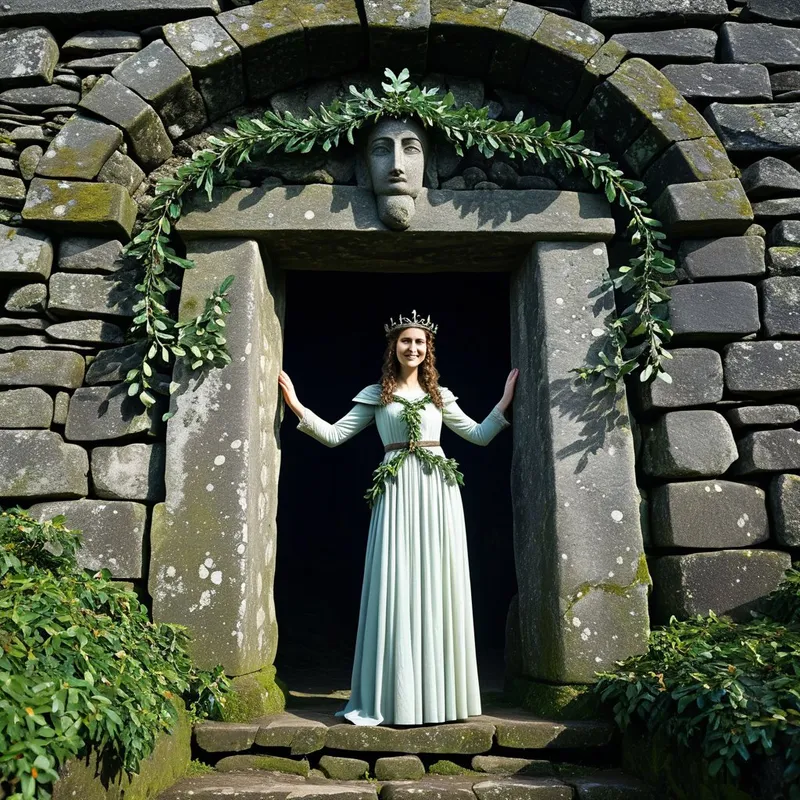
Féile Myth Meaning & Symbolism
A tale of a spirit who binds guests and hosts in sacred reciprocity, revealing the soul's contract between the inner self and the outer world.
The Tale of Féile
Listen. The wind does not just blow across the moor; it carries whispers from the hollow hills. In the time when the world was younger and the veil between what is seen and unseen was as thin as morning mist, there walked a spirit of the threshold. Her name was Féile.
She was not a goddess of the great battles, nor of the deep, singing wells. Her dominion was the space between the hearth-fire and the wild night, the moment a stranger’s shadow fell across your doorstone. Her form was like the shimmer of heat above a flame, sometimes seeming a woman of noble bearing, clad in robes the grey of hospitable smoke and the green of sheltering ivy, other times merely a presence, a weight in the air, a watchful silence.
The tale is told of a chieftain, Cormac, in his high-walled dún. A storm, born from the wrath of the Aos Sí, raged, tearing at the thatch and howling like a banshee. A knock came, not loud, but heard through all the noise. On the threshold stood a figure, travel-worn, his cloak sodden, his face hidden. The warriors reached for spears, but Cormac stayed them. Remembering the old laws, he spoke: “Enter, and be welcome to the warmth of this fire.”
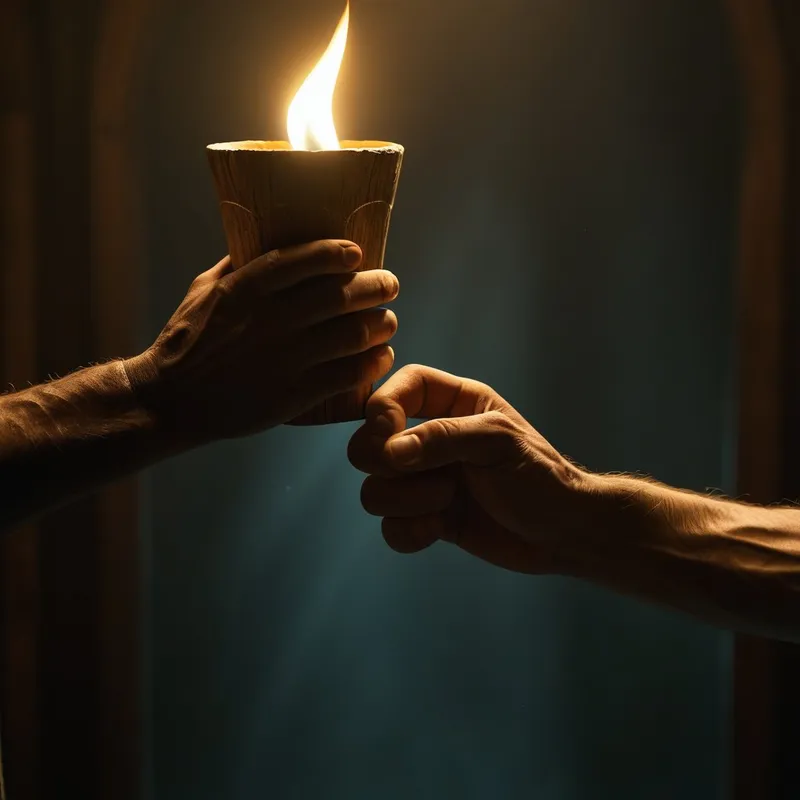
The stranger entered, and as he shed his dripping cloak, the hall grew still. The storm outside seemed to hold its breath. The stranger did not speak, but his eyes, in the firelight, held the depth of a still pool. Cormac served him the choicest meat, the oldest mead. Only when the cup was drained did the stranger rise. He looked at Cormac, and then at the chieftain’s young son, playing by the hearth. “For your fire, I give you a warning,” the stranger said, his voice like stone grinding deep earth. “The storm is a sentinel. The one it seeks hides in the form of a wounded fox that will come to your door at dawn. Do not give it shelter.”
With that, the stranger was gone, the door closing softly behind him. The storm ceased instantly. At dawn, as mist curled over the land, a pitiful whine came from the gates. There, shivering and bleeding from a gash on its flank, was a beautiful red fox with eyes of startling intelligence. Cormac, remembering the warning, hardened his heart. He ordered the gates to remain shut. The fox stared at him, and its gaze was not that of an animal, but filled with a cunning, ancient malice. It vanished into the mist.
That night, Féile herself appeared within the hall, not as a shimmer, but solid and clear. “Cormac,” she said, and her voice was the sound of a door closing safely at twilight, “you honored the bond. You welcomed the unknown, and in return, received the truth that protected your hearth. The fox was a púca, seeking to unravel your line from within. Your hospitality was a shield. Your discernment was its edge.” She touched the central hearthstone, and the fire flared with a pure, steady light. “The bond is not blind, but seeing. The welcome is not weak, but wise. This is the balance.” And with that, she faded, leaving behind the scent of oakwood and a profound, enduring peace within the walls of the dún.
Cultural Origins & Context
The concept of Féile was not merely a myth in the narrative sense, but a foundational social and spiritual law permeating the Celtic world. In a landscape of isolated settlements, vast forests, and unpredictable elements, the stranger at the door could be a mortal enemy, a divine messenger, or a king in disguise. The custom of hospitality was therefore a sacred duty, a core pillar of fírinne (truth/order).
This mythic pattern was transmitted not as a single story, but as a principle woven into countless tales, bardic teachings, and seanfhocail (old words). The druids and filí (poets) would invoke the spirit of Féile when instructing on the laws of community. Its societal function was dual: it ensured the survival of travelers and the vulnerable, creating a web of obligation that bound society together, and it served as a spiritual test. How one treated the stranger reflected the state of one’s own sovereignty and integrity. The hearth was a microcosm of the kingdom; to manage its threshold was to rule justly.
Symbolic Architecture
At its heart, the myth of Féile is an archetypal drama of boundaries and exchange. Féile herself symbolizes the psychic function of the threshold—the conscious faculty that decides what to let in and what to keep out.
The true self is forged not in isolation, but in the sacred, discerning exchange between the inner sanctum and the outer wilderness.
The wandering stranger represents the unknown, the Self in its disguised, often unsettling form. He brings the storm (chaos, the unconscious) with him. Cormac’s initial welcome is the ego’s necessary courage to engage with what is not yet understood, to offer the resources of consciousness (the hearth, the food). The critical turn is the gift of the warning—the reciprocal wisdom that emerges only after the act of hospitality is complete. This is the insight gained from engagement. The wounded fox is the shadow, the deceptive element that appeals to pity and unconscious sentiment. To let it in would be to confuse blind compassion with wise boundaries, allowing psychic poison entry under a guise of virtue. Féile’s final appearance validates the completed cycle: conscious engagement, followed by discernment, leading to integrated wholeness and protection.

The Dreamer's Resonance
When this myth stirs in the modern dreamer, it often manifests as potent threshold dreams. You may dream of your front door being both familiar and alien, of a mysterious guest waiting in your living room, or of urgently needing to prepare a meal for someone unseen. Somatic sensations are key: a tightening in the chest or gut at the moment of opening the door, or a profound feeling of relief and rightness after a successful exchange.
Psychologically, this signals a process of psychic digestion. The dream-ego is negotiating what new content, emotion, or relationship it is being asked to “host” within the psyche. The anxiety is the ego’s rightful caution. The feeling of obligation is the ancient law of Féile activating. Is the dream offering a disguised gift (the stranger’s warning), or presenting a deceptive shadow (the wounded fox)? The dream is an internal enactment of the soul’s eternal question: How do I remain open to growth without being invaded by that which would destroy my core integrity?

Alchemical Translation
The alchemical journey modeled by Féile is that of coagulatio followed by separatio—the forming of a bond, then the wise separation within it. For the modern individual pursuing individuation, the myth outlines a non-pathological way to manage the boundaries of the self.
Individuation is not building a higher wall, but becoming a more skilled and gracious gatekeeper.
The first operation is the Welcoming of the Stranger: We must consciously invite in the unfamiliar aspects of our own psyche—the grief, the ambition, the creativity, the rage we have exiled. We offer it the hospitality of our attention. The second operation is the Receipt of the Gift: In engaging with this content, without immediate judgment, it transforms. The grief may reveal its core of love; the rage, its bedrock of justice. This is the warning, the clarifying insight. The final operation is the Discerning Refusal: With this new insight, we learn to say no to the superficial, deceptive, or parasitic forms these energies can take. We refuse the “wounded fox” of self-pity that masquerades as processed grief, or the aggressive persona that pretends to be strength. This completes the sacred circuit. The spirit of Féile then arises not as an external entity, but as an integrated inner function—the wise, sovereign self that knows both the depth of its own hearth and the measure of the world at its door.
Associated Symbols
Explore related symbols from the CaleaDream lexicon: