Fensalir Myth Meaning & Symbolism
The myth of Fensalir, the hall of Frigg, is a story of sanctuary, profound grief, and the hidden power of the hearth to hold fate's secrets.
The Tale of Fensalir
Listen, and let the mists of the north part. Not for a tale of thunderous battle or serpent-slaying, but for a story woven in silence, in the deep places where water meets earth and memory pools. This is the tale of Fensalir.
In the high halls of Asgard, where the rafters ring with boasts and the mead flows like golden rivers, there is a knowing that turns the heart cold. It is the knowing of Frigg, All-Mother, she who sees the threads. Her gaze does not always rest upon the glittering thrones; it is drawn downward, to the edges, to the soft and sinking places. And so she built her hall not upon a mountain, but where the solid ground gives way. She built Fensalir in the fens.
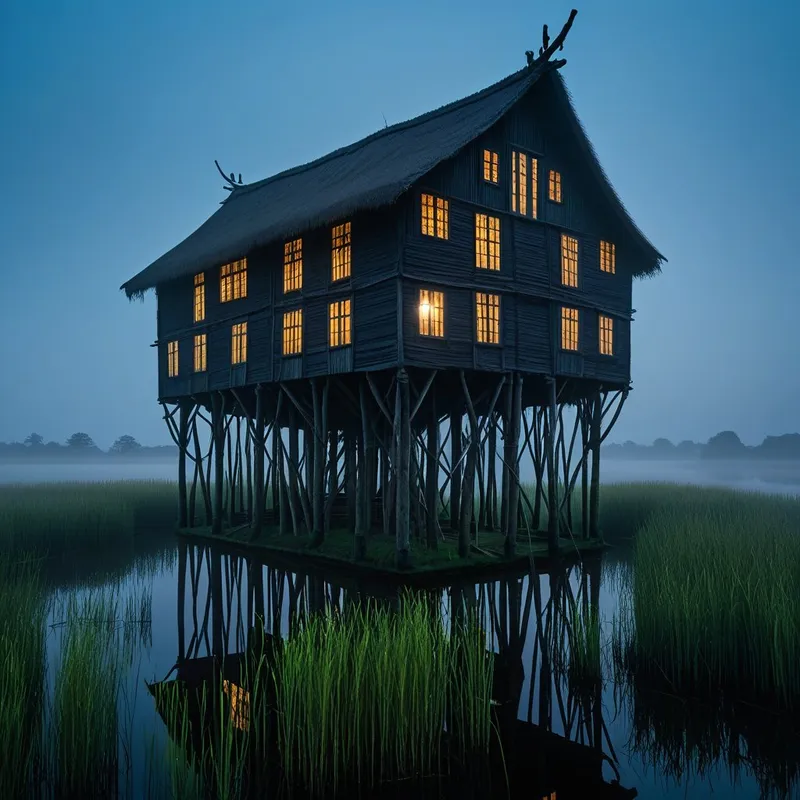
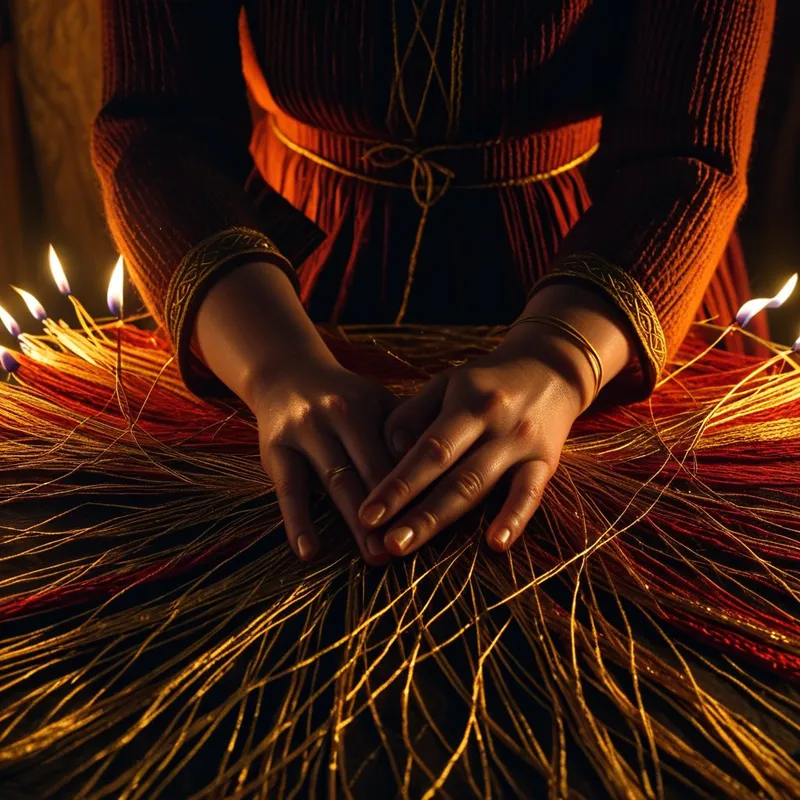
Feel the air there—damp, cool, heavy with the scent of peat and blooming water-lily. Hear the chorus of frogs and the whisper of reeds. See the hall itself, a wonder of ancient timber and living willow, its pillars rooted deep in the black water, its windows glowing with a light that is soft as remembered summer. This is not a fortress; it is a refuge. Here, the weary find rest. Here, the secrets of the heart are safe. It is said that here, Frigg and her handmaidens—Eir, the healer; Fulla, the confidante; Hlín, the protector—sit together. They do not always speak. Often, they weave.
And in the weaving, the knowing grows heavy. For Frigg has seen the pattern. She has traced the crimson thread that is her son, Baldr the Beautiful, the shining one. She has seen it snap. She has seen the light go out. A mother’s dread, colder than any fen-water, settled in her bones. So she journeyed forth from her watery hall, a queen on a desperate errand. To every being in the nine worlds—stone and metal, fire and flood, beast and sickness—she extracted an oath. Swear to me you will not harm my son. And all things, weeping at her grief, swore it. All but one. A young shoot of mistletoe, she deemed it too innocent, too weak to swear. What harm could reside in such tenderness?
The oath was kept. In the gilded fields of Asgard, the gods made sport, hurling weapons at the invulnerable Baldr, laughing as they fell away harmless. But Loki, the shape-shifter, whose heart was a nest of spite, discovered the one unsworn thing. He fashioned a dart from the mistletoe. He guided the hand of the blind god Höðr. The tender shoot flew. The shining thread snapped.
Then did the silence of Fensalir become a different thing. No longer the silence of peace, but of a grief so vast it had no sound. The golden light within dimmed. The waters of the fen seemed to rise, to weep for her. Here, in the hall built on softness, the All-Mother endured the world’s hardest truth. The sanctuary became a tomb for a living heart. Yet, even in that desolation, the hearth-fire of Fensalir was not extinguished. It burned low, a witness to sorrow, holding the space for a loss that would echo until the world’s end.
Cultural Origins & Context
The name Fensalir appears primarily in the Poetic Edda, specifically in the Grímnismál and the Völuspá, and is later referenced in Snorri Sturluson’s Prose Edda. Unlike the grand narratives of Odin’s quests or Thor’s battles, references to Frigg’s hall are sparse, almost whispered. This is fitting, for the myth operates in the domestic and feminine spheres of Norse cosmology, realms often alluded to but less chronicled in the sagas dominated by martial and exploratory ethos.
Frigg’s role as a seeress and matriarch placed her at the emotional and fateful center of the divine family. Fensalir, as her seat, would have been understood not just as a physical location but as a conceptual space—the hearth of the gods, the inner chamber where fate (wyrd) was contemplated and familial bonds were paramount. Its transmission likely occurred in quieter settings: around household fires, in the teachings from mother to child, in the lament-poems that gave voice to collective grief. It served a societal function of modeling a different kind of power: not sovereignty won by force, but authority maintained through wisdom, foresight, and the profound, often terrible, responsibility of care. It acknowledged that the most devastating battles are sometimes fought not on fields, but in the heart, and that sanctuary is necessary even for the mighty.
Symbolic Architecture
Fensalir is an archetypal symbol of the sanctuary of the psyche. Built upon the fen—a liminal space between solid land and deep water, between the conscious and the unconscious—it represents a psychic structure created to hold what is vulnerable, intimate, and profound.
The marsh does not resist; it receives. It is in the yielding, saturated ground that the deepest roots of knowing and feeling find purchase.
The hall itself symbolizes the constructed self, the ego, but one built in harmony with the unconscious (the waters) rather than in defiance of it. Its stilts suggest a conscious life raised above, but forever connected to, the fertile, chaotic depths below. Frigg’s foresight and her ensuing grief represent the burden of consciousness—the terrible price of knowing fate, especially the fate of what we love most. Her failed attempt to secure Baldr’s safety is the ultimate human (and divine) tragedy: the understanding that love and care, no matter how exhaustive, cannot always circumvent loss. The mistletoe, the “innocent” oversight, symbolizes the unconscious shadow, the overlooked element that inevitably manifests to unravel our most carefully laid plans. Fensalir, therefore, is not a haven from suffering, but a container for it. It is the psychological capacity to hold grief without being utterly dissolved by it.

The Dreamer's Resonance
When the imagery of Fensalir arises in modern dreams, it often signals a profound process of psychic incubation. The dreamer may encounter a house on water, a safe room that feels suspended, or a comforting yet melancholic presence in a damp, green place.
This dreamscape indicates a somatic and psychological retreat for the purpose of integration. The ego, overwhelmed by the demands of the outer world or a specific trauma (often a loss, betrayal, or failure of protection), is instinctively seeking the fen-state—a return to the primal, receptive waters of the unconscious to be held and reconstituted. The grief felt in such dreams is not always personal; it can be a collective or archetypal sorrow, a feeling of mourning for something beautiful and doomed in the world or within the self. The dream is an internal journey to one’s own Fensalir, urging the dreamer to grant themselves sanctuary, to allow for a period of quiet weeping and foresight, to weave the threads of their experience without immediate action. It is the psyche’s way of building stilts in soft ground, creating a structure that can withstand the weight of knowing.

Alchemical Translation
The myth of Fensalir models a critical, non-heroic phase of individuation: the alchemy of containment. The heroic journey often focuses on questing, slaying, and winning. The Fensalir phase is about holding, preserving, and enduring.
The great work is not only in the forging of the sword, but in the creation of the scabbard that holds it—and in the wisdom to know when it must remain sheathed.
The process begins with recognition (Frigg’s foresight), the painful dawning of a fateful pattern or wound. The ego’s first alchemical action is not to charge forth and change the outer world, but to build the inner vessel—the personal Fensalir. This is the work of creating conscious boundaries and a compassionate inner space where the complex emotions (the oath-seeking, the dread, the grief) can be fully felt without destruction. The failure to secure absolute safety (the mistletoe) is then integrated not as a flaw, but as an acceptance of life’s inherent vulnerability and the limits of control.
The ultimate transmutation is in the fire that continues to burn in the hall of sorrow. It is the transformation of raw, annihilating grief into sacred memory and enduring presence. The individual who undergoes this alchemy does not “get over” their loss; instead, they learn to live in the hall built upon it. They carry the sanctuary within them, becoming a person capable of holding profound sorrow without losing their fundamental warmth, a person whose depth and compassion are born of having tended the fire in the deepest fen. In this, the caregiver archetype achieves its highest expression: not as one who prevents all pain, but as one who provides the unwavering sanctuary in which pain can be endured, and meaning can, slowly, be rewoven from the broken threads.
Associated Symbols
Explore related symbols from the CaleaDream lexicon: