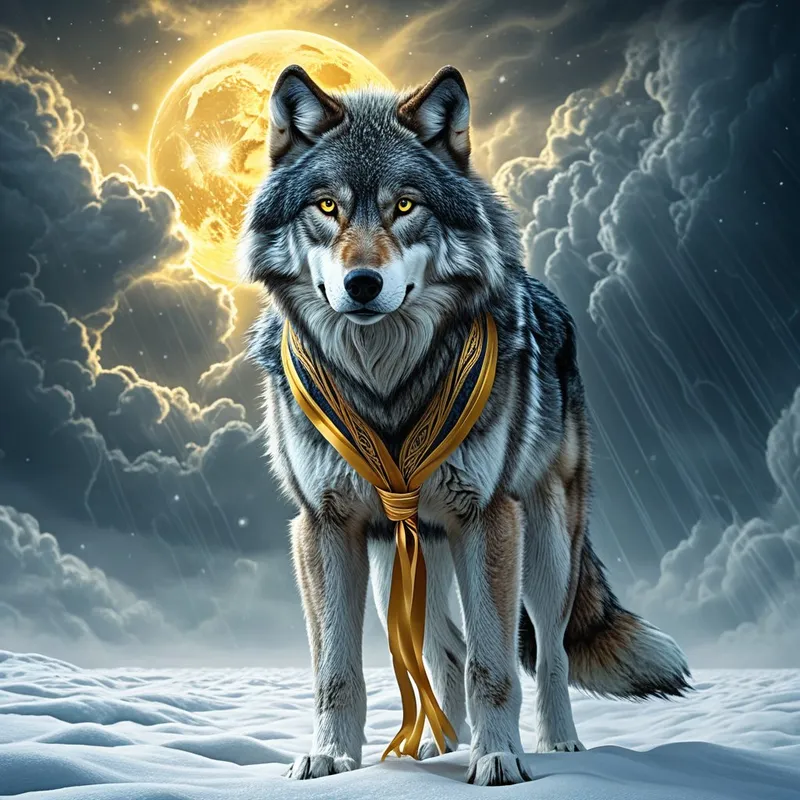
Fenrir Myth Meaning & Symbolism
The story of the monstrous wolf, bound by the gods through trickery, whose inevitable escape signals the end of the world and a necessary rebirth.
The Tale of Fenrir
In the dawn of the world, when the roots of the Yggdrasil were still tender, a shadow was born. It was not a shadow of darkness, but of a coming storm. From the union of the trickster Loki and the giantess Angrboða, three children came into being, each a prophecy written in bone and breath. One was Jörmungandr, who would circle the earth. Another was Hel, who would rule the dead. And the third was a wolf, named Fenrir.
He grew not as a pup grows, but as a fear grows—swift, relentless, and vast. The Æsir in Asgard watched, their mead turning sour in their mouths. They saw his eyes, twin suns of amber fury, and knew the whispers of the Norns were true: this beast was woven into the doom of all things, Ragnarök. First, they brought him to their halls, a gesture of false kinship. They fed him from their own hands, but the more they fed him, the more he embodied the hunger they sought to quell. His growth was a silent challenge to the order of the gods.
So, they proposed a game of strength. "Let us test your famed might, great Fenrir," they said, their voices honeyed. They forged a mighty chain called Læðingr. "Break this," they dared. With a snort of contempt, the wolf stretched, and the iron links shattered like glass. Undeterred, they crafted a second chain, twice as strong, named Drómi. Again, Fenrir gathered his power, muscles coiling like mountain roots, and again the chain exploded into useless fragments.
A cold dread settled over Asgard. The gods turned to the cunning dwarves in the deep places of the earth. From the sound of a cat's footfall, the beard of a woman, the roots of a mountain, the sinews of a bear, the breath of a fish, and the spittle of a bird, the dwarves crafted a fetter. It was a ribbon, slender and soft as silk, and they named it Gleipnir. It held no strength a wolf could comprehend, for its power was of a different order entirely.
When the gods presented this delicate band, Fenrir's wisdom, a gift from his lineage, stirred. "I see no fame in breaking so slight a thread," he growled, his voice a rockslide. "But I sense a trick. If this is made with magic and guile, then you must place a hand in my jaws as a pledge of good faith. One of you must stake your flesh on your honesty." The gods fell silent, their eyes shifting. Then, one stepped forward. It was Týr, whose word was law and whose courage was without peer. Without hesitation, he placed his right hand into the wolf's maw.
The other gods bound Fenrir with Gleipnir. The wolf strained, but the softer he struggled, the tighter the ethereal band constricted. He roared, a sound that cracked the ice on distant mountains. He writhed, and the gods, seeing him secured, laughed—all but Týr. For in that moment of triumph and betrayal, Fenrir closed his jaws. The sound of snapping bone was brief and final. Týr's hand, the pledge, was severed.
They fastened the ribbon to a great rock, Gjöll, and drove a sword deep into the wolf's mouth, its hilt against his lower jaw, its point against his palate. His howls became a river of saliva, a river named Ván, flooding the earth. There he lies, bound, his rage a constant tremor in the world, until the day the bonds of fate and time themselves break.
Cultural Origins & Context
The myth of Fenrir was not mere entertainment; it was a foundational pillar in the Norse worldview, preserved primarily in the 13th-century Poetic Edda and Snorri Sturluson's Prose Edda. These texts, compiled in Christianized Iceland, are our windows into a much older oral tradition. The story would have been told in longhouses, the firelight dancing as a skald gave voice to the terror and inevitability of Fenrir's binding.
Its societal function was multifaceted. It explained a fundamental tension in the Norse cosmos: order (Asgard/Midgard) is not a natural state, but a precarious imposition upon primordial chaos (Ginnungagap and the giants). The gods are not omnipotent guardians but flawed administrators fighting a doomed, yet heroic, rearguard action against entropy. Fenrir’s binding was a necessary crime, a tragic act of realpolitik that upheld the world while simultaneously guaranteeing its eventual, fiery end. It taught that stability often has a terrible price, paid in trust and wholeness, as Týr’s sacrifice attests.
Symbolic Architecture
Fenrir is the incarnate symbol of uncontrollable, annihilating force. He is not evil in a moral sense, but a primal, amoral reality—the earthquake, the wildfire, the raging sea, and the fury within that threatens to consume all structure.
The bound monster is not defeated chaos, but chaos deferred. Its containment is the very condition of civilization, yet its prison is the seed of the world's end.
Psychologically, Fenrir represents the ultimate Shadow. He is everything the conscious ego (Asgard) seeks to deny, repress, and chain: wild instinct, boundless rage, insatiable hunger, and the knowledge of our own mortality. The gods' attempt to domesticate him mirrors our own futile efforts to "tame" our deepest natures through willpower alone, only to find they grow stronger in the dark.
Týr's sacrifice is the central, tragic key. He is the god of oath and justice, and his lost hand is the price of a broken promise. The binding is achieved through trickery (Loki’s lineage is key), meaning the ordered world is founded on a foundational betrayal of the wild truth. The integrity of the system is purchased with the integrity of the self. The sword in Fenrir's mouth, forcing his howls into a silent river, symbolizes the psychic cost of repression: the creative/destructive voice of the instinctual self is gagged, but its energy (the river Ván) still flows, poisoning the ground of the psyche.
The Dreamer's Resonance
When Fenrir pads into modern dreams, he announces a profound psychological crisis of containment. To dream of a massive, restrained wolf—whether chained, caged, or silently watching—suggests a powerful instinctual force is straining against the dreamer's conscious adaptations. This is not a casual anxiety but a somatic truth knocking at the door of awareness.
The dreamer may feel a constriction in the throat (the sword of Gleipnir), a tension in the jaw, or a sense of being bound by invisible, silken threads—these are the "reasonable" obligations, societal expectations, or self-imposed limitations (Gleipnir) that have become a psychic prison. The wolf's rage is the dreamer's own vitality, turned feral through neglect and repression. The dream is a warning system: the bonds are under maximum stress. The river of drool (Ván) is the pent-up emotional energy, the "expectation" of release, that is already flooding the unconscious and affecting one's life in chaotic, indirect ways.
Alchemical Translation
The myth of Fenrir does not offer a path to slay the beast, but a terrifying roadmap for its integration. The alchemical process it models is not victory, but sacred encounter.
The first stage is Recognition: acknowledging the Fenrir within—the rage, the hunger, the capacity for destruction we disown. This is the wolf growing in Asgard, fed by our denial. The second is the Binding: our ego's necessary, yet ultimately flawed, attempt to control this force through willpower, rules, and suppression (the chains Læðingr and Drómi). This fails, for primal power cannot be broken by its own kind.
The third, critical stage is the Trickster's Bond (Gleipnir). This represents a shift from brute force to cunning, from repression to a more subtle, accepting form of relationship. It is the paradoxical "soft" power of awareness, of sitting with the shadow without being consumed. But here is the crux: this new bond requires the Sacrifice of the Pledge. Týr's hand is the price.
Individuation demands a Týr-like sacrifice: the conscious ego must offer up its prized instrument of control—its certainties, its self-image, its "right" to be safe—and place it in the jaws of the truth it has feared.
For the modern individual, this means voluntarily facing the bound fury within. It is to look at the gagged wolf, to remove the sword of repression, and to listen to its howl, knowing it may cost you a part of your old identity (the "hand" you use to grasp your world). This is the approach of Ragnarök on a personal level—the end of an old, rigid psychic order. Yet, in the Norse vision, Ragnarök is not merely an end; it is a cleansing fire from which a new, green world emerges. So too, the conscious engagement with one's inner Fenrir, though it feels apocalyptic, is the only process that can free the immense, vital energy bound within the shadow and allow it to be reborn as a source of fierce authenticity and untamed life force, rather than as an agent of unconscious destruction. The wolf must be met, not to be slain, but so that when the bonds of an outgrown self finally break, you are not its victim, but the one who unchained it.
Associated Symbols
Explore related symbols from the CaleaDream lexicon:
- Wolf
- Panic
- Dangerous
- Awful
- Leash
- Killer
- Wolf Howl
- Whirlwind of Emotion
- Turbulent Emotions
- Funnel Cloud
- Eclipsed Railing
- Radon Whisper
- Killer Bee
- Fangs and Claws
- Dramatic Wolf
- Burned Out Lightbulb
- Chained Infinity
- Animal Trap
- Wolf Fur
- Crumbling Avalanche
- Clouds of Change
- Survival Instinct
- Oni Demon
- Wolf Guide
- Tense Muscle
- Atmospheric Pressure
- Stasis
- Paralysis
- Dread
- Terror
- Gamey