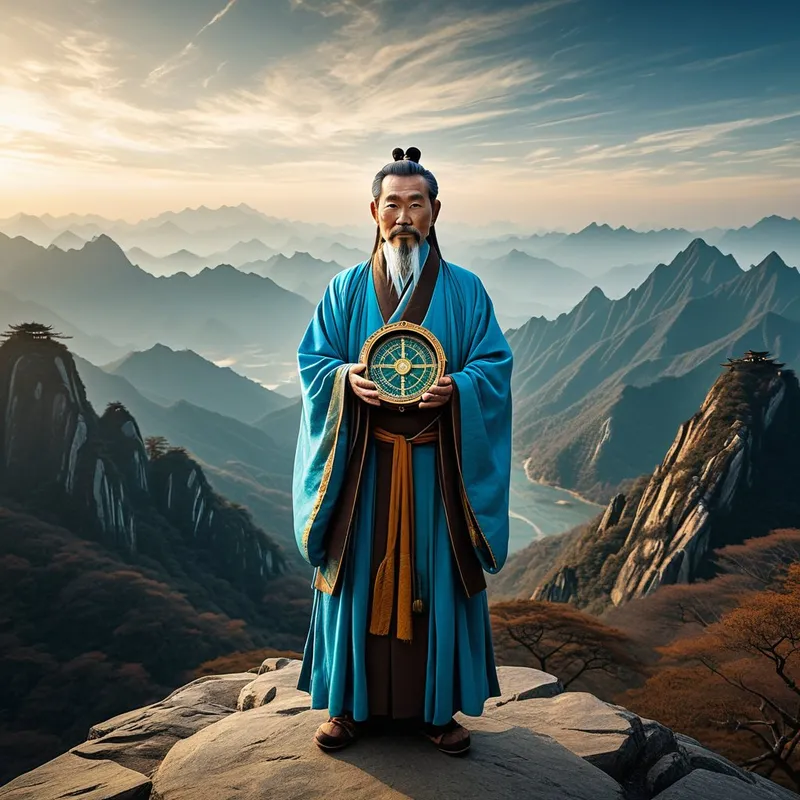
Feng Shui Principles Myth Meaning & Symbolism
The myth of Feng Shui tells of a primordial quest to align human dwellings with the living breath of the earth and the celestial patterns of the stars.
The Tale of Feng Shui Principles
Listen, and hear the story written not on parchment, but on the land itself. In the time when the world was young and the Tai Chi had just unfolded into the dance of Yin and Yang, the dwellings of humanity were places of fear. Storms would shatter huts, sickness would fester in dark corners, and a deep unease settled in the bones of the people, though they knew not why. They lived as strangers in a world that whispered secrets they could not comprehend.
Then came the first sages, those with eyes that could see the unseen. They were not gods, but men and women who had learned to still their own hearts to listen to the heart of the world. The greatest among them was known as the Dili Shi, the Master of Earth Patterns. He walked the land for years, his feet bare upon the soil, his hands brushing the bark of ancient trees. He did not see mere hills and rivers, but the sleeping form of the Qing Long, its verdant spine rising in mountain ridges. He saw the crouching power of the Bai Hu in the protective curve of western hills. He felt the warm, nurturing pulse of the Zhu Que in the southern sun, and the deep, mysterious wisdom of the Xuan Wu in the still northern waters.
The conflict was the discord between human haste and earthly rhythm. People built where the wind (Feng) screamed through narrow passes, scattering their vitality. They drank from waters (Shui) that ran sluggish and dark, mirroring the stagnation in their lives. Their homes faced the biting winter gales, not the gentle summer breezes. They were at war with the very elements that sought to sustain them.
The rising action was the Master’s great labor. He took the I Ching and the star charts of the heavens, and he laid them upon the living body of the earth. He taught that a hill was not just a hill, but a protective arm. A stream was not just water, but the lifeblood of the Qi. He showed how to site a village in the gentle embrace of the dragon and tiger, where the wind would gather but not ravage, where water would collect but not flood. He used a simple lodestone, the ancestor of the Luopan, to find the hidden currents. He did not command the land; he courted it. He listened for the resonant hum where a house should stand, the soft sigh where a door should open.
The resolution was not a battle won, but a harmony achieved. Where the principles were followed, a change settled like dew. Homes felt secure, not just strong. Families thrived, their health robust. A profound peace descended, as if the very walls sang with the same quiet song as the surrounding forest and stream. The people learned they were not separate from the world, but a note within its grand symphony. To build with Feng Shui was to enter into a sacred covenant with the visible and invisible, to place one’s life within the great, breathing order of all things.
Cultural Origins & Context
The mythos of Feng Shui did not spring from a single story, but from the slow accretion of observation, Taoist philosophy, and agrarian necessity over millennia. Its origins are intertwined with the early Kanyu (“Canopy and Chariot”) practices of the Zhou and Han dynasties, used primarily for tomb placement to ensure ancestral favor and dynastic longevity. It was the pragmatic heart of a culture deeply connected to the land; to disrespect the flow of Qi was to invite famine, illness, or misfortune.
The knowledge was passed down through lineages of masters, often secretly, from teacher to disciple. It was not merely folk wisdom but a sophisticated system integrating astronomy, geography, and the symbolic language of the Bagua. Its societal function was profound: it was a technology of well-being and a cosmology of place. It provided a ritual framework for everything from founding a capital city (like Beijing, laid out according to celestial principles) to orienting a humble farmhouse. It answered the human need for order, safety, and meaning by rooting that order in the cosmos itself.
Symbolic Architecture
At its core, the myth of Feng Shui is a profound map of the psyche’s relationship to the greater Self. The landscape—with its dragons, tigers, and flowing waters—is not an external reality, but a projection of the inner terrain.
The external arrangement is an alchemy of the internal condition. To harmonize your dwelling is to begin the far more difficult task of harmonizing your soul.
The Qing Long symbolizes the ascending, active, masculine principle of the psyche—our ambitions, growth, and vitality. The Bai Hu represents the protective, discerning, feminine principle—our boundaries, instincts, and capacity to release. Their balanced embrace around the “Ming Tang” (the bright hall, or the central self) is the ideal state of inner polarity. The flowing Shui represents the unconscious, the flow of emotion, wealth, and psychic energy. Blocked water is repressed feeling; a torrent is uncontrolled emotion. The gentle Feng is the breath of spirit, the circulation of ideas and inspiration. A howling wind is mental chaos; stagnant air is ideological rigidity.
The Dreamer’s Resonance
When Feng Shui principles erupt into modern dreams, they signal a profound somatic and psychological process of re-alignment. One does not dream of a Luopan if one’s life is in flow.
Dreaming of a house with a door facing a wall, a bed placed under a heavy beam, or a room choked with clutter is the psyche’s stark diagnosis. It is the somatic feeling of being “out of place” in one’s own life, of energy blocked in a relationship (a blocked corridor), of potential crushed by unseen pressures (the overhead beam). The dream is a direct experience of one’s own psychic architecture. The feeling upon waking is often one of unease, constriction, or a nagging sense that something is “off.” The dream is not about redecorating; it is about the urgent, often unconscious, need to reconfigure the internal structures that govern one’s emotional safety, creative expression, and connection to the world.
Alchemical Translation
The myth models the individuation process as a sacred act of geomancy upon the self. The modern individual is both the disoriented villager and the aspiring Dili Shi.
The first step is Observation, like the sage walking the land. This is self-reflection—feeling where in your life the “wind” scatters your energy (overcommitment, distraction) and where the “water” is stagnant (old grudges, unexpressed grief). The Conflict is the recognition of this discord between your innate nature and the life you’ve constructed.
The Rising Action is the active work of internal Feng Shui. It is identifying your personal Qing Long—what makes you rise and grow—and giving it a clear eastern view in your daily habits. It is honoring your Bai Hu—setting fierce boundaries to protect your inner space. It is clearing the cluttered “rooms” of past traumas (releasing blocked Qi) and opening the “windows” to new inspiration (inviting fresh Feng).
The ultimate translation is this: You are the site. Your consciousness is the compass. Your choices are the adjustments that either block or invite the cosmic breath.
The Resolution—the achieved harmony—is not a static state of perfection. It is the ongoing practice of sensing the subtle shifts in your internal landscape and adjusting accordingly. It is the moment you feel “at home” in your own skin, your life aligned with your deepest values, your energy flowing without obstruction. You become the dwelling place perfectly sited within the greater cosmos of the Self, where every internal element is in respectful, dynamic, and life-giving conversation with the whole.
Associated Symbols
Explore related symbols from the CaleaDream lexicon: