
Feng Shui Myth Meaning & Symbolism
The art of listening to the land's dragon veins and watercourses, aligning human dwellings with the sacred breath of Heaven and Earth to invite harmony and fortune.
The Tale of Feng Shui
Listen. Before the first emperor, before the written word carved its will into bamboo, [the world](/myths/the-world “Myth from Tarot culture.”/) was a single, breathing body. The mountains were not stone, but the sleeping spine of the Cosmic Dragon. The rivers were not [water](/myths/water “Myth from Chinese culture.”/), but its silver blood, coursing with [the mandate of Heaven](/myths/the-mandate-of-heaven “Myth from Chinese culture.”/). [The wind](/myths/the-wind “Myth from Various culture.”/) was its breath, and the rain, its whispered secrets to [the earth](/myths/the-earth “Myth from Hindu culture.”/).
In those days, people built their homes where the fire was warm and the water was near, but they were often troubled. Plague would visit one village and spare another. One family would flourish while its neighbor withered. They did not yet know how to listen. They lived upon [the dragon](/myths/the-dragon “Myth from Chinese culture.”/)’s back but were deaf to its dreams.
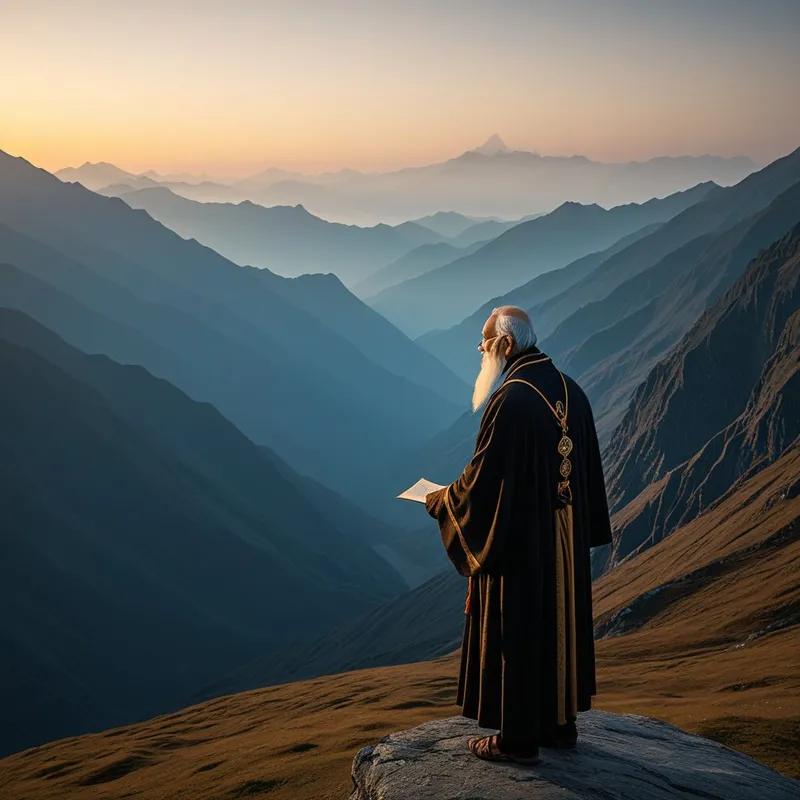
Then came the first of the Listeners. Some say he was a sage who had studied the flight of birds and the growth of trees for a hundred years. Others whisper he was a child of the dragon itself, born from a vein of jade in a sacred mountain. His name is lost, but his title remains: the Dixueshi.
He walked the world with the patience of the seasons. He felt the land’s pulse through the soles of his feet—a gentle hum where the dragon’s energy, the Qi, pooled softly; a vibrant thrum where it rushed like an underground river. He saw how the wind, the Feng, gathered in certain valleys, carrying seeds and songs. He watched how the water, the Shui, curved around hills, nurturing life in its embrace and carving paths of destiny in its flow.
His great labor was not to command, but to converse. He found a clan living in a harsh, wind-scoured plain, their spirits as brittle as the dry soil. “You sit in the dragon’s exhaust,” he told them. “You receive only its spent breath.” He led them to a gentle slope, cradled by arms of hill, with a clear stream curling before it like a protective belt. “Here,” he said, placing his hand on the earth. “Here, the dragon rests its head. The wind is softened, the water embraces you. Build your hearth here, and you will build upon a well of vitality.”
They obeyed, though they doubted. They built their homes with their backs to the protective hills, facing the nurturing water. And as the years turned, their children grew strong, their harvests grew plentiful, and a sense of deep peace settled upon them like morning mist. The Listener had shown them how to find the Xue, the dragon’s lair—the place where the breath of Heaven met the body of Earth in perfect harmony.
Thus, the art was born. It was not magic, but a marriage. A sacred dialogue between humanity and the living cosmos, written in the language of land, water, wind, and stars.
Cultural Origins & Context
The practice and philosophy of Feng Shui, meaning “Wind and Water,” emerged from the deep, animistic soil of ancient Chinese cosmology. Its origins are not pinned to a single mythic event but are woven into the very fabric of pre-imperial Chinese thought, evolving from the Neolithic reverence for ancestral spirits and the forces of nature. It is the practical application of a worldview where humanity is not separate from, but an integral part of, a continuous, energetic universe.
This knowledge was not for everyone. It was the domain of the Dixueshi and later, the imperial geomancers. They served at the right hand of kings, for to site a capital city, a palace, or a tomb—the Yin Zhai—was to secure the fate of a dynasty. The Forbidden City in Beijing is perhaps the ultimate testament to this, meticulously aligned along a north-south axis, protected by hills and water, designed to channel celestial Qi to the Son of Heaven. The myth was passed down through oral tradition, cryptic texts like the Zang Shu, and the intricate symbology of the [luopan](/myths/luopan “Myth from Chinese culture.”/) compass. Its function was profoundly societal: to ensure harmony between the human order and the cosmic order, promising stability, prosperity, and continuity in a world perceived as dynamically alive.
Symbolic Architecture
At its core, the Feng Shui myth is a profound map of relational [consciousness](/symbols/consciousness “Symbol: Consciousness represents the state of awareness and perception, encompassing thoughts, feelings, and experiences.”/). It moves beyond mere superstition into the [realm](/symbols/realm “Symbol: The symbol of ‘Realm’ often signifies the boundaries of one’s consciousness, experiences, or emotional states, suggesting aspects of reality that are either explored or ignored.”/) of deep symbolic [truth](/symbols/truth “Symbol: Truth represents authenticity, honesty, and the quest for knowledge beyond mere appearances.”/).
The true site of power is not a place of domination over the landscape, but a place of resonant alignment within it.
The Cosmic [Dragon](/symbols/dragon “Symbol: Dragons are potent symbols of power, wisdom, and transformation, often embodying the duality of creation and destruction.”/) represents the unseen, animating [life](/symbols/life “Symbol: The symbol of ‘Life’ represents a journey of growth, interconnectedness, and existential meaning, encompassing both the joys and challenges that define human experience.”/) force of the world itself—the [anima](/symbols/anima “Symbol: The feminine archetype within the male unconscious, representing soul, creativity, and connection to the inner world.”/) mundi or world [soul](/symbols/soul “Symbol: The soul represents the essence of a person, encompassing their spirit, identity, and connection to the universe.”/). Its “veins” are the channels of psychic and biological [energy](/symbols/energy “Symbol: Energy symbolizes vitality, motivation, and the drive that fuels actions and ambitions.”/) that run through all things. The Dixueshi, the Listener, symbolizes the awakened [human](/symbols/human “Symbol: The symbol of a human represents individuality, complexity of emotions, and social relationships.”/) consciousness, the part of the [psyche](/myths/psyche “Myth from Greek culture.”/) that can perceive these deeper patterns and choose to cooperate with them rather than oppose them.
The central conflict—human suffering amidst natural [abundance](/symbols/abundance “Symbol: A state of plentifulness or overflowing resources, often representing fulfillment, prosperity, or spiritual richness beyond material needs.”/)—mirrors the psychological state of being out of sync with one’s own [nature](/symbols/nature “Symbol: Nature symbolizes growth, connectivity, and the primal forces of existence.”/). The “harsh, wind-scoured plain” is a life built on willful [effort](/symbols/effort “Symbol: Effort signifies the physical, mental, and emotional energy invested toward achieving goals and personal growth.”/) against the [grain](/symbols/grain “Symbol: Represents sustenance, growth cycles, and the foundation of civilization. Symbolizes life’s harvest, patience, and transformation from seed to nourishment.”/) of one’s innate talents and deepest needs. The nurturing Xue, or dragon’s lair, symbolizes the authentic self, the unique configuration where an individual’s energy flows unimpeded and is nourished by their environment. Feng Shui, therefore, is an archetypal [drama](/symbols/drama “Symbol: Drama signifies narratives, emotional expression, and the exploration of human experiences.”/) of finding one’s rightful place in the grand scheme—a [journey](/symbols/journey “Symbol: A journey in dreams typically signifies adventure, growth, or a significant life transition.”/) from alienation to belonging.
The Dreamer’s Resonance
When this myth stirs in the modern psyche, it often manifests in dreams of space and placement. To dream of endlessly rearranging furniture in a familiar room, of discovering hidden chambers in one’s own home, or of a house where certain corners feel dreadfully cold while others glow with warmth, is to dream the dream of Feng Shui.
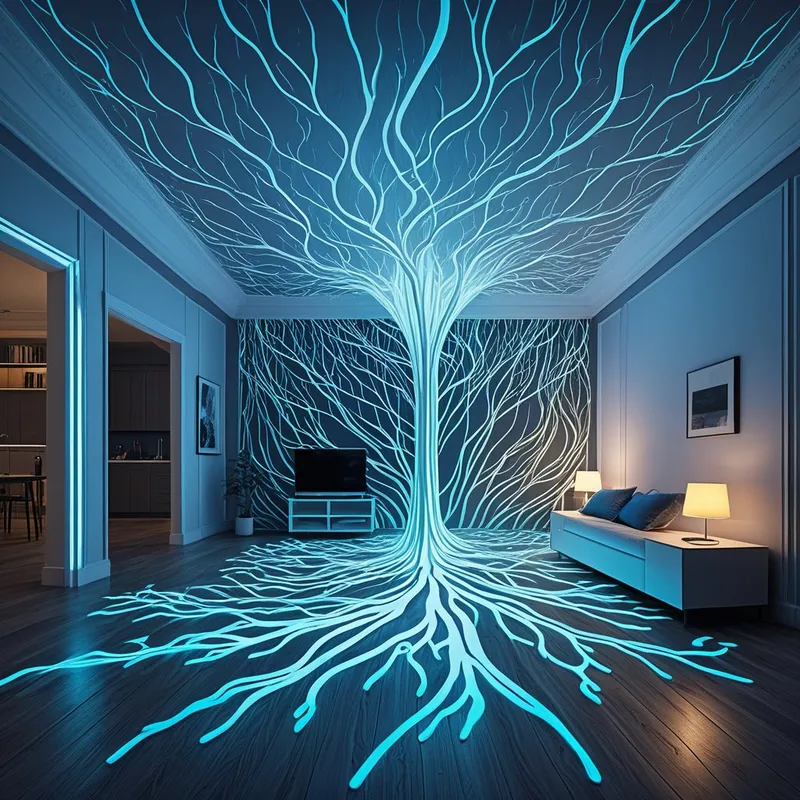
These are not dreams about interior decorating, but about interior state. The house in the dream is the dreamer’s own psyche. The cluttered, blocked hallway represents a stifled creative impulse or a repressed memory. The room with the stunning view that is always kept locked signifies an unrecognized potential or talent. The persistent draft symbolizes an energy leak—perhaps a relationship or commitment that drains vitality. The somatic experience is one of discomfort, unease, or searching within one’s own mental and emotional architecture. The dreamer is undergoing a process of psychic assessment, feeling out where their inner Qi flows and where it is blocked, guided by an unconscious Dixueshi seeking a more harmonious configuration of [the self](/myths/the-self “Myth from Jungian culture.”/).
Alchemical Translation
The alchemical process modeled by Feng Shui is the individuation journey of creating a [temenos](/myths/temenos “Myth from Greek culture.”/)—a sacred, protected inner space—where the psyche can integrate. It is the slow, deliberate work of psychic landscaping.
First comes the Form School (Xingfa Pai) of the soul: observing the raw topography of one’s life. Where are my protective mountains (healthy boundaries, supportive relationships)? Where is my nurturing water (sources of inspiration and emotion)? This is shadow work—acknowledging the harsh plains and the sheltered valleys within.
Next is the Compass School (Lifa Pai) application: using the luopan of self-knowledge to orient. This involves aligning one’s actions (the furniture of daily life) with one’s true north—core values, authentic purpose, and cyclical timing. It is the conscious decision to place the “bed” of rest in a position of security, and the “desk” of work in a position of expansive energy.
The ultimate transformation is not in moving mountains, but in learning to hear the song the mountain has been singing all along.
The alchemical gold produced is not limitless fortune, but Sheng Qi—vital, ascending energy. It is the feeling of being in flow, where effort becomes grace, where the environment supports rather than hinders, and where one feels held by a larger order. The individual becomes their own sacred site, a harmonious vessel where the breath of spirit (Feng) and the flow of soul (Shui) are in perfect, dynamic balance. They have found their Xue in the world, and in doing so, have allowed the world to find its rightful place within them.
Associated Symbols
Explore related symbols from the CaleaDream lexicon: