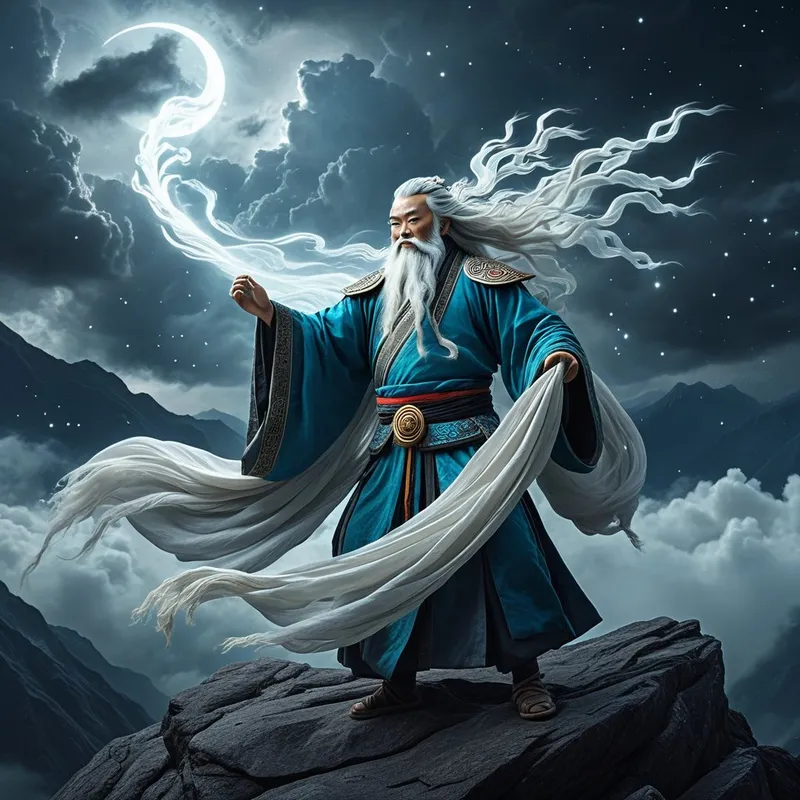
Feng Po Myth Meaning & Symbolism
The myth of Feng Po, the ancient Chinese deity who commands the winds, embodying the primal forces of chaos, change, and the breath of the world.
The Tale of Feng Po
Listen, and feel the air grow still. Before the rain, before the thunder’s voice, there is a silence that is not empty, but full of waiting. It is the held breath of the world. And then, from the distant edge of the Four Seas, where the sky bruises to violet and the waters churn white, he comes.
He is Feng Po, the Elder of the Wind. Do not picture a gentle spirit. His visage is ancient, a man’s face carved by millennia of storms, with eyes like polished jet that see the pathways of the air. From his shoulders sprout vast, feathered wings, dark as a starless midnight, and in his hands—hands both human and talon—he carries his great treasure and his terrible tool: a mighty cloth sack.
He does not walk; he is borne on the currents he commands. With a solemn, relentless purpose, he arrives at the borders where order frays. Perhaps a village has grown arrogant, its fires burning too bright, its prayers grown faint. Perhaps the balance between Yang and Yin has tipped, and the world shudders with impending fever or rot.
Feng Po opens the mouth of his sack.
It begins not with a roar, but with a sigh—a long, drawn-out exhalation that ripples through the rice fields, making every stalk tremble in unison. This is the Ming Tiao Feng. But his work is not done. He shifts the sack, and the sigh becomes a moan, a Liú Sà that strips leaves from branches and sends tiles skittering from roofs. The conflict is joined: the stagnant air must be moved, the old must be cleared.
Now he tilts the sack fully, and the storm is unleashed. This is no mindless destruction, but a furious, sculpting chaos. Winds shriek down from mountain passes, howl across plains, and whip the seas into frothing mountains. Boats that dared too much are playthings; trees that stood for centuries groan at their roots. In the heart of the gale, Feng Po is a calm, relentless center, his wings beating a rhythm older than temples, his face impassive as he executes the will of heaven. He is the crisis, the great unraveling that must precede any new weaving.
And then, as suddenly as it came, the fury abates. The sack is drawn closed. The winds, having scoured the land clean of hubris and stagnation, soften to a breeze. They carry away the dust of decay and the heat of imbalance. They bring, on their trailing edge, the first cool, clean breath of change—and often, the life-giving rain. Feng Po turns, his great wings catching a gentler current, and departs as silently as he arrived, leaving a world washed, humbled, and ready to begin anew.

Cultural Origins & Context
The figure of Feng Po emerges from the deep, animistic wellspring of early Chinese cosmology, where natural forces were not abstract concepts but willful, divine personalities. His origins are folkloric, woven into the fabric of daily life by farmers, sailors, and storytellers who lived intimately with the whims of weather. He appears in texts like the Classic of Mountains and Seas (Shan Hai Jing), which catalogues the strange beings at the edges of the known world.
He was not a deity of grand state temples in the same way as the Jade Emperor, but a spirit of the periphery and the immediate. His myth served a crucial societal function: it gave a face and a reason to the terrifying, uncontrollable force of the wind. A storm was not mere chance; it was Feng Po executing his duty. This personification allowed for a relationship—one could fear him, respect him, and in some traditions, even attempt to appease him. For a maritime or agricultural society, understanding the wind was a matter of survival, and myth provided the first framework for that understanding, transforming blind fear into a narrative of cosmic balance.
Symbolic Architecture
Feng Po is the archetypal personification of the Unseen Mover. He is the breath of the cosmos itself—the pneuma or qi in motion. His form, a hybrid of human and bird, symbolizes the mediation between the grounded human realm and the lofty, intangible realm of the heavens and ideas. The human face suggests intelligence and purpose behind the force; the bird’s body embodies absolute freedom and dominion over the sky.
His sack is the ultimate symbol of potential and containment. It holds all winds: the gentle breeze and the devastating typhoon, the breath of spring and the gasp of winter. It represents the unfathomable potential of the unconscious, where all psychic energies—creative and destructive—are stored before being released into the world of conscious experience.
The storm is not an enemy, but the psyche’s necessary language when silence has become a prison.
Feng Po’s action is never portrayed as malicious, but as functional. He is an agent of the Dao, enforcing the inevitable cycles of clearing and renewal. Psychologically, he represents the autonomous, disruptive force of the Self that acts to shatter stagnant complexes, comfortable illusions, and rigid ego structures. He is the inner gale that arrives when we have refused to change, forcing a crisis that clears the ground for new growth.
The Dreamer's Resonance
To dream of Feng Po, or of a great, personified wind, is to experience the somatic signature of profound internal pressure seeking release. The dreamer may feel themselves battered by invisible forces, struggling to stand, or hearing a deafening roar with no source. Alternatively, they may be the wind, experiencing a terrifying yet exhilarating sense of boundless, destructive power.
These dreams often visit during life transitions—the end of a relationship, a career upheaval, a spiritual crisis—when old identities are being dismantled. The somatic feeling is one of anxiety, breathlessness, or a thrilling, dangerous energy coursing through the body. Psychologically, this is the Self intervening where the ego has become rigid or the persona too constricting. The dream is an announcement: a storm is coming. The psychic atmosphere can no longer hold its current configuration. Something must be moved, scoured away, or ventilated. The dreamer is encountering the raw, archetypal force of their own need for transformation, which feels alien and overpowering because it originates from beyond the ego’s control.
Alchemical Translation
The individuation process, the journey toward psychic wholeness, is not a gentle stroll. It requires periodic, violent renovations of the inner landscape. Feng Po models the essential, alchemical stage of solutio and separatio—dissolution and separation.
First, one must recognize the Sack of Stagnation. This is the accumulated, unconscious content—unexpressed emotions, outgrown beliefs, unresolved traumas—that we have sealed away. The ego, fearing chaos, keeps the sack tightly bound. But pressure builds.
The arrival of Feng Po marks the inevitable Breaking Open. This is the crisis: the depression, the explosive anger, the life event that shatters our carefully constructed world. Alchemically, this is the nigredo, the blackening. It feels like destruction because it is. The conscious mind experiences it as pure loss.
The wind does not ask permission to blow; it answers only to the need of the wider atmosphere.
The work of integration is to endure the gale without identifying solely as its victim or its god. One must learn to see the Purpose in the Scouring. What brittle structures is the wind toppling? What dust-laden corners is it exposing? The goal is not to stop the wind, but to understand its direction and collaborate with its cleansing function.
Finally, one arrives at the Calm After. This is the new space, the albedo or whitening. The old debris is gone. The air is clear, charged with potential, and moist with the promise of rain—the nurturing tears that allow new seeds to sprout. The individual who has integrated the Feng Po archetype does not fear inner turmoil. They understand themselves as both the vessel that contains the storm and the navigator who can, with respect and humility, adjust the sails. They have made a pact with the invisible mover within, agreeing that periodic, necessary chaos is the price of authentic breath and continuous becoming.
Associated Symbols
Explore related symbols from the CaleaDream lexicon: