Feather of Ma'at Myth Meaning & Symbolism
In the Hall of Two Truths, the deceased's heart is weighed against the Feather of Ma'at, a cosmic test of integrity that determines the soul's eternal fate.
The Tale of Feather of Ma’at
Hear now the tale of the final crossing, the journey every soul must make when the sun of life sets for the last time. The world of the living fades, a memory of reed and river, of bread and breath. The Ka slips its earthly moorings and is drawn, a silent boat on a dark current, toward the western horizon.
The path leads through twilight realms, past guardians of stone and silence, until a great door looms. This is the entrance to the Duat, the Hall of Two Truths. Its air is not air, but the stillness between stars. Its light comes not from torch or sun, but from the luminous beings who wait within.
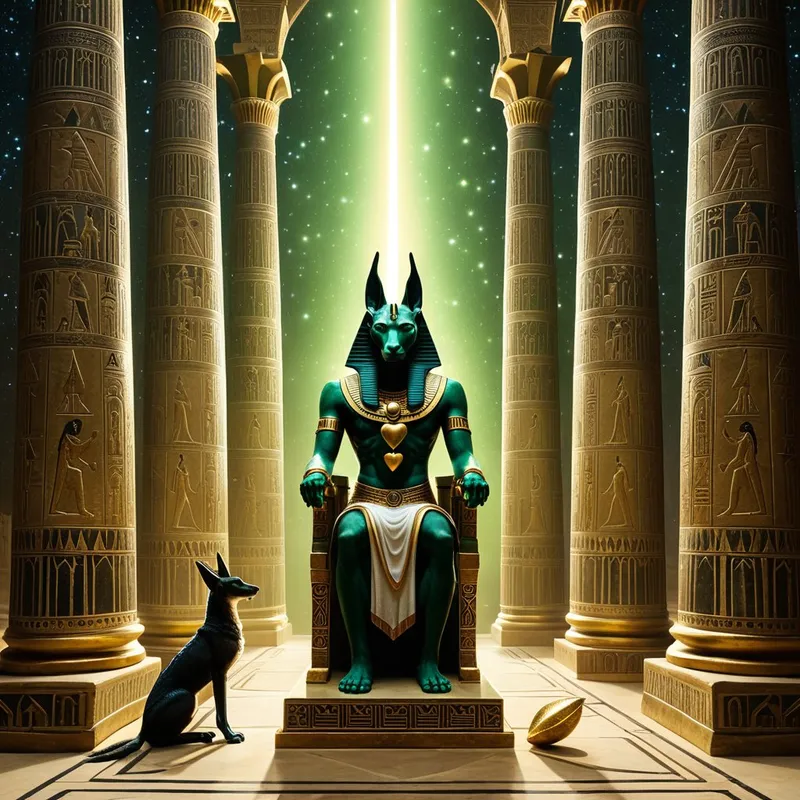
At the threshold stands Anubis, his eyes pools of ancient night. With hands that have prepared a thousand kings for this moment, he guides the trembling soul-essence forward. In the center of the vast hall, a scale of perfect gold hangs in the cosmic quiet. To one side, the soul witnesses a terrifying wonder: its own heart, the Ib, is placed upon the left pan. It beats there, not with blood, but with the record of a lifetime—every kindness, every secret greed, every moment of courage and of cowardice.
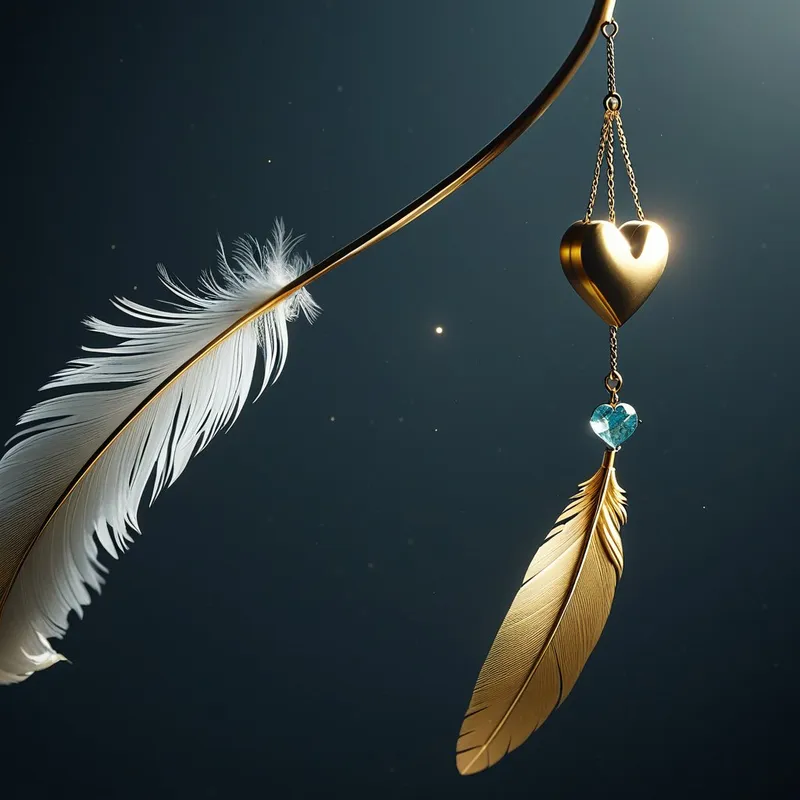
Upon the right pan, Anubis places a single feather. This is the Shu-feather of Ma’at. It is not from any bird of the Nile. It is the feather of truth itself, plucked from the headdress of the goddess Ma’at, who sits watching, her presence a cool, unwavering flame. The feather is the weight of a life lived in harmony, of speech that held no lie, of actions that did not disturb the balance of the world.
The hall holds its breath. Thoth, scribe of the gods, stands ready with palette and reed, his gaze fixed on the golden pointer. The pointer trembles. The heart, heavy with forgotten deeds, dips. The soul feels a cold terror, the approach of the Ammit, who waits crouched in the shadows, jaws agape for the condemned. But then, perhaps, the heart lightens—a memory of a cup of water given to the thirsty, a truth spoken when a lie was easier, a moment of pure awe beneath the stars. The scales sway, seek equilibrium… and find it. The beam levels. Heart and feather are in perfect balance.
A sound like a sigh of relief rustles through the hall. Thoth records the verdict: “True of voice.” Then, the soul is led before the great green-skinned king upon his throne, Osiris, lord of the peaceful dead. He who was slain and restored offers a nod, a gesture of welcome. The path to the Field of Reeds lies open. The soul has passed the ultimate test, not of strength, but of substance. It has been weighed and found truthful.
Cultural Origins & Context
This was not merely a story to frighten children or comfort the elderly. The “Weighing of the Heart” ceremony was the central doctrinal drama of Egyptian afterlife belief for millennia, meticulously detailed in funerary texts like the Book of the Dead. It was a myth enacted through ritual and preparation. The telling of this tale was the work of priests and the funerary artisans who painted it on tomb walls and inscribed it on sarcophagi, creating a guidebook for the deceased.
Its societal function was profound. It served as the ultimate ethical engine of the culture. Ma’at was not just a goddess; she was the principle that held the universe—and society—together. To live in Ma’at was to be in right relationship with the gods, the Pharaoh (the living embodiment of Ma’at on earth), one’s community, and oneself. The myth externalized an internal process: your life was a ledger, and your heart was the scribe. The dramatic judgment in the Duat made abstract morality terrifyingly, beautifully concrete. It provided a framework for justice that transcended the mortal world, offering the promise that truth and balance would ultimately—and literally—carry the day.
Symbolic Architecture
The myth is a masterclass in symbolic psychology. Each element is an aspect of the self confronting its totality.
The Heart (Ib) is not the romantic seat of emotion, but the integrated record of the entire personality—thoughts, deeds, intentions, and unconscious impulses. It is the “I” that is to be judged.
The Feather of Ma’at is the weight of a clear conscience. It is the gravitational pull of authenticity, where every action aligns with an inner, unshakable truth.
The Scales represent the objective, non-human mechanism of cosmic law. They do not judge; they merely reveal. They are the archetype of impartiality, the natural consequence of cause and effect applied to the moral and psychic realm.
Anubis, the guide and weigher, symbolizes the part of the psyche that must confront and handle the raw, often frightening, material of our nature (the heart). He is the psychopomp—the guide of souls—who leads us into the depths of self-examination.
Thoth, the recorder, is consciousness itself, the faculty of witnessing and naming. His record is the story we tell ourselves about who we are, finalized in the face of ultimate truth.
Osiris, the resurrected judge, represents the potential for wholeness that comes after this brutal honesty. He is the Self, in the Jungian sense, that can only be approached once the ego (the heart) has been weighed and integrated.
The monstrous Ammit is the shadow of total annihilation, the psychic disintegration that awaits if the lies we tell ourselves are so foundational that the structure of the self cannot bear the truth. She is the fear of being utterly consumed by our own falseness.
The Dreamer’s Resonance
When this mythic pattern stirs in the modern dreamer, it signals a profound inner trial. To dream of being weighed, of standing before a tribunal, or of a feather possessing immense significance is to experience the psyche’s own Hall of Two Truths.
The somatic sensation is often one of suspense, a held breath in the chest—the very location of the symbolic heart. The dreamer may feel exposed, scrutinized by an invisible but deeply felt presence. This is the process of self-auditing. The psyche is comparing the lived reality of the dreamer’s life—their actions, relationships, career choices—against an inner, often neglected, standard of truth and integrity. The “feather” in the dream may appear as a simple white object, a feeling of lightness, or a person who embodies honesty. The “heart” may be a heavy stone, a cluttered room, or a shameful secret made visible.
This dream is not a prophecy of doom, but an invitation to integrity. The anxiety it produces is the friction between who we are and who we know, at the deepest level, we could be. It is the soul’s quality assurance department, running a diagnostic check on our alignment with our own values.

Alchemical Translation
The alchemical journey of individuation—becoming the unique, integrated Self—is perfectly modeled by this myth. The process is one of psychic transmutation, where the base lead of the unexamined ego is turned into the gold of authentic being.
The first, crucial operation is Mortificatio: the descent into the Duat. This is the dark night of the soul, the voluntary confrontation with shadow, failure, and illusion. One must willingly place one’s own heart—the totality of one’s identity—on the scale.
The weighing itself is the Separatio. It is the painful, precise work of discrimination. What in me is essential, true, and in harmony with my deepest nature (the feather)? What is dross, hypocrisy, or borrowed identity that adds dead weight? This requires the help of our inner Anubis (the courage to look) and inner Thoth (the honesty to name what we see).
The goal is not to have a heart lighter than a feather, but a heart whose weight matches the feather. It is the balance of full humanity—flaws, passions, and all—fully acknowledged and integrated, brought into conscious alignment with truth.
Achieving this balance is the Coniunctio, the sacred marriage. The heart-ego is not destroyed but justified—“true of voice.” It is reunited with the greater Self (Osiris). This is the resurrection. The devouring Ammit is rendered powerless, not because the shadow is gone, but because it has been faced and its energy reclaimed.
For us now, the Field of Reeds is not a geographical afterlife, but a state of being. It is the psychological freedom and creative fertility that comes from living a life where your inner truth and your outer actions are in equilibrium. You carry the feather not in a scale, but in your spine. You become, in your own way, a living embodiment of Ma’at, a center of order and authenticity in your own world. The judgment is not a one-time event at death, but a continuous, lifelong practice of weighing, balancing, and striving to be true of voice.
Associated Symbols
Explore related symbols from the CaleaDream lexicon: