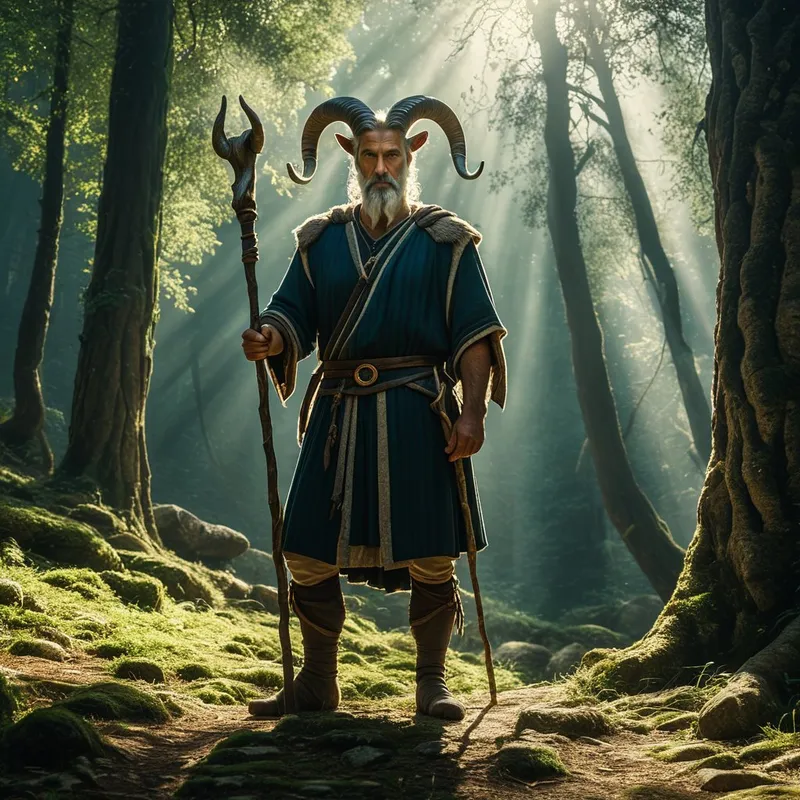
Faunus Myth Meaning & Symbolism
The myth of Faunus, the horned god of the wild woods, reveals the untamed, prophetic voice of nature that dwells within the human psyche.
The Tale of Faunus
Listen, and let your mind wander to the deep, uncut forests of ancient Latium, where the sun is a stranger to the tangled floor. Here, the air is thick with the scent of damp earth, wild thyme, and the musk of unseen creatures. This is the kingdom of Faunus.
He is not a god of marble temples, but of the living grove. You hear him first in the sudden silence that falls when you enter his domain—a silence that is itself a presence. Then comes the rustle in the underbrush, the snap of a twig just out of sight. His form is glimpsed between the trunks: the powerful, hairy legs of a goat, ending in cloven hooves that make no sound on the soft loam; the torso of a man, weathered and strong; and upon his head, the proud, curling horns of the wild ibex. His eyes hold the ancient knowledge of the forest, a wisdom that is neither good nor evil, but utterly other.
Faunus is a restless spirit. By day, he guards the boundaries of field and forest, a benevolent but stern protector of shepherds and their flocks. He teaches them the secret songs to calm a nervous herd. But when the sun sinks and the world is painted in the blues and purples of twilight, his other nature stirs. This is the time of the Fauni, the multitude of wild, goat-legged spirits who are his children and his manifestations. They dance in moonlit clearings, their pipes weaving melodies that stir panic—the very panic that bears his Greek name's echo—in the hearts of any mortal who dares to watch.
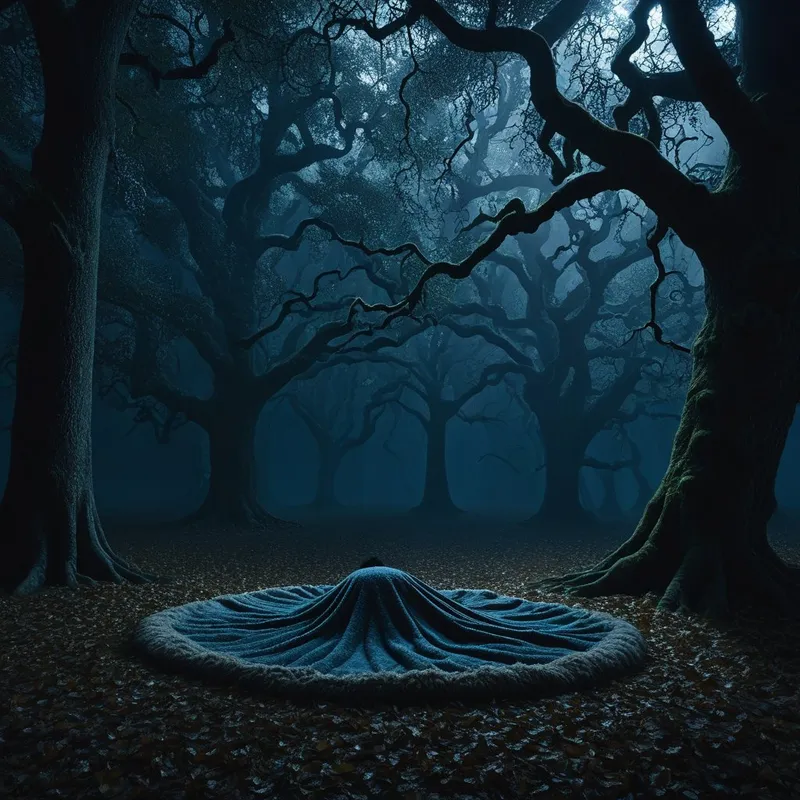
Yet his most sacred power is reserved for the deepest night. Those who seek prophecy, who are brave enough or desperate enough, must journey to a sacred grove. There, they perform the rite of incubatio. They sacrifice a sheep, lay its skin upon the cold ground, and lie upon it. They must not sleep, but enter a trance, suspended between worlds. And then, in the absolute dark, the voices come. Not from one mouth, but from the grove itself—a chorus of whispers rustling through the sacred oak leaves above. The words are cryptic, tangled like roots, speaking of futures hidden in the patterns of flighting birds and the entrails of beasts. It is Faunus who speaks, not in comfort, but in the raw, unfiltered truth of nature. To receive his message is to be touched by the wild, divine mind of the world itself, a gift that is as terrifying as it is profound.
Cultural Origins & Context
Faunus is a deity of deep, pre-Roman antiquity, his roots sunk into the soil of the Italian peninsula long before the founding of the city on seven hills. He is a god of the Italic peoples, a spirit of the land itself. His worship was rustic and local, centered not in the urban Capitolium, but in the lucus, the sacred forest grove. This places him firmly in the realm of numina—the ancient Roman conception of spiritual presences inhabiting specific places and processes.
His myths were not codified in a grand epic like those of Greece, but were passed down through folk practice, shepherd's lore, and the rituals of the agricultural calendar. The festival of the Lupercalia, though later associated with Romulus and Remus, originally honored Faunus in his aspect as a god of fertility and purification. His oracular function was a vital part of rural life; farmers and village elders would seek his guidance on planting, weather, and the health of their communities. He was the voice of the land, a direct line to the chaotic, generative, and often frightening forces of the natural world upon which all life depended. As Rome expanded and systematized its religion, Faunus was increasingly identified with the Greek Pan, absorbing some of Pan's more Hellenized attributes, but his core essence—the wild, prophetic spirit of the Italian woodland—remained.
Symbolic Architecture
Faunus represents the irreducible wildness at the heart of nature and, by extension, at the core of the human psyche. He is the archetype of the untamed instinct, the part of the self that exists before and beyond civilization's rules.
He is the psychic embodiment of the forest itself: a place of both nourishment and danger, of profound peace and sudden panic, where clarity is found not in straight lines but in tangled roots.
His hybrid form—half-human, half-goat—symbolizes the liminal state between the domesticated self (the human) and the animalistic, instinctual self (the goat). He is the bridge between the conscious mind and the unconscious, instinctual drives. His horns connect him to the crown chakra of intuition and spiritual connection, yet they are also weapons, signifying the potent, sometimes dangerous, power of this untamed knowledge.
His oracular function is key. Faunus does not speak in the forum; he whispers in the grove. His prophecies come not through logical deduction but through incubatio—a lying upon the sacred fleece, a surrender to the trance state. This symbolizes the necessity of yielding to the unconscious, of making oneself vulnerable and receptive to the messages that arise from the deep, instinctual layers of the psyche. The message is often cryptic because the language of the unconscious is symbolic, not literal.
The Dreamer's Resonance
When the archetype of Faunus stirs in the modern dreamer, it often manifests as an encounter with the "wild" within. This is not a call to literal chaos, but a summons from the parts of the personality that have been fenced off, domesticated, or ignored.
You may dream of being lost in a vast, beautiful, but intimidating forest—a classic symbol of the unexplored unconscious. The appearance of a horned figure, or simply the feeling of a watchful, non-human presence in a natural setting, signals the activation of this archetype. Somatic sensations in the dream are crucial: the feeling of rough bark under your hands, the cool damp of moss, the sudden, heart-thumping panic at a sound in the bushes. These are the body's way of processing the re-emergence of instinct.
Psychologically, this dream pattern indicates a process where deeply buried instincts, creative urges, or natural talents are seeking expression. The "prophecy" Faunus offers in the dream might be a cryptic image, a forgotten memory, or a strong gut feeling about a life direction. The dreamer is undergoing a necessary incubatio: a period of lying fallow, of listening inward, to receive guidance from a source older and wiser than the conscious ego. Resistance to this process often manifests as nightmares of being chased by wild beasts or trapped in the woods—the ego's panic at the approach of the untamed self.

Alchemical Translation
The myth of Faunus models a critical phase in the alchemical process of individuation: the coniunctio oppositorum (conjunction of opposites) between the civilized persona and the wild shadow. The goal is not to become the goat, but to integrate its wisdom into the whole human.
The first step is the journey to the lucus, the sacred grove. This is the conscious decision to engage with one's own depth, to enter the therapeutic or introspective space. The sacrifice—the offering of the sheep—represents the surrender of a comfortable, docile identity (the flock animal) to make room for a more authentic, complex self.
The core alchemical operation is the incubatio: the patient, vulnerable act of lying upon the fleece, of holding the tension between sleep and wakefulness, conscious and unconscious. This is the nigredo, the dark night of the soul, where one waits without forcing, listens without demanding.
The cryptic whispers from the leaves are the raw, unintegrated contents of the unconscious rising to be heard. The modern individual's task is to become the interpreter of this wild prophecy. This means translating the symbolic language of dreams, synchronicities, and powerful intuitions into conscious understanding and action. It is the process of taking the untamed creative impulse (the Faun) and giving it disciplined form (the song, the art, the new life path).
To integrate Faunus is to achieve a psychic state where instinct informs action, where creativity flows from a deep, natural wellspring, and where one possesses an inner oracular capacity—a "gut feeling" that is trusted as a form of wisdom. The rebel archetype is fulfilled not through destruction, but through the courageous act of reclaiming one's inherent, natural wildness from the over-civilized superego, creating a self that is both culturally functional and instinctively alive.
Associated Symbols
Explore related symbols from the CaleaDream lexicon: