Fata Morgana Myth Meaning & Symbolism
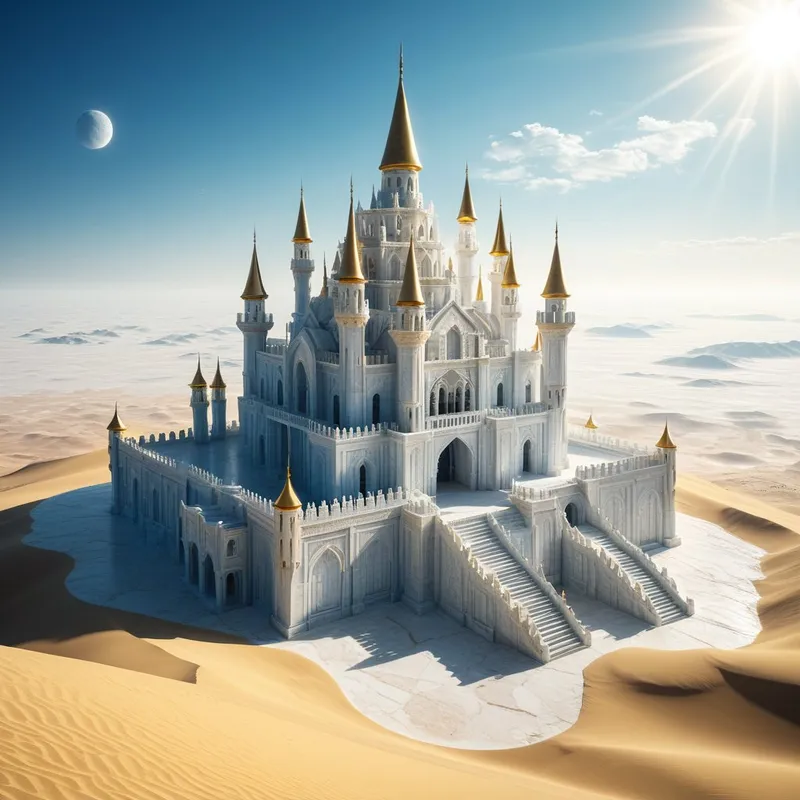
A phantom castle on the horizon, a promise of paradise that dissolves upon approach—the myth of the mirage as a fairy's cruel, beautiful enchantment.
The Tale of Fata Morgana
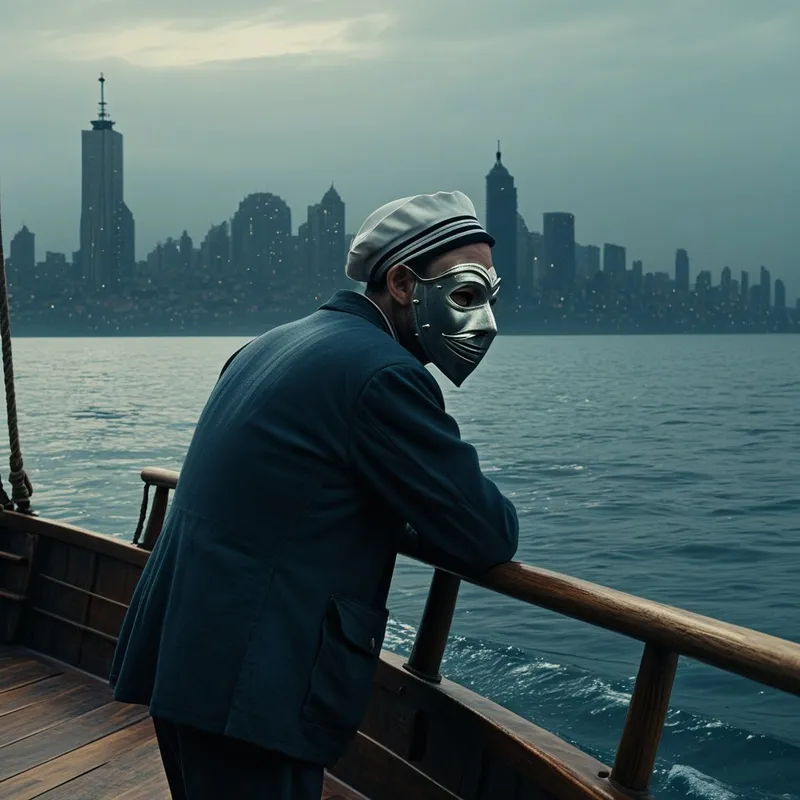
Listen, and let the salt air fill your lungs. Let the horizon, that thin, cruel line between sea and sky, become the only world you know. You are on a vessel of wood and hope, and the water is a flat, endless plain of mercury. The sun is a hammer on the deck, and your thirst is a living thing in your throat. Days bleed into one another, and the mind begins to whisper its own truths.
Then, you see it.
At first, it is a smudge, a trembling in the air. But it gathers itself, pulling substance from light and longing. Towers rise—not of stone, but of mother-of-pearl and captured sunset. Spires of crystal pierce the haze. You see verdant gardens hanging in the sky, waterfalls that flow upward into clouds of gold. A city. A castle. A kingdom of such sublime perfection that it makes your heart ache. It is close enough to see the banners fluttering on impossible battlements, to almost hear the faint echo of celestial music. It is there. Salvation. Home. The answer to every silent prayer you’ve breathed into the wind.
The helmsman turns the ship. The crew, hollow-eyed, find new strength. You sail toward it, your course as straight as an arrow shot from desire itself. The vision holds, shimmering, promising. It grows clearer, more detailed. You can almost smell the orchards.
You sail for hours. The sun moves. And then, the foundation of the dream begins to waver. The towers stretch, thin, become vaporous. The gardens blur into streaks of green and blue. The entire glorious edifice, that anchor for your soul, begins to smear across the sky. It lifts, it fractures, it inverts. A wall becomes a ship. A spire becomes a distant mountain peak you passed days ago. The paradise disassembles itself before your eyes, revealing its true components: a layer of hot air, a cold layer beneath, and the distorted, tortured image of a coastline far, far beyond the curve of the world.
It was never there. And yet, you saw it. You know you saw it. All that remains is the empty sea, the relentless sun, and a silence deeper than before. The enchantress has shown you her palace and withdrawn it, leaving only the imprint of its beauty on your burning eyes. Her name is whispered on the dry lips of every sailor who has chased a dream on the water: Fata Morgana.
Cultural Origins & Context
The name itself is a clue to its lineage. Fata Morgana translates from Italian as “Fairy Morgan,” directly linking the optical phenomenon to Morgan le Fay, the half-sister of King Arthur. In the medieval romances, Morgan is a figure of profound ambiguity—a healer, a sorceress, a shape-shifter who creates illusory castles and phantom armies to test, tempt, or torment knights. She is a mistress of glamour.
This myth did not originate in a single culture but was woven from the shared experience of Mediterranean and later Atlantic sailors. They encountered this specific, complex mirage—a superior mirage causing distant objects to appear elevated, stretched, and inverted—in the straits of Messina and on the open ocean. With no scientific framework, they interpreted it through the only lens they had: the supernatural. The mirage became the psychic projection of a powerful, capricious fairy, a narrative that gave form to a terrifying and awe-inspiring natural event. It was a story told on night watches, a warning and a wonder, explaining both the treachery of the sea and the vulnerability of the human mind to its own deepest yearnings.
Symbolic Architecture
At its core, the myth of Fata Morgana is an archetypal drama of perception and reality, of the psyche’s magnificent capacity to project its contents onto the world.
The Mirage represents the promissory image of the unconscious. It is the idealized life, the perfect relationship, the ultimate achievement, the state of salvation. It is compelling because it is composed of genuine psychic material—our hopes, our repressed potentials, our un-lived lives. It is not a “lie” but a symbolic truth displayed in the wrong dimension, mistaken for a literal, external reality.
The most beautiful prison is the one built from your own deepest desires.
Morgana herself is the archetype of the Magician, specifically in her Trickster aspect. She does not create something from nothing; she rearranges reality. She takes the raw data of the world (light, distant land) and the raw data of the soul (longing, need) and synthesizes a vision that feels more real than reality. Her lesson is cruel but initiatory: to show you what you truly want, you must first be shattered by the realization that you cannot simply sail to it. The promise must dissolve for the real work to begin.
The Barren Expanse is the necessary condition of the vision. It is the state of need, thirst, deprivation, or psychological aridity that makes the psyche desperate enough to conjure its salvation. Without the desert, there is no phantom oasis.
The Dreamer's Resonance
When this myth pattern activates in the modern dreamer, it rarely appears as a medieval castle at sea. Its form is updated, but its function is identical. You dream of the perfect job offer that vanishes when you reach for the phone. You dream of a lover with a familiar-yet-unknown face who turns a corner and is gone. You dream of your childhood home, but it is now a vast, luminous museum you can never quite enter.
The somatic experience is one of acute lifting followed by profound grounding. There is the heart-leaping recognition, the surge of adrenaline and hope (“There it is! The answer!”). This is followed by the slow, cold dawning of the illusion, a visceral drop in the gut, a feeling of hollow exhaustion. The psyche is performing a critical regulation: it is allowing you to fully experience the charge of your desire, and then it is forcing a dis-identification with the specific, literal image of that desire. The dream is teaching you to differentiate between the essence of what you seek (fulfillment, connection, wholeness) and the symbol your mind has hastily constructed to represent it.

Alchemical Translation
The alchemical process mirrored in Fata Morgana is the stage of Nigredo, moving toward Albedo. The initial state is the massa confusa—the confused mass of the sailor’s longing and the raw data of the world. The mirage is a spectacular, failed projection, a premature attempt to create the philosopher’s stone (the perfected self, the attained ideal) by mere wishing.
The dissolution of the vision is not a failure, but the crucial operation of solutio—dissolution. The salt water of disappointment washes away the literal interpretation. The goal of individuation is not to reach the castle, but to understand why you needed to see it in the first place.
The treasure is not in the phantom castle, but in the navigation of the empty sea it leaves behind.
The true alchemical work begins when the ship sails on, over the now-empty spot where paradise hung. The seeker must internalize the magician’s power. Instead of being enchanted by Morgana, one must learn her art. This means consciously working with the raw materials of one’s own life and psyche—the memories, the talents, the wounds, the yearnings—and synthesizing them into something substantial and real in this world, not as a distant illusion, but as an embodied reality. The final stage is not finding the castle, but realizing you carry its blueprint within you, and the only ground firm enough to build it upon is the hard, unglamorous deck of your own present, conscious life. The enchantress’s greatest gift is the disillusion that forces you to become the architect of your own soul.
Associated Symbols
Explore related symbols from the CaleaDream lexicon: