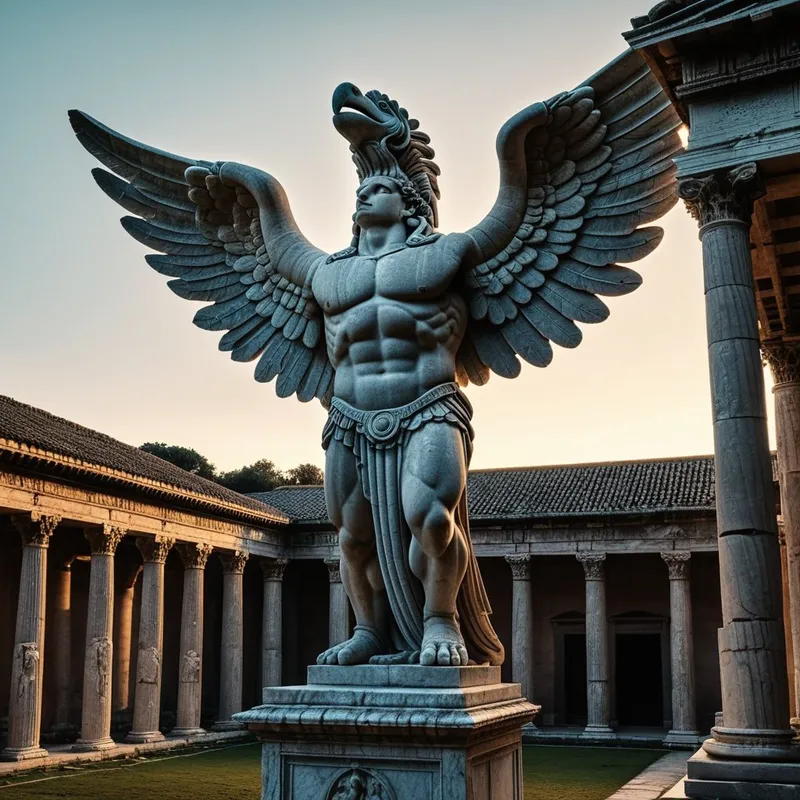
Fascinus Myth Meaning & Symbolism
The myth of the winged phallus deity, a primal symbol of generative power, apotropaic magic, and the unbreakable life force that wards off the evil eye.
The Tale of Fascinus
Listen. Before the marble cooled, before the legions marched, there was a hum in the dark. It was the sound of the world being made, not with a word, but with a pulse. From this primal thrum, in the space between the chthonic depths and the first light, he was born. Not a god of Olympus with a thunderbolt, nor a spirit of the grove with a gentle touch. He was Fascinus himself.
He had no face to speak of, yet he saw all. He had no voice, yet his presence was a vibration felt in the marrow. His body was the first shape, the archetype of generation—a phallus, carved not from lust but from the essential geometry of life’s insistence. And from his base sprang wings, not of an eagle, but of a swift, darting insect, gossamer and iridescent, humming with the same energy that quickened the seed in the soil.
His domain was the threshold. The moment a child, slick and wailing, entered the world from the blood-dark womb. The moment a general, in his gilded chariot, passed through the cheering throngs, the weight of envy hanging thick in the air. The moment a merchant’s ship, laden with fortune, slipped from the safe harbor into the jealous sea. Wherever life was at its most potent, its most vulnerable, its most enviable, there Fascinus hovered.
He was the unseen guardian. When the evil eye, that cold, psychic venom born of another’s bitterness, shot like an arrow towards the newborn, it was his wings that beat the air into a protective vortex, deflecting the invisible poison. His very form was a mirror and a weapon—a display of the generative force so bold, so unabashed, that it dazzled and overwhelmed the petty malevolence of the envious gaze. He did not fight with sword or shield, but with the undeniable assertion of existence itself. His magic was apotropaic; he turned away evil by embodying the power it sought to wither.
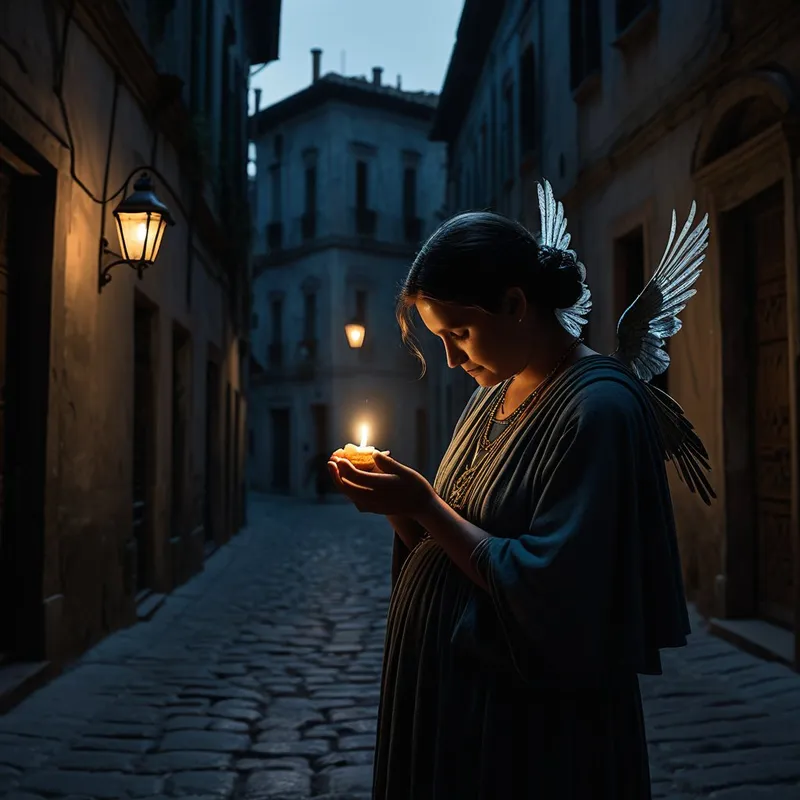
The people knew. The Vestals, keepers of Rome’s sacred flame, cherished his most potent effigy within their sanctum. Mothers whispered his name as they hung tiny, winged amulets of bronze or gold around the necks of their babes. Triumphant generals, at the peak of their mortal glory, would have his image suspended beneath their chariots, a sacred and ribald counter-charm to the fickle favor of the crowd. He was there in the laughter that followed the lewd joke in the tavern, and in the solemnity of the amulet hidden under a senator’s toga. He was the divine shock, the holy jolt that reminded all—from slave to Caesar—that the raw, creative, propagating force of life was the original and ultimate ward against the sterile gaze of death and envy.
Cultural Origins & Context
Fascinus occupied a unique and vital space in the Roman, and to a lesser extent, broader Italic and Greek, worldview. This was not a myth told in epic verse around a fire, but one enacted daily in ritual and worn on the body. His worship was profoundly embedded in the praxis of life—a practical, magical religiosity concerned with immediate protection.
The concept likely has roots deep in pre-Roman Italic fertility cults, merging with Greek ideas of the phallos as a symbol of Dionysiac vitality and comic apotropaic power. In Rome, he was integrated into the state religion under the care of the Vestal Virgins, a fascinating juxtaposition that highlights his numinous, non-sexual aspect. The Vestals’ Fascinus was the deity’s sacrum, his most powerful cult object, invoked for the protection of the city itself.
This was a populist divinity. His effigies, called fascina, were ubiquitous: carved over doorways, painted on shop walls, worn as jewelry, and even fashioned into wind chimes (tintinnabula) that would tinkle in the breeze, their sound and shape combining to scatter malignant influences. He was divinity democratized—a direct, accessible, and potent interface with the supernatural for everyday dangers, specifically the pervasive cultural fear of the evil eye.
Symbolic Architecture
At its core, the myth of Fascinus is a profound symbolic statement about the nature of power, vulnerability, and protection.
The most potent ward is not a wall, but the fearless display of one's own generative core.
The phallus here transcends mere sexuality. It is the primal symbol of generative power—creativity, assertion, lineage, and the forward-thrusting energy of life (libido in its broadest Jungian sense). The wings symbolize the elevation and mobility of this spirit; it is not a base instinct, but a dynamic, conscious force that can ascend and navigate. The combination creates an image of potent vulnerability. The life-force is exposed, a target, yet it is this very exposure, when owned and consecrated, that becomes its armor.
Psychologically, Fascinus represents the Self’s innate apotropaic function. He is the archetypal pattern within the psyche that recognizes a fundamental truth: to hide one's vitality out of shame or fear of envy is to make it a secret wound, susceptible to infection. To consciously embody it, to "wear it on one's chariot," is to integrate it into the structure of the personality, where it acts as a self-validating, protective force field.
The evil eye is the symbol of the negative complex, the psychic poison of internalized criticism, societal shaming, or the projected envy of others. Fascinus does not argue with this poison; he overwhelms it with a more compelling, reality-based assertion of being.

The Dreamer's Resonance
When this myth stirs in the modern dreamer, it often signals a confrontation with the dynamics of envy, shame, and personal power. One might dream of a small, glowing object—a talisman or a strange, abstract shape—that feels intensely personal and powerful, which the dream-ego must hide or protect from the gaze of shadowy, judgmental figures. Alternatively, the dreamer may find themselves in a vulnerable, exposed position (giving a speech, being on stage, celebrating an achievement) while feeling a hostile, envious energy from a crowd or a specific person.
Somatically, this can feel like a contraction in the solar plexus or gut—a literal "knot" of fear that one's success, creativity, or joy will attract negative consequences. The Fascinus pattern emerges as the psyche's attempt to forge a tool for psychic immunity. The dream is initiating a process of moving from a state of vulnerable hiding to one of empowered, talismanic display. The "amulet" in the dream is the nascent symbol of the dreamer's own unique life-force, which must be recognized, crafted, and consciously worn.

Alchemical Translation
The individuation process modeled by Fascinus is one of psychic transmutation through sacred embodiment. The "base material" is the raw, often unconscious, and potentially shame-laden life force—our primal creativity, ambition, sexuality, and vitality. The "evil eye" represents the nigredo, the darkening and corrosive effect of the shadow, both personal and collective, that seeks to negate this force.
The alchemical gold is not the power itself, but the conscious, winged integration of it that renders the poison of envy inert.
The operation is threefold. First, Extraction: One must identify and extract this core generative energy from the murk of complexes and societal conditioning. Second, Fashioning: Like the artisan crafting a fascinum, one must consciously shape this energy into a personal symbol—a creative outlet, a owned ambition, a dignified expression of desire. This is the fascinus as crafted artifact. Third, Consecration & Display: This symbol must be "consecrated" by the Vestal aspect of the psyche—the inner sanctuary of value and meaning—and then, crucially, displayed. Not in grandiosity, but in simple, grounded assertion. It is hung beneath the chariot of one's public persona, worn as the quiet amulet of self-respect.
This final act completes the transmutation. The previously vulnerable power becomes an active, protective agent. The individual no longer fears the envious gaze because their sense of worth and vitality is now internally referenced and symbolically guarded. They have internalized Fascinus, becoming both the protected and the protector, the generative force and the sacred wing that shields it. In doing so, they turn the base lead of fear into the spiritual gold of inviolable, self-generated authority.
Associated Symbols
Explore related symbols from the CaleaDream lexicon: