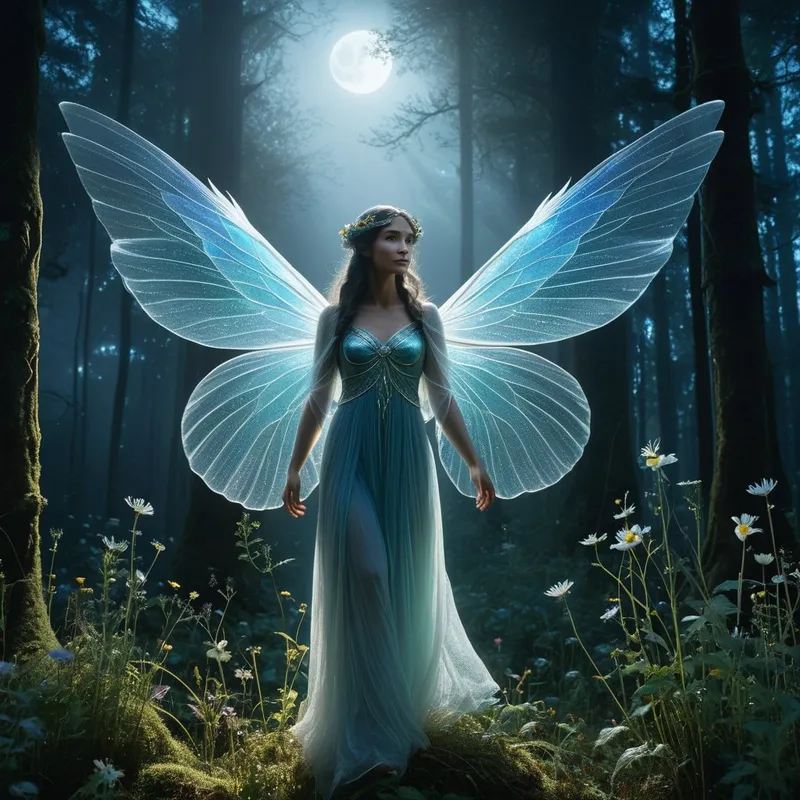
Fairy or Sylph Myth Meaning & Symbolism
A tale of elemental spirits, forbidden bargains, and the elusive, transformative power of the air, woven from global folklore.
The Tale of Fairy or Sylph
Listen, and let the veil between worlds grow thin. In the time when every rustle in the bracken was a word, and every sigh of the wind carried a secret, the spaces between the trees were not empty. They were filled with the People of the Air—the Sylph, the Fairy. They were not gods, nor were they mortals. They were the breath of the wild places, the shimmer on the lake at dawn, the sudden chill that raises the hairs on your neck when you feel watched in a silent wood.
Their realm was one of perpetual twilight, a glade where time dripped like honey from a comb, slow and golden. They danced in rings of toadstools, their laughter the sound of crystal bells and rustling aspen leaves. To them, human affairs were a fleeting, fascinating drama—brief sparks in their long, long lives. But they were covetous of certain human things: the warmth of a hearth, the tang of salt from a tear, the solid, stubborn weight of a promise.
Into such a glade came a mortal, lost and desperate. Perhaps a mother seeking a cure for her child’s fever, or a lover hoping to win back a vanished heart. The air grew still, and the light took form. A being of breathtaking, unsettling beauty stood before them—slender as a sapling, with eyes that held the depth of the night sky and wings that were mere suggestions of light and gossamer.
“I have what you seek,” the airy spirit whispered, a voice like wind through reeds. “But the currency of my realm is not your gold. It is your word. A promise for a boon. A task for a treasure.”
The mortal, heart pounding with a mix of terror and wild hope, agreed. The bargain was struck. The spirit might demand the firstborn child, or the memory of a first love, or a lifetime of service beginning on a day the mortal would never foresee. The price was always precise, and always more than it first seemed. The boon was granted—the child healed, the lover returned—and for a time, the world was right.
But the mortal world is one of clocks and calendars, of forgotten words and changing hearts. The appointed day would arrive, or the specific condition of the promise would be breached. A rosebush was pruned when it should have been left wild. A name was spoken aloud that should have been kept secret. A threshold was crossed with iron in hand.
Then, the glade would grow cold. The benevolent spirit would become an implacable force of nature. The debt was called in, not with malice, but with the cold, absolute logic of a law of physics. What was given by the air was reclaimed by the air. The mortal might be whisked away to the twilight realm forever, or find their blessing twisted into a curse, leaving them to wander the world with a profound, unshakeable sense of loss for something they could no longer name. The fairy folk would return to their dance, the glade falling silent once more, holding its secrets close.

Cultural Origins & Context
The myth of the air spirit—whether called Fairy, Sylph, Jinn of the air, or Vila—is a global phenomenon, a story told from the misty highlands of Scotland to the steppes of Central Asia. It belongs to the vast, oral "Various" culture of folklore that existed long before national borders, passed from grandmother to grandchild by the fireside. These were not formal religious texts but living stories, told to explain the uncanny: the sudden illness that medicine couldn't touch, the lost traveler who returned years later unchanged, the inexplicable luck or misfortune that befell a household.
Societally, these tales served as profound cautionary narratives. They encoded natural law and social boundaries. They taught respect for the wild, untamed places beyond the village fence. They warned of the dangers of desperate bargains and the absolute sanctity of one's word. The fairy folk represented the capricious, amoral force of nature itself—beautiful, generative, but utterly indifferent to human notions of fairness. The storyteller, often an elder, was not just an entertainer but a keeper of ecological and ethical wisdom, using the awe of the tale to govern behavior in a world that felt alive with unseen powers.
Symbolic Architecture
Psychologically, the air spirit is a pure archetype of the Anima or Spirit in its most elusive form. It represents the realm of thought, inspiration, possibility, and fate—forces that are vital to human life but cannot be grasped or owned.
The Sylph does not live in the world of objects, but in the spaces between them. It is the potential in the unspoken word, the fate in the unchosen path.
The mortal protagonist symbolizes the conscious ego, grounded in need and desire. The desperate bargain is the ego's attempt to harness the power of the unconscious (inspiration, luck, healing) for its own ends. The spirit's precise, cryptic price represents the law of psychic equilibrium: energy taken from the unconscious must be repaid in kind, often with a piece of one's own soul-structure—a commitment, a memory, a future possibility. The inevitable failure to uphold the bargain mirrors the ego's inability to fully comprehend or control the depths from which it seeks to draw. The spirit's reclaiming of its gift is not punishment, but a reassertion of the natural order of the psyche. The core conflict is between the human desire for permanent, concrete solutions and the essential, fleeting, and transactional nature of inspiration and grace.
The Dreamer's Resonance
When this myth pattern stirs in the modern dreamer, it often manifests as dreams of elusive figures, conditional gifts, or deals with shadowy entities. You may dream of finding a beautiful, empty house you can live in only if you never look into one specific room. You may be given a wondrous tool or piece of knowledge that you must return at dawn. The somatic feeling is one of breathless anticipation coupled with deep anxiety—a tightness in the chest, a feeling of being watched.
Psychologically, this signals a process where the conscious mind is engaging with a powerful content from the unconscious. You may be in a period of intense creativity (the "boon"), but it feels unsustainable and comes with a sense of impending cost. Or, you may have made a life choice (a career, a relationship) based on a desperate need, without fully integrating the "fine print"—the parts of your authentic self you had to sacrifice. The dream is the psyche's way of presenting the bill, forcing a confrontation with the neglected terms of your own inner bargain. It is a call to acknowledge the debt owed to your own wholeness.

Alchemical Translation
The alchemical journey modeled here is the sublimatio—the process of distillation and spiritualization, where matter is turned into volatile spirit. The mortal's initial state is one of nigredo, the blackness of despair and felt need. The encounter with the spirit is the flash of albedo, the white, illuminating idea or hope. The bargain itself is the crucial, and often misunderstood, stage of citrinitas, the yellowing, where the bright idea must be married to a commitment, a sacrifice of lesser values.
The treasure is never the gold; it is the transformation demanded by the price of the gold.
The failure to keep the bargain is not the end of the opus, but its central fire. The "loss" of the boon—the failed project, the collapsed inspiration, the relationship that turned sour—is the necessary mortificatio, the death of the ego's fantasy of control. This dissolution allows for the true rubedo, the reddening or culmination. This is not the retrieval of the original wish, but the birth of a new relationship to the spirit itself. The individual learns to interact with the airy, inspirational realm not through binding contracts of greed or fear, but with respect, humility, and an acceptance of transience. They no longer seek to own the wind, but to understand its patterns and sail by it. The integrated self becomes, in a sense, a steward of the threshold, capable of receiving grace without demanding to imprison it, embodying the magician archetype who works with the laws of nature and psyche, not against them.
Associated Symbols
Explore related symbols from the CaleaDream lexicon: