Fairy Forts Myth Meaning & Symbolism
Ancient earthen mounds where the Sídhe dwell, gateways to a perilous, enchanting realm that mirrors our deepest psyche.
The Tale of Fairy Forts
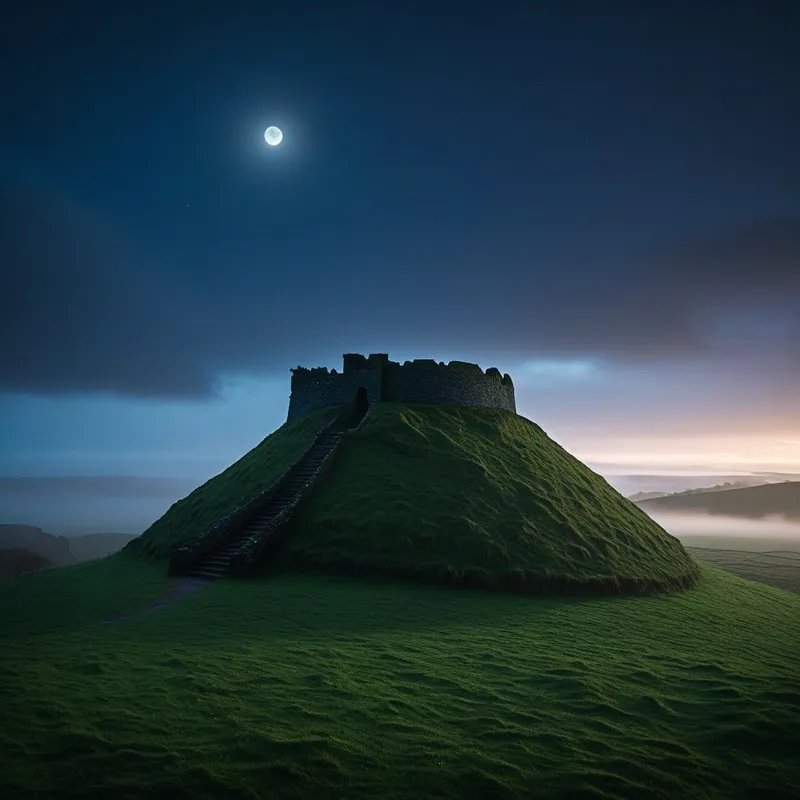
Listen. The land you walk is not the only one. Beneath the green cloak of grass, within the silent womb of the ancient mound, another world breathes. They call them raths or lisses—circular earthen banks, silent under the sun, sleeping under the stars. But do not be fooled by their slumber. These are the Sídhe, the forts of the Aos Sí, the People of the Mounds.
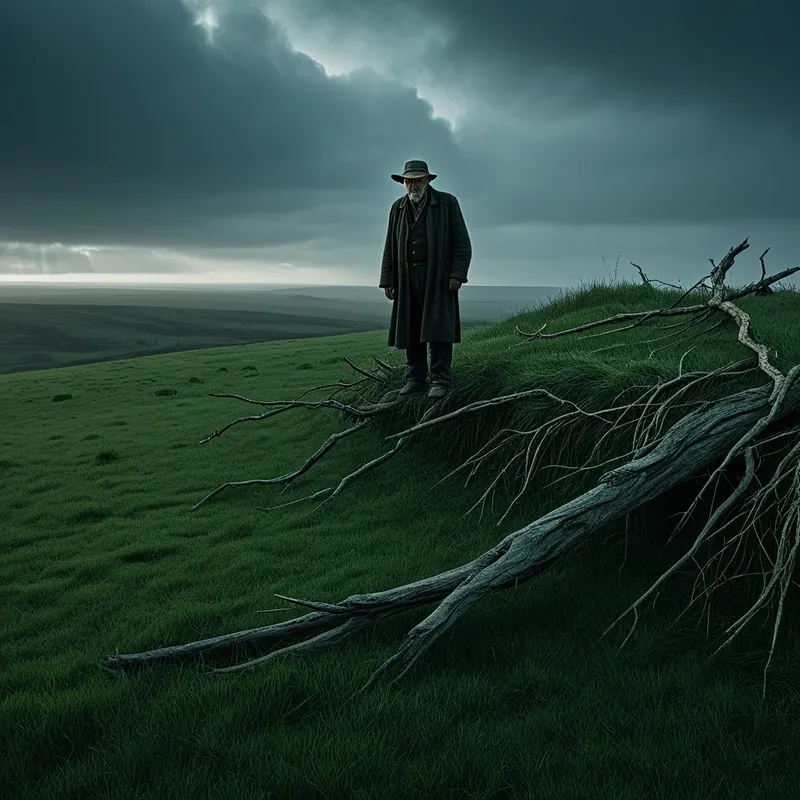
In a time when the wind carried older songs, there was a farmer named Dáire. His fields pressed right against the green, perfect ring of a rath. It was a place of profound quiet; even the birds did not sing from its lone, twisted hawthorn tree. One evening, after a fierce storm, Dáire saw that a great branch from that hawthorn had been torn loose and lay upon the sacred bank. A practical man, he saw only good firewood. As his hand closed on the branch, the air turned cold and thick as bog water. A voice, like the ringing of a silver bell heard through stone, spoke from nowhere and everywhere: “That is not yours to take.”
But Dáire, his heart hardened by toil, scoffed. He dragged the branch home. That night, his hearth-fire burned with an unnatural, green-tinged flame, and the wind howled with a sound like distant, furious laughter. The next dawn, his prize cow was found dead by the gate, its eyes wide with a terror not of this earth. Still, he did not heed the warning.
On the second night, the laughter came closer, just outside the wall. His children awoke screaming, speaking of beautiful, terrible faces at the window. His wife’s breath grew shallow, as if an invisible hand pressed upon her chest. The branch, now leant against the wall, seemed to pulse with a faint, malevolent light.
Broken, Dáire returned to the rath at twilight, the hour of the Met between Day and Night. He laid the branch back upon the exact spot from which he had taken it, his head bowed. “I return what was never mine,” he whispered to the silent mound. “I ask for peace.”
The silence deepened, then softened. A warmth, like the first sun of spring, brushed his cheek. From the mound came not a voice, but a feeling—a sense of ancient, placated watchfulness. He returned home. His wife’s breath eased. The oppressive weight lifted. And though he farmed beside the rath for all his days, he never again took so much as a blade of grass from its bank. He had learned the first and final law: some thresholds are not for crossing, only for honoring.
Cultural Origins & Context
The myth of the Fairy Fort is not a single story but a pervasive folk belief woven into the very topography of Ireland, Scotland, and other Celtic lands. These tales emerged from a profound animistic worldview, where the landscape was alive with personhood and agency. The Sídhe were not mere “fairies” of whimsy, but were often understood as the Tuatha Dé Danann, the old gods who, upon being displaced, withdrew into the hollow hills. They became the Aos Sí, the powerful, capricious guardians of the Otherworld.
These stories were the law code of the liminal spaces, passed down by the seanchaí (storytellers) and grandmothers by the fire. Their function was deeply pragmatic and psychological: to enforce conservation, to mark spiritual geographies, and to teach respect for the unseen. To disturb a fort was to invite The Blight—a curse upon one’s livestock, health, or fortune. This was not superstition, but a sophisticated cultural mechanism for maintaining ecological and social balance, framing the human world as a guest in a much older, more powerful order.
Symbolic Architecture
Psychologically, the Fairy Fort is a perfect symbol for the threshold of the unconscious. It represents the border between the ego’s cultivated field—the known, the controlled, the rational—and the wild, timeless, and potent realm of the psyche’s depths.
The fort is not a barrier to keep us out, but a membrane to define where the I ends and the Other begins.
The Aos Sí within symbolize the autonomous complexes and archetypal forces of the unconscious. They are beautiful because they hold our latent wholeness and creative potential; they are terrifying because they operate by laws alien to the conscious mind. The stolen branch is any psychic content—an intuition, a repressed emotion, a half-formed talent—that the ego attempts to pluck and use for its own purposes without proper reverence or understanding. The resulting blight is the symptom: neurosis, depression, or a sense of haunting alienation that arises when we violate our own inner boundaries.
The Dreamer's Resonance
When the imagery of the Fairy Fort arises in modern dreams, it signals a powerful encounter with a psychic threshold. The dreamer may find themselves at the edge of a mysterious hill, a sealed door in a grassy bank, or a ring of stones humming with energy.
Somatically, this can correlate with a feeling of magnetic pull or repulsion, a tightening in the chest, or a chill—the body sensing the numinous. Psychologically, it marks a moment of choice. To enter the fort unprepared is to risk psychic inundation, a dissolution of ego boundaries akin to psychosis. To ignore or desecrate it is to invite the “blight”: a life drained of meaning, plagued by repetitive failures, or a profound creative blockage. The dream is presenting a sacred boundary that demands acknowledgment. The process underway is one of confrontation with the autonomous psyche—learning that not all inner contents are servants to the will, but are sovereign entities with which one must negotiate.
Alchemical Translation
The myth models the alchemical stage of mortificatio and separatio—the necessary death of arrogant egoic possession and the separation of the sacred from the profane. Dáire’s journey is one of failed inflation followed by humbled restitution.
Individuation is not about storming the fortress of the unconscious to claim its treasures, but about learning the etiquette of the threshold.
The modern individual’s “fairy fort” may be a neglected creative impulse, a traumatic memory sealed away, or the shadow aspect of the personality. The “branch” we steal is our attempt to exploit this content for personal gain, status, or comfort without undergoing the required transformation. The blight that follows is the soul’s corrective, forcing us to turn back. The act of returning the branch—the apology to the depths—is the beginning of true relationship. It is the moment we shift from seeing the unconscious as a resource to be mined to a realm to be respected, a dialogue to be entered. This restitutive act is the first step in the unio mentalis, the aligning of conscious attitude with psychic reality. We do not become masters of the Sídhe; we become respectful neighbors to the vast, ancient territory of the Self. The peace that follows is not safety, but right relation—the only foundation from which genuine transformation can grow.
Associated Symbols
Explore related symbols from the CaleaDream lexicon: