
Fafnir's Hoard Myth Meaning & Symbolism
A cursed treasure transforms a man into a dragon, a hero must slay the beast to claim the gold, and the prize carries a heavy doom.
The Tale of Fafnir's Hoard
Listen, and hear the tale of gold that turned to grief, of a heart that hardened into a hide, of a curse that coiled around the soul like a serpent.
It began not with a dragon, but with three brothers: Hreiðmarr, the stern father, and his sons Reginn and Fáfnir. Into their hall stumbled the gods Loki, Thor, and Hœnir, bound by a terrible debt. They had slain Otr, and the father demanded a weregild—enough gold to fill the otter’s skin and cover its outside completely.
Loki, the weaver of woes, was sent to fetch it. He descended to the watery realm of Andvari, a dwarf who swam as a pike in the dark pools. With a net of cunning, Loki caught him and stripped him of every glittering piece of his hoard. Andvari pleaded for one ring, a single band of power and beauty. Loki ripped it from his finger. As the gold left his hand, Andvari’s despair curdled into a prophecy: “That gold, and the ring that rules it, shall be the death of all who own it.” The curse was spoken. It seeped into the metal.
The gods delivered the ransom. Hreiðmarr gloated as the gold covered the otter-skin, but Loki, with a grim smile, placed the final ring, the Andvaranaut, upon it. “The debt is paid,” he said, “and with it, a gift.” The hall grew cold.
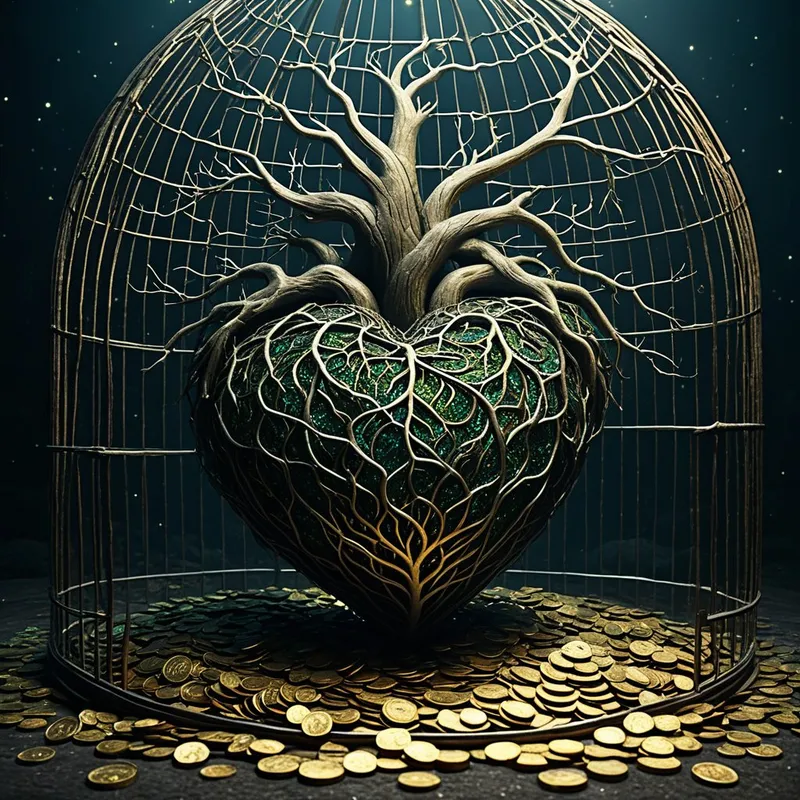
Greed, a quiet worm, began to gnaw. Fáfnir, the strongest son, coveted the hoard. In the dead of night, he raised a sword against his own father, spilling kin-blood upon the very gold meant to mend a killing. He took the treasure, every cursed coin, and fled to the Gnitaheiðr. There, in a cave dark and deep, he brooded. The gold was his world. He lay upon it, stared at it, feared its loss. The worm of greed grew, twisting his form. His skin thickened into scales, his limbs shrank, his jaw elongated into a venomous maw. The man Fáfnir was no more. In his place was a dreki, a poison-breathing dragon coiled around his ill-gotten heart.
Years passed. The hoard lay untouched, guarded by a beast whose only joy was its possession. But the curse was not idle. It called for a hero. Reginn, the surviving brother, now a master smith, found his instrument in Sigurd, a youth of peerless courage. Reginn reforged the shards of his father’s sword, Gram, into a blade that could shear iron. He fed Sigurd tales of the dragon’s evil and the glory of the gold, hiding his own thirst for it.
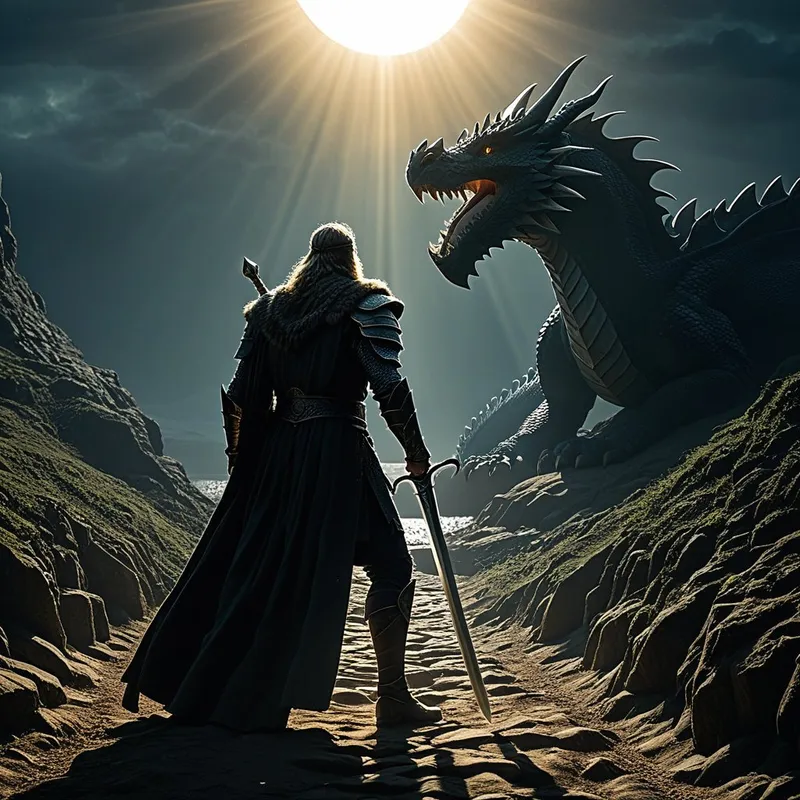
Guided by Reginn’s knowledge, Sigurd journeyed to the Gnitaheiðr. He did not face the monster in open combat. Wisdom, from the lips of the god Odin, had taught him cunning. He dug a pit on the path Fáfnir took to drink and hid within it. As the earth shook and the stench of decay filled the air, the dragon passed overhead. From below, Sigurd thrust Gram upward with all his strength, piercing the soft underbelly, letting the life of the worm pour out onto the barren heath.
Dying, Fáfnir spoke, his voice a rattle of stones. “The gold you take will be your bane, bright boy. It will glitter and lie. It will turn brother against brother, love to ash.” Sigurd, roasting the dragon’s heart to taste its wisdom, heard the prophecy in the sizzling fat. He understood then the nature of his prize. He took the hoard, the Helm of Terror, and the cursed ring. He had slain the outer dragon, but the inner one, the lure of the curse, now traveled with him, a silent passenger in a chest of gold.
Cultural Origins & Context
This saga is not a single story but a vital thread in the vast tapestry of Norse and wider Germanic legend. It is most famously preserved in the Icelandic Völsunga saga and the Poetic Edda, texts compiled in the 13th century but echoing traditions centuries older. These stories were the lifeblood of the Viking Age and the medieval Scandinavian world, told in longhouses by skalds and around fires by elders.
The function of Fáfnir’s tale was multifaceted. On one level, it was pure, thrilling entertainment—a story of heroic deed, monstrous transformation, and cursed treasure. On a deeper, societal level, it served as a powerful ethical and psychological parable. In a culture with complex laws of compensation and blood feud, the myth graphically illustrates the catastrophic consequences of violating sacred bonds—first, Loki’s violation of hospitality leading to Otr’s death, then Fáfnir’s kin-slaying for gold. It warns that wealth obtained through violence or betrayal carries a spiritual poison that corrupts the very soul, transforming a man into a monstrous, isolated hoarder. The dragon is the ultimate symbol of anti-social, self-consuming greed, the opposite of the ring-giver’s generosity that was the ideal of a good lord.
Symbolic Architecture
At its core, the myth of Fáfnir’s Hoard is a profound map of psychic corruption and the perils of the heroic quest. The treasure is not merely wealth; it is frozen potential, creative life-force that has been seized, stagnated, and cursed. The Andvaranaut represents the central, binding power of this complex—the initial trauma or “spell” that turns life-giving energy into a possessive, repetitive loop.
The dragon is not born; it is made. It is the shape of a soul that has chosen possession over relation, hardening its heart to protect its wound.
Fáfnir’s transformation is a literalization of a psychological process: identification with a complex. He does not have greed; he becomes Greed. His humanity is sacrificed to the single, all-consuming drive to guard his prize. His cave is the isolated, armored psyche, and his poisonous breath is the corrosive effect such a fixation has on all it touches. Sigurd, the hero, represents the thrust of consciousness necessary to confront this petrified structure. His victory, however, is ambivalent. He slays the outer manifestation but must now carry the cursed complex—the hoard—into his own life. The myth wisely shows that slaying the dragon does not dissolve the curse; it merely transfers the responsibility for it to a more conscious bearer.

The Dreamer's Resonance
When this myth stirs in the modern unconscious, it often manifests in dreams of hidden treasure, guarded vaults, or confronting a terrifying, reptilian presence. The dreamer may be searching for something of immense value in a labyrinthine basement (the personal unconscious) or a desolate landscape (the inner wasteland). The dragon is rarely just an external monster; it is frequently an aspect of the dreamer’s own body—a stiffened back, a clutching hand, a jaw locked in tension.
These dreams signal a somatic and psychological process where a vital part of the personality—perhaps a talent, a capacity for joy, or a source of creative power—has been “cursed” by early experience. It has been turned into a hoarded secret, something protected to the point of isolation, which now blocks the flow of life. The dragon’s poison is the bitterness, resentment, or chronic anxiety that surrounds this sequestered energy. The dream is an invitation from the psyche to undertake the Sigurd-task: to locate the guarded hoard, to have the courage to dig the trench (a moment of vulnerable, strategic receptivity), and to confront the possessive “worm” that has grown around a wounded part of the self.
Alchemical Translation
The journey of Fáfnir’s Hoard is a stark model of psychic alchemy, a roadmap for the individuation process where base material is transmuted into gold of the spirit. The initial state is nigredo—the blackening. This is the curse itself, the primal theft (Loki’s coercion) and the kin-slaying (Fáfnir’s crime) that represent a fundamental split or trauma in the psyche, turning life into deathly possession.
Fáfnir’s existence as the dragon is the stage of fixatio—a rigid, compulsive identification with a single complex, utterly immobile. Sigurd’s intervention is the separatio and mortificatio—the necessary, violent separation from this stuck state, the “killing” of an old, maladaptive attitude. This is not a gentle process; it requires the forged sword of focused will (Gram) and the wise stratagem of humility (the trench).
The true alchemical work begins not with slaying the dragon, but with tasting its heart. It is the assimilation of the insight hidden within the pathology.
Sigurd roasting the heart and understanding the dragon’s speech is the albedo—the whitening, the gaining of wisdom from the shadow. He learns the nature of the curse directly from its source. For the modern individual, this translates to the hard-won insight gained from examining one’s own “dragonish” behaviors: the possessive relationships, the hoarded grievances, the isolated pride. The final, and most difficult, stage is the rubedo—the reddening, or integration. This is represented by Sigurd taking the hoard. The cursed treasure does not vanish; it must be carried forward consciously. The gold—the libido, the life energy—is reclaimed, but now with the full, sober knowledge of its potential to corrupt. The individuated individual does not disown their complexes or their past wounds; they learn to carry the “curse” with awareness, transforming a fate into a responsibility, and a hoarded secret into a redeemed part of the whole self.
Associated Symbols
Explore related symbols from the CaleaDream lexicon: