Eye of Horus Myth Meaning & Symbolism
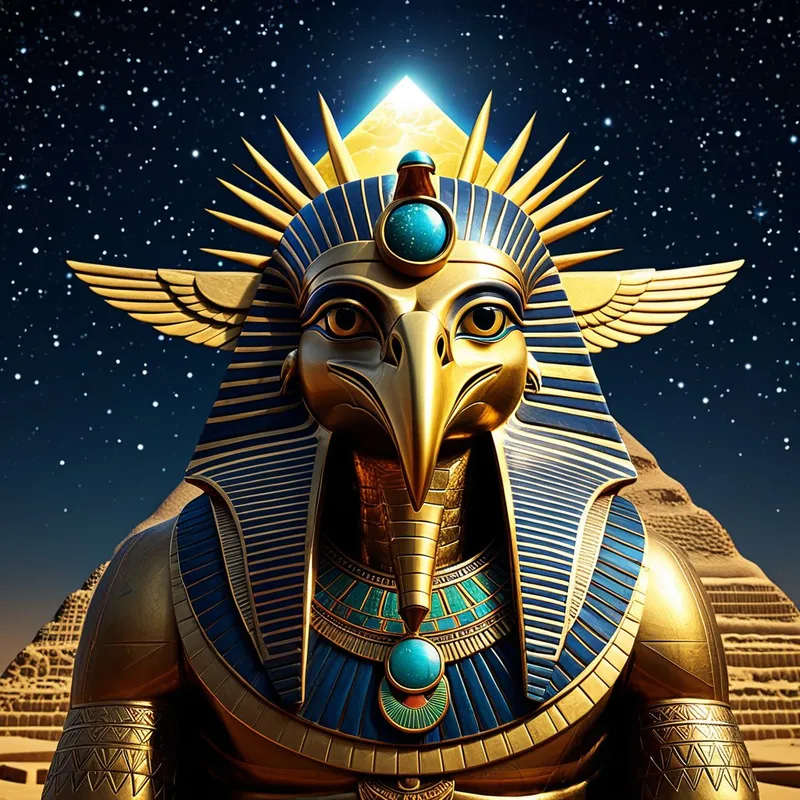
A myth of divine vengeance, loss, and magical restoration, where the wounded eye of the falcon god becomes a symbol of healing and cosmic order.
The Tale of Eye of Horus
Listen, and let [the sands of time](/myths/the-sands-of-time “Myth from Greek culture.”/) part. Before [the pyramids](/myths/the-pyramids “Myth from Egyptian culture.”/) cast their long shadows, when the gods walked the black earth of Kemet and the chaos of the red lands whispered at the edges of [the world](/myths/the-world “Myth from Tarot culture.”/), a great strife shook the heavens.
It began with a throne, empty and gleaming, and a hunger that festered in the heart of Set, the red-haired one. His brother, the good king [Osiris](/myths/osiris “Myth from Global/Universal culture.”/), lay dismembered, his reign ended by treachery. But from the mourning of the goddess Isis sprang an avenger: her son, [Horus](/myths/horus “Myth from Egyptian culture.”/), the distant one, the falcon whose wings spanned [the sky](/myths/the-sky “Myth from Persian culture.”/). He was youth and rightful order incarnate, and he challenged his uncle Set for the legacy of his father.
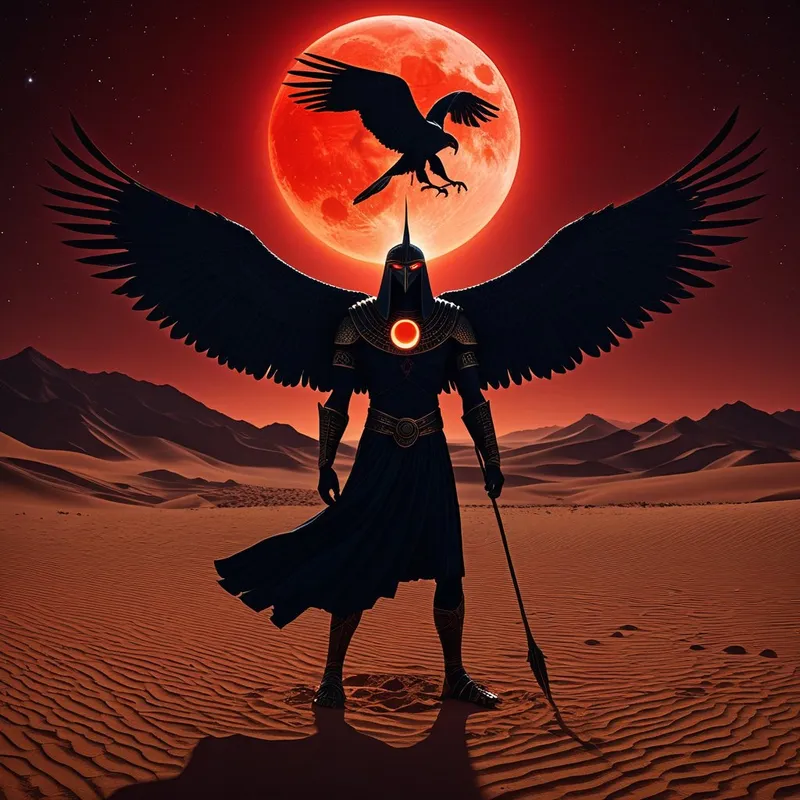
Their battle was not of a single day, but of eighty years—a cosmic struggle that churned the Nile and scorched [the desert](/myths/the-desert “Myth from Biblical culture.”/). They became hippopotami, locked in [the river](/myths/the-river “Myth from Buddhist culture.”/)’s mud. They became serpents, poisoning the reeds. Finally, as falcon and unnameable beast, they clashed in the final, fateful duel. The air crackled with divine fury. Set, embodiment of brute force and disorder, lunged with a terrible cry. His fingers, like claws of a desert demon, found their mark. He gouged, he tore, and he plucked the left eye of Horus from its socket—a celestial orb, a miniature moon and sun fused, a vessel of his very power and perception.
The young god reeled, a scream of agony and cosmic imbalance echoing through the Nun. The eye, the Udjat, was lost, shattered into six fragments that scattered like fallen stars. But the story does not end in darkness.
Into this void of pain stepped [Thoth](/myths/thoth “Myth from Global/Universal culture.”/), the measurer, the scribe of the gods. With spells older than time and a patience as deep as the sky, he sought out each piece. Not with violence, but with the precision of a healer and the knowledge of a star-chart. One by one, from the river silt and the desert wind, he recovered the fragments. Then, with the magic of [Ma’at](/myths/maat “Myth from Egyptian culture.”/) itself, he performed the first act of divine restoration. He pieced the eye back together, whole, sound, and more radiant than before.
And what did the healed Horus do with this restored eye, this symbol of his suffering and his [triumph](/myths/triumph “Myth from Roman culture.”/)? He did not keep it for himself. He offered it. To his father, Osiris, resting in the Duat. This act of filial sacrifice fed Osiris, revitalizing him, completing the cycle of loss and return. The Eye was made sound, the Udjat, and in its healing, the world itself was made more whole.
Cultural Origins & Context
This myth was not merely a story; it was a foundational pillar of Egyptian reality. It was recited in temple rituals, inscribed on coffin texts, and worn as amulets by kings and commoners alike. Its primary function was to explain and reinforce the principle of Ma’at—the cosmic order that held chaos at bay. The injury and restoration of the Eye mirrored the daily wounding and healing of the sun (Ra) as it passed through the perilous night, and the monthly waning and waxing of [the moon](/myths/the-moon “Myth from Tarot culture.”/).
The myth served as the divine precedent for [the pharaoh](/myths/the-pharaoh “Myth from Egyptian culture.”/)’s role. Every [pharaoh](/myths/pharaoh “Myth from Egyptian culture.”/) was the living Horus on earth, and his duty was to maintain the “sound eye” of the state—its health, prosperity, and order—against the chaotic forces (Set) that threatened it. The offering of the Eye to Osiris directly paralleled [the pharaoh](/myths/the-pharaoh “Myth from Egyptian culture.”/)’s duty to make offerings to the gods and his ancestors to sustain the cosmic cycle. Thus, the myth was a map of royal responsibility and a promise of restoration after inevitable conflict and loss.
Symbolic Architecture
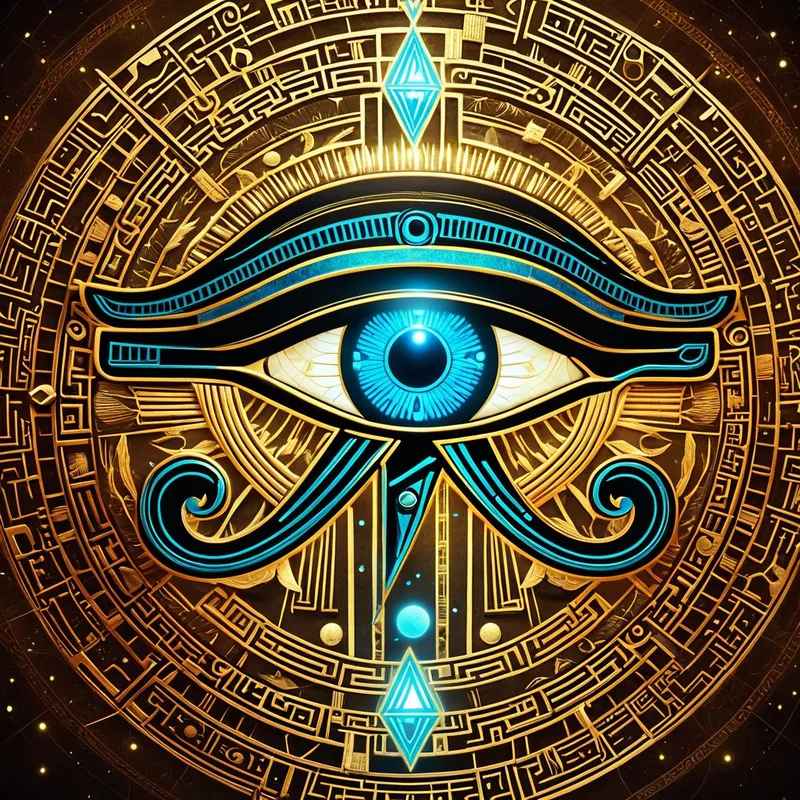
[The Eye of Horus](/myths/the-eye-of-horus “Myth from Egyptian culture.”/) is a profound [symbol](/symbols/symbol “Symbol: A symbol can represent an idea, concept, or belief, serving as a powerful tool for communication and understanding.”/) of [fragmentation](/symbols/fragmentation “Symbol: The experience of breaking apart, losing cohesion, or being separated into pieces. Often represents disintegration of self, relationships, or reality.”/) and reintegration. It is not a [symbol](/symbols/symbol “Symbol: A symbol can represent an idea, concept, or belief, serving as a powerful tool for communication and understanding.”/) of perfect, unchanging wholeness, but of wholeness achieved through wounding and repair. The six fragments recovered by Thoth were later associated with the six senses ([sight](/symbols/sight “Symbol: Sight symbolizes perception, awareness, and insight, representing both physical and inner vision.”/), smell, thought, hearing, taste, touch) and with specific fractions used in [grain](/symbols/grain “Symbol: Represents sustenance, growth cycles, and the foundation of civilization. Symbolizes life’s harvest, patience, and transformation from seed to nourishment.”/) measurements, linking the myth to both [perception](/symbols/perception “Symbol: The process of becoming aware of something through the senses. In dreams, it often represents how one interprets reality or internal states.”/) and [material](/symbols/material “Symbol: Material signifies the tangible aspects of life, often representing physical resources, desires, and the physical world’s influence on our existence.”/) sustenance.
The true self is not born whole; it is assembled from the shards of our losses, bonded by the magic of conscious attention.
Psychologically, Horus represents the emerging conscious ego—the “[hero](/symbols/hero “Symbol: A hero embodies strength, courage, and the ability to overcome significant challenges.”/)” [archetype](/symbols/archetype “Symbol: A universal, primordial pattern or prototype in the collective unconscious that shapes human experience, behavior, and creative expression.”/) tasked with confronting the chaotic, shadowy forces of the unconscious (Set). The [loss](/symbols/loss “Symbol: Loss often symbolizes change, grief, and transformation in dreams, representing the emotional or psychological detachment from something or someone significant.”/) of the eye is the inevitable price of this engagement; it is the wounding of our naive perception, our idealized self-[image](/symbols/image “Symbol: An image represents perception, memories, and the visual narratives we create in our minds.”/), in the brutal encounter with [reality](/symbols/reality “Symbol: Reality signifies the state of existence and perception, often reflecting one’s understanding of truth and life experiences.”/), [trauma](/symbols/trauma “Symbol: A deeply distressing or disturbing experience that overwhelms the psyche, often manifesting in dreams as unresolved emotional wounds or psychological injury.”/), or our own inner darkness. Thoth symbolizes the mediating function of [consciousness](/symbols/consciousness “Symbol: Consciousness represents the state of awareness and perception, encompassing thoughts, feelings, and experiences.”/)—[logos](/myths/logos “Myth from Christian culture.”/), intellect, and reflective wisdom—that can patiently gather and reassemble what has been shattered. The restored Eye is then offered to Osiris, the deeper, ancestral Self in the [underworld](/symbols/underworld “Symbol: A symbolic journey into the unconscious, representing exploration of hidden aspects of self, transformation, or confronting repressed material.”/) of the [psyche](/myths/psyche “Myth from Greek culture.”/), indicating that the [fruit](/symbols/fruit “Symbol: Fruit symbolizes abundance, nourishment, and the fruits of one’s labor in dreams.”/) of our suffering must be sacrificed to nourish a wisdom greater than our personal ego.
The Dreamer’s Resonance
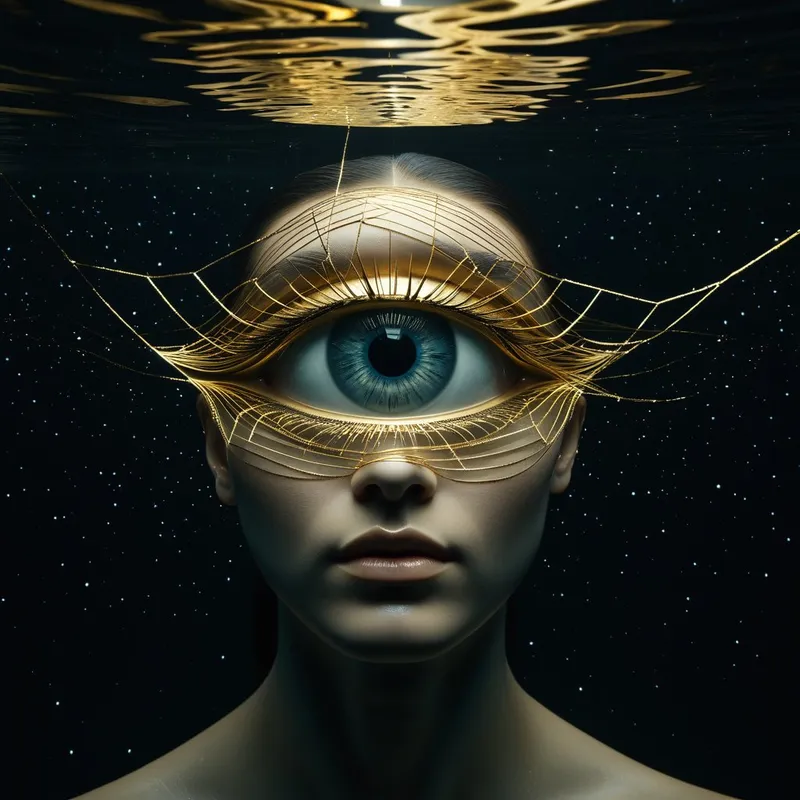
When this myth stirs in the modern dreamer, it often manifests as dreams of injury to the face or head, particularly the left eye. One may dream of being blinded, of a crucial piece of a puzzle or a valuable object being lost and needing to be found, or of a fragmented, geometric object that demands reassembly. Somatically, this can correlate with feelings of disorientation, a literal “loss of sight” regarding one’s life path, or a deep anxiety about being incomplete or “in pieces.”
The psychological process at work is one of active restitution. The psyche is signaling that a part of the dreamer’s perceptual framework or psychic integrity has been damaged, likely in a recent or past conflict (a “Set encounter”). The dream is not merely replaying the wound but initiating the Thoth process: calling for a careful, mindful search through the inner landscape to recover the dissociated parts of experience, emotion, or identity that were lost in the battle. The dreamer is in the phase between the injury and the healing, tasked with the sacred work of gathering.
Alchemical Translation
The alchemical journey mirrored in this myth is the opus contra naturam—the work against nature, which is here the work against entropy and disintegration. The raw material ([prima materia](/myths/prima-materia “Myth from Alchemical culture.”/)) is the shattered self after a profound conflict. The battle with Set is the necessary [nigredo](/myths/nigredo “Myth from Alchemical culture.”/), the blackening, the descent into chaos and mutilation.
Individuation is the restoration of the Udjat-eye: the conscious integration of missing fragments until one can offer a perfected perception back to the source.
Thoth represents the albedo, the whitening stage of analysis, reflection, and careful distillation. He is the cognitive and spiritual function that sorts, names, and understands each fragmented piece of pain, memory, or talent. The reassembly is the citrinitas, the yellowing, where insight begins to coalesce into a new, more complex structure of being—the geometric, “sound” Eye.
The final offering to Osiris is the ultimate [rubedo](/myths/rubedo “Myth from Alchemical culture.”/), the reddening. This is the stage many modern seekers miss: the reintegrated wholeness is not for [the ego](/myths/the-ego “Myth from Jungian culture.”/)‘s glorification. The healed perception, the hard-won wisdom, must be surrendered to the greater, transpersonal Self. It is fed back into the ancestral river of one’s own depth, to nourish the roots of being and complete the sacred circuit. The individual becomes a vessel for a restored order, a living Udjat, capable of seeing—and sustaining—a more complete world.
Associated Symbols
Explore related symbols from the CaleaDream lexicon: