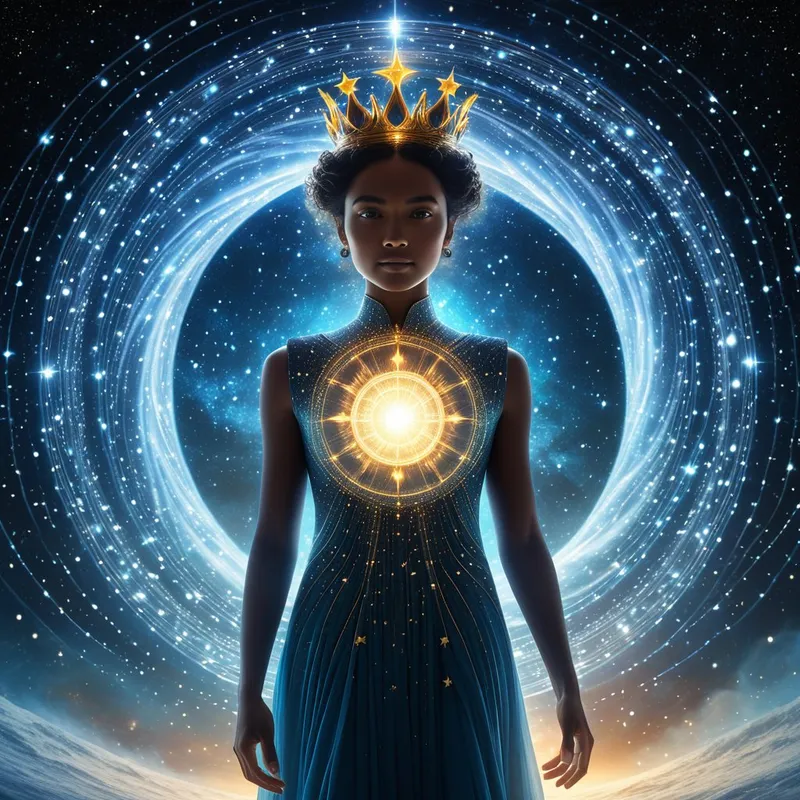
Ether Myth Meaning & Symbolism
The story of the Fifth Element, the liminal breath of spirit that weaves the fourfold world into being and offers the key to inner transmutation.
The Tale of Ether
Before the world was fixed, it was a dream. Before the dream, there was a breath.
Listen, then, to the tale that is not sung but felt, the story written not on parchment but in the spaces between the stars and the silence between heartbeats. In the beginning, the Four Elements danced in chaos—a roaring, clashing, seething tumult. Earth yearned to be still. Water longed to flow. Air ached to rise. Fire burned to consume. Each was sovereign, each was alone, and in their solitude, they knew only conflict. The cosmos was a cacophony of potential with no conductor, a canvas of pure color with no image.
Then, from the heart of this primordial discord, a sigh was heard. It was not a sound, but the shape of silence. It was not a light, but the source of seeing. This was the first stirring of Aether—or as the wise would later name it, the Quintessence. It did not command; it permeated. It did not fight; it wove.
Where Earth’s mountains strained against the void, Aether became the adhesive that bound particle to particle, not as a chain, but as a whispered agreement to be. Where Water’s tides threatened to drown all distinction, Aether became the surface tension, the meniscus that held the drop together, allowing it to reflect the sky. Where Air’s tempests sought to scatter all to dust, Aether became the medium through which the storm could be a single, coherent breath. Where Fire’s rage sought to reduce all to ash, Aether became the invisible crucible, the space in which transformation could occur without utter annihilation.
This subtle weaver did not impose order, but offered relationship. One by one, the Elements felt not a force, but an invitation. Earth felt itself cradled. Water felt itself heard. Air felt itself guided. Fire felt its purpose focused. Into the spaces between them, Aether flowed, a luminous, living glue. It was the carrier of their voices, the translator of their desires, the marriage bed of their unions. From this sacred mediation, the world was born—not as a victory of one over the others, but as a symphony composed of their distinct notes, held together by the silent, sustaining resonance of the fifth.
And so, the cosmos found its voice. The fixed stars are Earth’s dream of permanence, sung through Aether. The rolling seas are Water’s ballads of longing, carried on Aether. The winds are Air’s swift epics, written in Aether. The sun’s forge is Fire’s eternal hymn, resonating in Aether. The myth tells us that Aether never rests. It is the eternal mediator, the breath of spirit that continually breathes the world into being, asking only that we learn to listen for the harmony in the chaos.
Cultural Origins & Context
The myth of Ether is not the property of a single tribe or epoch, but a persistent, underground river flowing through the bedrock of Western thought. Its headwaters are in the pre-Socratic philosophers of ancient Greece. Anaximenes spoke of aer as the primordial substance, while Aristotle later formalized Aether as the fifth element, the immutable substance of the heavenly spheres, distinct from the corruptible four below the moon. This philosophical concept was alchemized by the Hermetic and Neoplatonic traditions.
In these esoteric streams, Ether transformed from a cosmological postulate into a mystical reality. It became the Spiritus Mundi—the World Spirit—the living, intelligent medium that connects all things. Renaissance magi like Paracelsus and John Dee sought to harness it. Rosicrucian manifestos spoke of it as the secret fire of enlightenment. It was passed down not in popular folklore, but in encrypted grimoires, alchemical diagrams, and the oral teachings of secret societies. Its societal function was initiatory: to map the invisible architecture of reality for the adept, providing a conceptual framework for spiritual ascent and the ultimate goal of unifying the human microcosm with the divine macrocosm.
Symbolic Architecture
Psychologically, Ether represents the transcendent function—the psychic capacity to hold opposites in tension until a new, third position emerges. It is not the content of consciousness (the four elements), but the very field of consciousness itself.
Ether is the psyche’s innate drive toward wholeness, the silent architect working to integrate the warring factions of our inner world.
The Four Elements symbolize the fundamental aspects of the human psyche: Earth as the body and the sensing function (sensation); Water as the soul and the feeling function (emotion); Air as the mind and the thinking function (intellect); Fire as the spirit and the intuitive function (intuition and will). In their unreconciled state, they manifest as inner conflict: bodily inertia (Earth) versus emotional turbulence (Water), cold rationality (Air) versus compulsive passion (Fire).
Ether is the symbolic embodiment of the Self, the central archetype of order and totality in Jungian psychology. It does not eliminate these elements but provides a containing, meaningful context for them. It is the principle of relationship. In its absence, we experience fragmentation—a life where thought is disconnected from feeling, action from intuition, spirit from matter. Ether’s myth teaches that healing and creation occur not by defeating a part of ourselves, but by discovering the subtle, animating principle that can orchestrate our inner multiplicity into a coherent life.
The Dreamer's Resonance
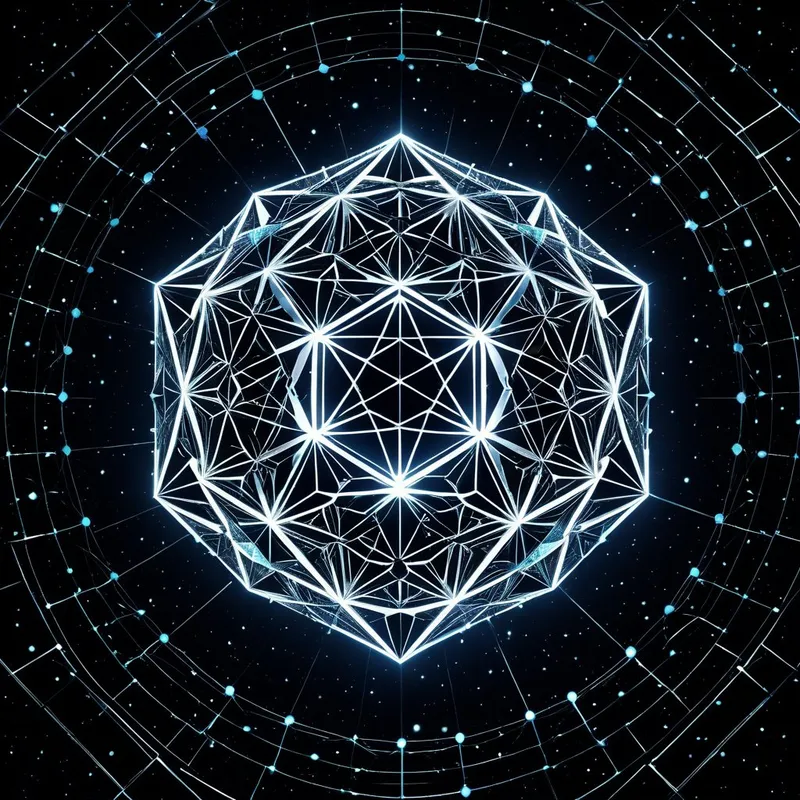
When the archetype of Ether stirs in the modern unconscious, it often manifests in dreams of profound synthesis and liminal space. The dreamer may find themselves in a vast, empty hall that suddenly becomes filled with harmonious, geometric light. They may witness quarreling figures (representing the four functions) who are suddenly calmed by the arrival of a silent, luminous presence. A common motif is the discovery of a hidden room, a secret chamber in the heart of one’s own dream house, filled not with objects, but with a palpable, peaceful energy or a single, perfect crystal.
Somatically, this process can feel like a release of tension held for a lifetime—a softening in the chest, a deepening of breath, a sense of spaciousness within the body. Psychologically, it marks a transition from identification with one dominant element (“I am only my thoughts” or “I am only my passions”) toward a more fluid, witnessing consciousness. The conflict doesn’t disappear, but it loses its absolute, tyrannical power. The dreamer is undergoing the initial stages of what Jung called the transcendent function: the ego’s agonized stalemate is beginning to be permeated by the reconciling breath of the larger Self.
Alchemical Translation
The alchemical journey is the myth of Ether made personal. The prima materia—the raw, conflicted stuff of one’s life—is the unmediated clash of the four elements within. The first stages of the work (nigredo, albedo) involve confronting and purifying these individual aspects: facing the shadow (Earth), washing in the waters of emotion (Water), clarifying the mind (Air), and burning away impurities with honest self-scrutiny (Fire). This can feel like dissolution.
The great secret, whispered by the myth, is that the philosopher’s stone is not a fifth thing to be added, but the awakening of the fifth principle that was always there.
The goal of psychic alchemy is not to become spirit by denying matter, but to discover the spirit in matter—the Ether that has been weaving the pattern of your life all along.
The final stages (citrinitas, rubedo) symbolize this integration. The disparate colors of experience coalesce into golden understanding and, ultimately, the red of embodied wisdom. The modern individual engaged in this “Great Work” of individuation is performing the Ether myth. They are learning to become the mediator of their own inner cosmos. They stop trying to silence their earthy needs, drown their watery feelings, argue away their airy thoughts, or extinguish their fiery passions. Instead, they cultivate the subtle, attentive presence—the Ether—that can listen to each, honor each, and find the unique harmony that is their authentic life. The triumph is not a state of static perfection, but the attainment of a resilient, creative tension—the continuous, breathing synthesis that is a soul fully alive.
Associated Symbols
Explore related symbols from the CaleaDream lexicon: