Eternal Flame Myth Meaning & Symbolism
A sacred fire, divinely kindled and perpetually tended, symbolizing the unbroken covenant between the divine and the human soul.
The Tale of the Eternal Flame
Listen, and hear of a fire that does not consume, a light that knows no dusk. In the vast, whispering silence of the desert, a people walked, dust on their feet and a promise in their hearts. Their god, a presence of cloud by day and pillar of fire by night, had spoken from the heart of a burning bush that was not consumed. And from that same unearthly fire, a command was given, etched not on stone, but in the very rhythm of their newfound worship.
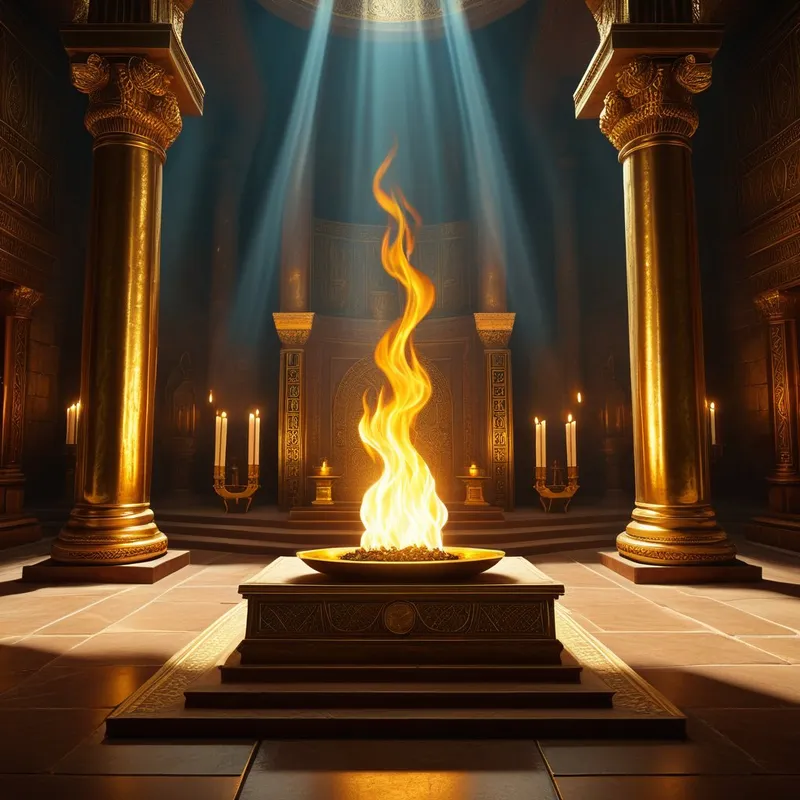
They built a sanctuary of acacia wood and finest linen, a traveling holy place called the Tabernacle. Within its innermost court, behind a veil woven with cherubim, stood the Ark of the Covenant. But before that final mystery, in the Holy Place, stood an altar of gold—the Altar of Incense. And upon it, a command was to be fulfilled: a fire was to be lit. Not with common spark struck from flint, but with coals taken from the great Burnt Offering altar outside, a fire Heaven itself had initially kindled.
The priests, sons of Aaron, approached with trembling reverence. They placed the sacred coals upon the golden altar. They sprinkled finely ground spices—frankincense, galbanum, onycha—upon the heat. A fragrant smoke, thick and sweet, began to rise, a visible prayer coiling toward the tent’s ceiling. This was the beginning. The fire was to burn perpetually. It must never go out.
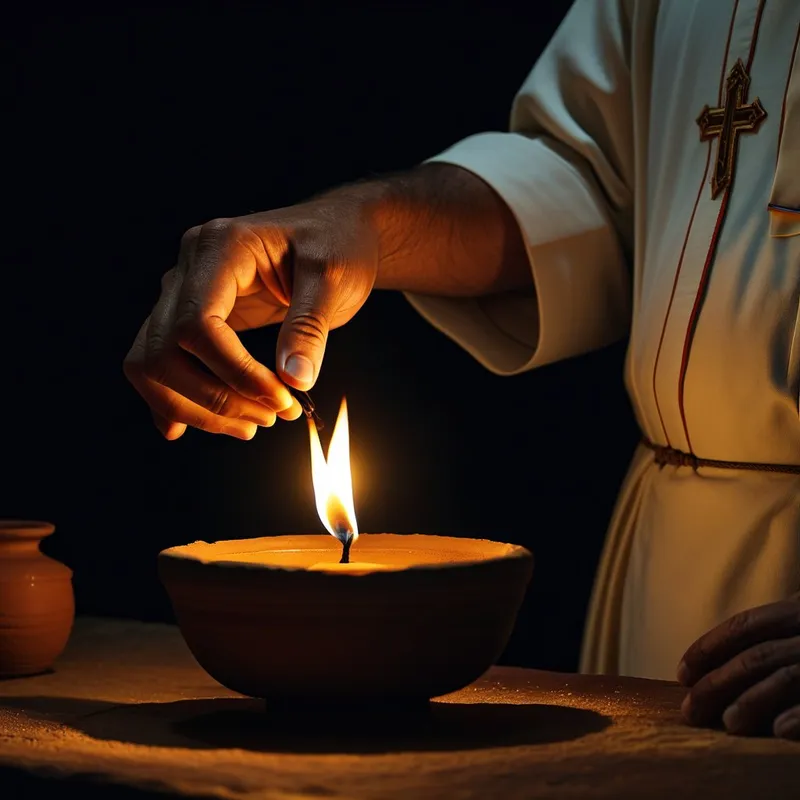
So began the vigil. By night and by day, in the cool of the evening and the heat of the noon, a priest would enter. His task was simple, yet of cosmic weight: to tend. To add the sacred fuel of pressed olive oil, pure and clear. To trim the wick so the flame burned clean and bright. To ensure that no breath of neglect, no moment of forgetfulness, would allow the light to falter. This flame was not a symbol; it was a living presence. It was the breath of the covenant made visible, the unbroken thread of connection between a mobile people and their unmoving God. It burned through generations, through battles and peace, through doubt and faith—a single, unwavering point of light in the flux of history, a heartbeat of the divine in the heart of the camp.
Cultural Origins & Context
The mythos of the Eternal Flame, or more precisely, the "perpetual fire" (Esh Tamid), finds its roots in the priestly traditions of ancient Israel, codified in the books of Leviticus and Exodus. This was not a folktale for the campfire, but a precise ritual law given to the Levites. Its primary tellers were the priests themselves, and its audience was the entire congregation of Israel, for whom the continuous smoke was a tangible sign of God’s abiding presence.
Its societal function was multifaceted. Practically, it established a rigorous, unceasing liturgical rhythm, centering the community’s life around a sacred constant. Theologically, it served as a powerful counter-narrative to the pagan cults of the ancient Near East, where fires were often relit with the sun or through seasonal rites. Here, the fire was given by God and maintained by humans—a partnership. It symbolized the Sinaitic Covenant itself: eternal on God’s part, requiring perpetual faithfulness on Israel’s part. The flame’s journey from the desert Tabernacle to the stone temples in Jerusalem marked the transition of a nomadic faith into a settled kingdom, yet the core mandate remained unchanged: the light must not fail.
Symbolic Architecture
At its heart, the Eternal Flame is an archetypal symbol of consciousness itself—a consciousness that is both given and must be tended.
The flame is the spark of the divine within the human vessel, the scintilla of soul that connects the temporal to the eternal.
The sacred fire from Heaven represents the initial, spontaneous ignition of awareness, what we might call grace, inspiration, or the awakening of the Self. It is not self-generated; it is received. The priestly vigil symbolizes the ego’s necessary, humble service to this greater consciousness. It is the daily work of attention, intention, and psychological maintenance—the "oil" of our efforts, the "trimming" of our distractions.
The golden altar situated before the veiled Holy of Holies is profoundly significant. It represents the threshold where the human and the divine meet. The flame burns in that liminal space, suggesting that true consciousness (conscientia, "knowing with") exists in the relationship between our finite awareness and the infinite mystery. The fire’s perpetuity symbolizes the enduring reality of the psyche’s core, the Self, which persists beneath the changing states of the ego.
The Dreamer's Resonance
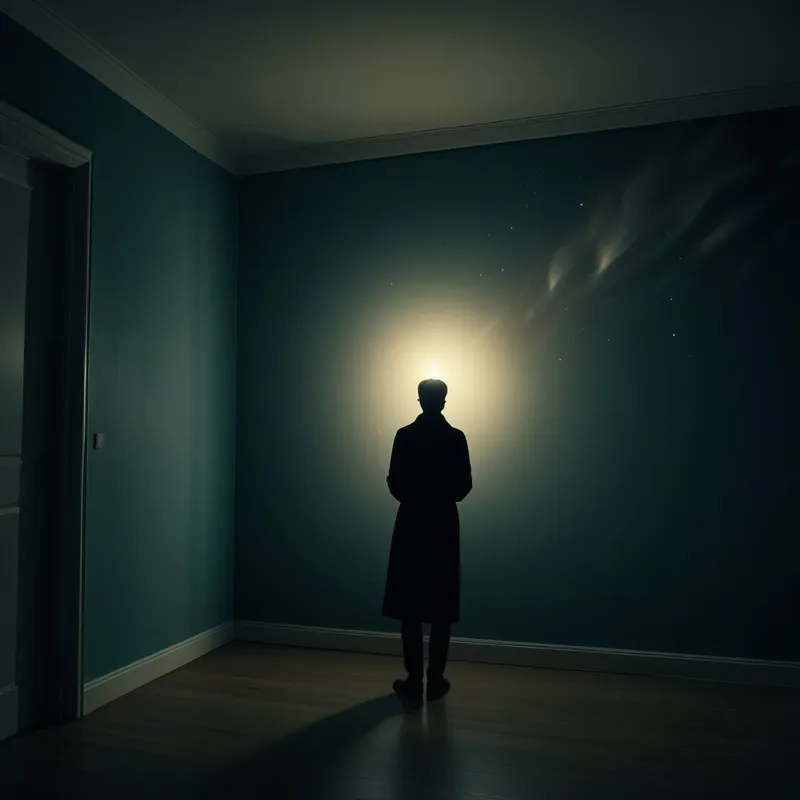
When this mythic pattern stirs in the modern dreamscape, it often signals a critical phase in the dreamer’s relationship with their own inner vitality and purpose. To dream of tending a small, fragile flame in a vast darkness speaks to a somatic feeling of profound responsibility mixed with vulnerability. The dreamer is in touch with something precious and essential within them—a creative spark, a newfound value, a fragile hope—and recognizes it must be protected and fed.
Dreams of a flame that is guttering, dying, or has gone out can induce deep anxiety, a psychological state of covenant-breaking. This often correlates with periods of burnout, depression, or a loss of meaning, where the connection to one’s inner "divine spark" feels severed. The unconscious is highlighting a deficit in the "oil" of self-care or the "vigil" of attention.
Conversely, dreaming of kindling or relighting a fire from an ancient, hidden source marks a moment of re-initiation. It is the psyche’s announcement of a rediscovery of one’s core passion or spiritual center, often after a long period of dormancy or exile. The dreamer is being called back to their priestly duty to their own soul.
Alchemical Translation
The myth of the Eternal Flame is a perfect allegory for the Jungian process of individuation. The alchemical work is not about creating the gold from base matter alone, but about receiving the prima materia and sustaining the transformative fire.
The initial divine ignition corresponds to the first profound confrontation with the unconscious—a powerful dream, a crushing crisis, an undeniable calling. This is the nigredo, the blackening, where the old ego-structure is burned away by a heat not of its own making. The ego, like the priest, is humbled. Its task is no longer to rule, but to serve this new, terrifying, and sacred reality.
The alchemical vessel is the disciplined life; the continuous heat is the practice of honest self-reflection and symbolic engagement.
The perpetual tending is the long, patient work of albedo and rubedo—the whitening and reddening. It is the daily opus: active imagination, journaling, engaging with emotions, making art, practicing integrity. Adding the "oil" is the commitment to nourishing practices. "Trimming the wick" is the conscious editing of life—releasing toxic patterns, relationships, or thoughts that smoke and obscure the clear light.
The ultimate goal is not to become the flame, but to become the golden altar—the stable, purified vessel upon which the transcendent flame of the Self can burn perpetually. In this state, the individual lives in unbroken dialogue between the human and the divine within. The flame no longer feels like an external command to be obeyed, but as the innate, radiant core of one’s own being, eternally kindled, eternally tended. The vigil becomes not a duty, but the very rhythm of a soul awake.
Associated Symbols
Explore related symbols from the CaleaDream lexicon: