Eternal Blue Sky Myth Meaning & Symbolism
A myth of the boundless, sacred sky, the source of all life and law, reflecting the soul's journey toward unity with the infinite.
The Tale of Eternal Blue Sky
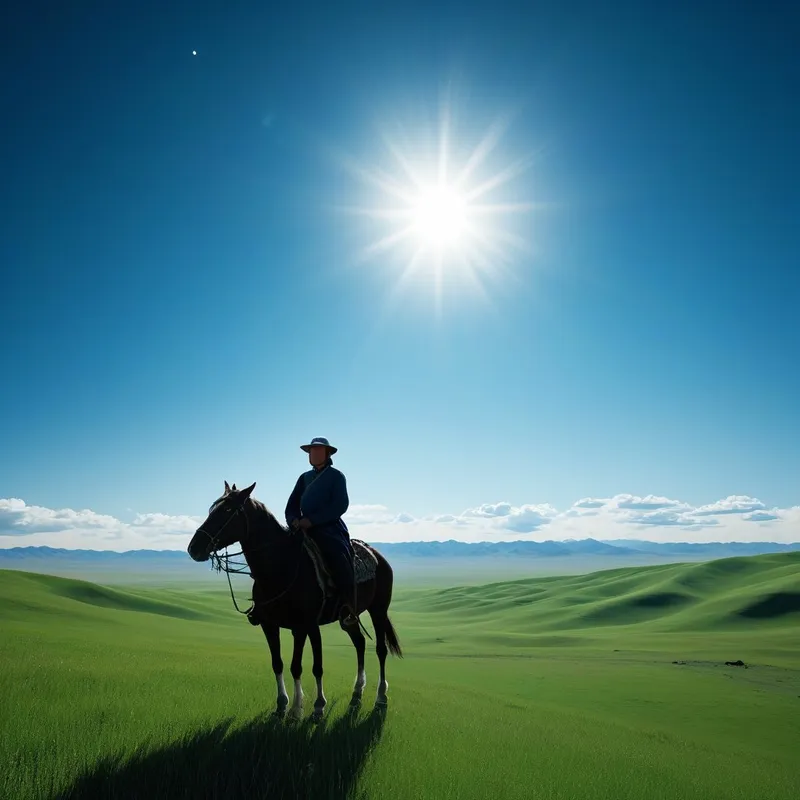
Listen. Before the first horse was tamed, before the first ger was raised, there was only the Breath and the Gaze. The Breath was the wind, sighing across the formless earth. The Gaze was the Tengri, a presence so vast it had no edge, a consciousness of pure, silent blue.
Below, the earth was dark and restless, a realm of churning potential without law. Mountains heaved without reason. Rivers ran backwards. Beasts of shadow, born from the earth’s own confusion, roamed without purpose, their forms shifting like smoke. There was no up or down, no summer or winter, only chaos yearning for a shape.
Then, Tengri turned its Gaze downward. Not with eyes, but with pure attention. Where that attention fell, the chaos stilled. The first law was declared not in sound, but in color: Blue. The endless, depthless blue of the sky became the first boundary, the first container. It did not crush the earth, but held it. From this holding, the second law emerged: Rhythm. The sun, Naran, was placed on its eternal journey from east to west, dragging the curtain of day and night. The moon, Saran, followed with her softer, measuring light, governing the tides of life and growth.
But the earth spirits, the luus and ezen, were wild and territorial. They did not understand the vast, impersonal order of the Blue. They clashed with each other, causing storms where there should be breeze, droughts where there should be flow. The people, the first humans who had emerged from the meeting of sky’s breath and earth’s clay, were caught in the middle, fearful and scattered.
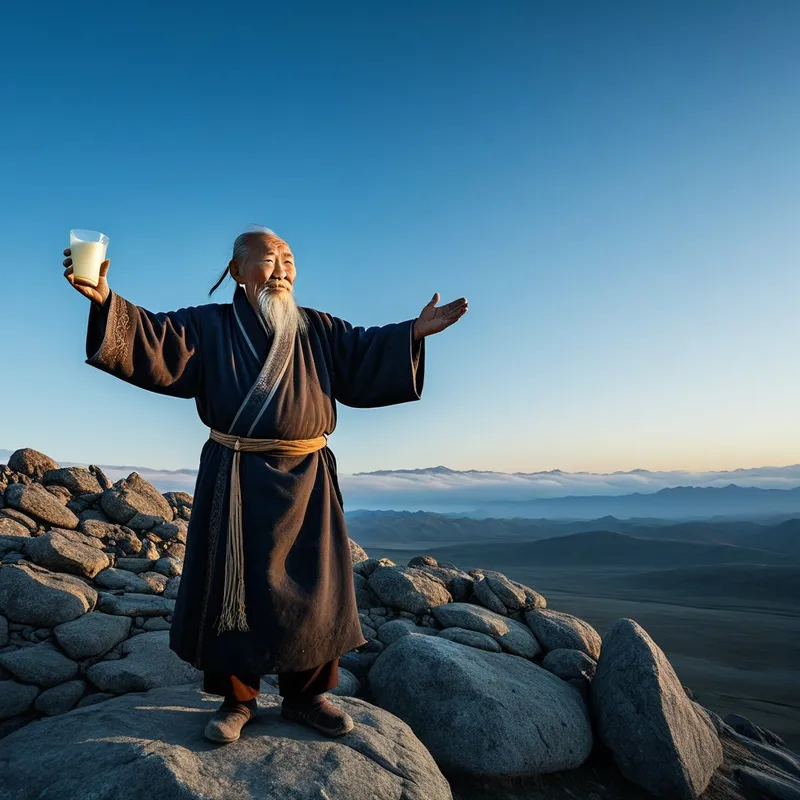
Tengri did not descend. It did not wage war. Instead, it bestowed a third law: Connection. It sent the purest essence of its blue order—not as a sword, but as a thread of sacred wind. This wind entered the world through the highest peaks, the ovoos, and through the hearts of the first shamans, the böö. The shamans learned to read the will of the Blue in the flight of eagles, the patterns of stars, and the whisper of the grass. They became the living bridges. They taught the people to honor the local spirits, to offer libations of milk, to tie ribbons to the ovoos, not to conquer nature, but to align with it under the greater canopy of the Sky.
The resolution was not a battle won, but a harmony achieved. The Eternal Blue Sky did not rule by command, but by pervasive presence. It became the ultimate witness, the immutable law against which all actions were measured. The conflict between chaos and order transformed into a dynamic, living relationship. The people learned to lift their eyes. To build their gers with the smoke hole open to the heavens. To live with the dignity of those who walk beneath an infinite, ordering father. The world found its balance not under a heel, but under a gaze—boundless, blue, and eternally serene.
Cultural Origins & Context
The myth of the Eternal Blue Sky, or Tengri, is the bedrock of the ancient Mongolian and broader Turco-Mongolic worldview. It is not a single story told around a fire on a specific night, but the very atmosphere of a spiritual civilization born on the steppe. Its origins are as old as the human experience of that landscape: an endless horizon where the dome of the sky is the most dominant, immutable feature of existence. This myth was passed down not merely through bardic tales, but through ritual, daily practice, and the very structure of society.
It was the shamans, the böö, who were the primary custodians and interpreters of this relationship. Through ecstatic journeys, they communed with Tengri’s will. The myth’s societal function was profound: it provided a cosmic justification for order. The Great Khan’s authority was derived from Tengri’s jayag, the mandate of heaven. Natural law, social law, and spiritual law were seen as reflections of the same celestial order. The myth created a resilient, adaptable spirituality where the supreme, distant Sky God delegated the management of worldly affairs to a pantheon of subordinate spirits and ancestors, all existing within the Blue’s overarching framework.
Symbolic Architecture
At its core, the Eternal Blue Sky symbolizes the archetype of the Cosmic Container—the ultimate principle of order, consciousness, and transcendent law.
The Blue Sky is not a thing to be possessed, but a space in which to become. It is the psyche’s own highest potential for impersonal awareness.
Psychologically, Tengri represents the Self in its most unified, transpersonal form. It is not a personal god who listens to petitions, but the very structure of objective reality and inner truth. The chaotic earth represents the undifferentiated, instinctual unconscious—the realm of complexes, drives, and raw potential. The sun and moon are the rhythms of conscious life: the active, discriminating principle (the ego in its proper role) and the receptive, cyclical principle (the unconscious in its nourishing aspect).
The local spirits, the ezen, symbolize the powerful, often autonomous complexes that inhabit our personal psychic landscape—our “inner demons” and tutelary spirits tied to memory, trauma, and talent. The myth’s resolution teaches that enlightenment or wholeness is not achieved by annihilating these powerful forces (the earth spirits), nor by being ruled by them (chaos). It is achieved by bringing them into alignment under a higher, more spacious order. The shaman—the mediating function—is the ego’s capacity for introspection and ritual, which can negotiate between the personal unconscious and the transpersonal Self.
The Dreamer's Resonance
When this myth stirs in the modern dreamer, it often manifests as a profound somatic and psychological experience of seeking orientation within chaos. One might dream of being lost in a labyrinthine city (personal chaos) but then looking up to see a shockingly clear, vast blue sky, bringing instant calm and a sense of direction. Or, one may dream of a cluttered, oppressive room where the walls or ceiling crack open to reveal infinite blue, suggesting a breakthrough where a limiting belief system dissolves, allowing contact with a broader perspective.
The somatic process is one of expansion versus constriction. The body in the dream may feel heavy, stuck, or chaotic (the earthly realm), followed by a sensation of lightness, breath, and elevation (connection to the Sky). This mirrors the psychological process of moving from a state of identification with turbulent thoughts and emotions (possession by the “earth spirits”) to a state of witnessing them from a place of detached, compassionate awareness (the gaze of Tengri). Such dreams signal a critical juncture where the psyche is attempting to establish inner order—not through suppression, but through the establishment of a larger, containing consciousness.

Alchemical Translation
The alchemical journey modeled by the Eternal Blue Sky is the opus of individuation—the process of becoming an integrated, whole individual. It is the transmutation of psychic lead (chaotic, personal identification) into gold (ordered, transpersonal awareness).
The first and final work is to create an inner sky vast enough to hold all of one’s weather—the storms of passion, the frosts of fear, the gentle rains of grief—without being defined by any of it.
The chaotic earth is the prima materia, the confused mass of our inherited and personal contents. The gaze of Tengri is the initial act of conscious attention—the theoria—that begins to organize this material. This is the difficult work of self-observation without judgment. The appointment of the sun and moon represents the establishment of a conscious life-rhythm, a discipline that channels energy (sun) and honors cycles of rest and intuition (moon).
The negotiation with the earth spirits is the heart of shadow-work. It is the process of encountering our powerful complexes—our inner “territorial spirits” of anger, pride, vulnerability—not to destroy them, but to recognize their power and offer them a place within a newly ordered system. We “tie ribbons” to them through acknowledgment, dialogue, and integration. The shamanic bridge is the developing function of the transcendent function, which can hold the tension between opposites (sky/earth, order/chaos) until a new, third position emerges.
The ultimate triumph is not a victory, but a state of being: living under one’s own Eternal Blue Sky. It is the achievement of a Self-governed psyche, where the ego is no longer a tyrant or a slave, but a faithful steward, administering the personal realm under the benevolent, impersonal law of a consciousness that has become as deep and boundless as the sky itself. One becomes, in essence, a living ovoo—a point where the earthly and the celestial meet in harmonious, sacred exchange.
Associated Symbols
Explore related symbols from the CaleaDream lexicon: