Eshu-Elegba Myth Meaning & Symbolism
The story of the divine messenger who sows discord to reveal truth, teaching that every choice is a sacred crossroads demanding attention.
The Tale of Eshu-Elegba
Listen. The story begins not in a palace or a paradise, but in the dust. In the place where paths meet and diverge, where the journey of one becomes the destiny of another. This is the domain of Eshu-Elegba.
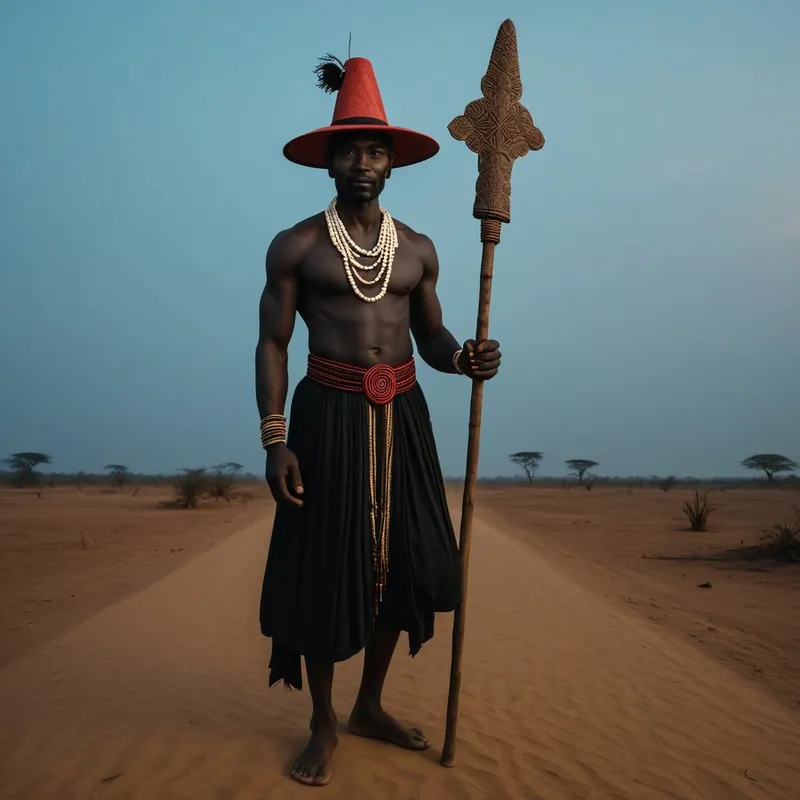
On a day when the sun hung heavy as a ripe fruit, two men, bound by blood and toil, worked their adjoining fields. Their friendship was as deep as the roots of the iroko tree. Eshu, the eternal wanderer, watched from the crossroads. He wore a hat, black as a moonless night on one side, red as sacrificial blood on the other. In his hand was his staff, the very axis of the world.
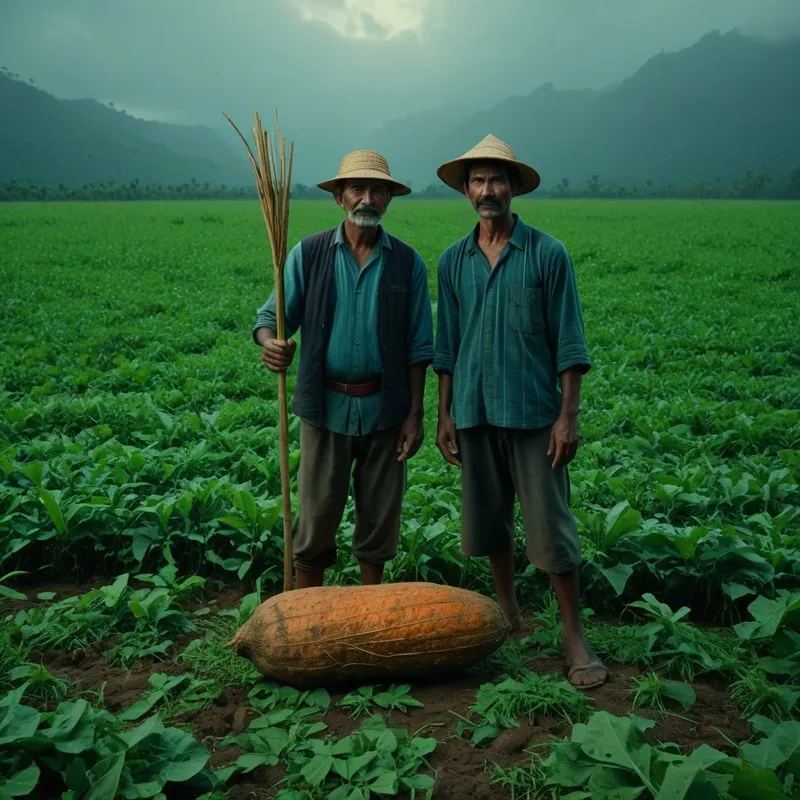
He moved with a purpose that seemed like chance. He walked the boundary between the two fields, a line of sacred separation. As he passed, he paused, and with a motion both casual and deliberate, he placed his staff upon the earth. From that point, a single, magnificent yam grew—not from seed, but from the potency of the crossroads itself. It grew fat and long, straddling the invisible line.
The sun began its descent. The first farmer, wiping sweat from his brow, saw the yam. “Ah!” he cried to his friend. “Look at this bounty the earth has given me!” The second farmer straightened, his eyes narrowing. “Given you? Can you not see? Its heart lies in my soil. It is my blessing.”
The air, once filled with the rhythm of shared labor, grew thick and hot. Words, once gentle, became stones. “Thief!” “Liar!” The magnificent yam, a gift of potential, became a symbol of division. They argued until their voices were raw, until the bond between them was as split as the yam they now threatened to cut.
And Eshu? He had vanished from the crossroads. He appeared instead at the village shrine, before the Babalawo. The elders were alarmed by his sudden, potent presence. “Great Eshu,” they asked, “what disturbance rides the wind? What have you done?”
Eshu smiled, a flash of teeth in the gathering dark. “I have done nothing but walk my path. I have done nothing but deliver a message they chose not to see. I placed a question at the crossroads of their friendship. They saw only an answer for themselves. Go. See the truth growing in their field.”
The elders rushed to the fields. There they found the two men, exhausted by rage, standing over the disputed yam. And there, plain as day, they saw it: the yam was pierced through its center by Eshu’s staff, the marker that belonged to no man and to both. The truth was not in the possession of the yam, but in the recognition of the boundary, the message, the divine hand that had placed it there.
The farmers fell to their knees, shame washing over them like a cool rain. They had not fought over a yam. They had fought over their own blindness. They made their offerings at the crossroads, their prayers a mixture of apology and awe. For they had learned the first law of Eshu: the message is everything, and to ignore the messenger is to invite chaos, which is his language.
Cultural Origins & Context
This narrative pulse originates in the spiritual heart of the Yoruba people of West Africa. Through the unspeakable violence of the Transatlantic Slave Trade, the Orisha did not die; they traveled. In the holds of ships and in the memories of the enslaved, Eshu-Elegba crossed the ocean. He re-emerged, resilient and transformed, in the African Diaspora: as Papa Legba at the gate, as Exu at the crossroads, and in the folklore of the Caribbean and the Americas.
The myth was not preserved in brittle scrolls but in the living breath—in the proverbs of elders, the rhythms of the drum, the sacred narratives (Odu) recited during divination. Its societal function was profound and practical. It was a teaching story, a psychological and social tool. It explained the inexplicable ruptures in community, the sudden misunderstandings between kin. It taught that not all chaos is meaningless; some is a sacred, if difficult, communication. It established Eshu as the first and last word in any ritual, the essential conduit without which no prayer, no offering, reaches the other Orisha. He was the divine linguist, the master of ashe (life force), who translates human intent into spiritual action.
Symbolic Architecture
Eshu-Elegba is the embodied symbol of the liminal—the threshold state where transformation becomes possible. He is not merely a trickster; he is the personification of the necessary disruption that precedes insight.
The crossroads is not just a place you pass through; it is the moment you become aware you have a choice. Eshu is the anxiety of that moment made divine.
His dual-colored hat symbolizes perspective itself. Truth depends on where you stand. The farmers each saw only the color facing them, believing their partial view was the whole reality. The staff is the axis mundi, the central pillar that simultaneously connects and divides heaven, earth, and the underworld. It is the unwavering truth that, when ignored, becomes the source of conflict.
Psychologically, Eshu represents the autonomous, unsettling voice of the unconscious. He is the sudden intuition that upends your plans, the forgotten detail that ruins a carefully constructed argument, the slip of the tongue that reveals a hidden truth. He is the shadow that, when acknowledged, becomes a guide; when denied, becomes a saboteur.

The Dreamer's Resonance
When this myth stirs in the modern dreamer, it often manifests as dreams of frustrating obstruction, missed communications, or chaotic, labyrinthine spaces. You dream of lost keys, missed busses, phones that won't dial the right number, or arriving at a critical meeting to find you've brought the wrong documents.
Somatically, this may be felt as a knot in the stomach, a tension at the base of the skull—the body’s intelligence signaling a crossroads it perceives but the conscious mind has overlooked. Psychologically, you are in the field with the farmers. The dream-Eshu has placed his "yam" on a boundary in your life: perhaps between a personal desire and a professional duty, between an old identity and an emerging one. The conflict in the dream is not about the object (the job, the relationship, the decision), but about your partial perception of it. The chaos is a demand from the psyche to stop, to circumambulate the problem, to see it from the other side—from under the hat of the other color.

Alchemical Translation
The individuation process, the journey toward psychic wholeness, is not a straight path. It is a series of crossroads, each requiring a death of a certain one-sidedness. Eshu-Elegba is the archetypal agent of this alchemical solve—the dissolution of rigid ego positions.
The psychic transmutation begins not with finding the right answer, but with faithfully acknowledging the reality of the question. Eshu does not bring the answer; he is the question incarnate.
For the modern individual, the myth models a profound inner practice. First, recognize the messenger in the disruption. That frustrating delay, that unexpected criticism, that sudden change of plan—instead of reflexively opposing it, ask: "What message is this carrying? What boundary or blind spot is it highlighting?"
Second, make the offering at the internal crossroads. This is the act of conscious attention. It is to pause in the heat of your reaction and genuinely consider the opposite perspective, the shadow side of your argument, the need you have been ignoring. This attention is the libido, the psychic offering, that transforms chaotic conflict into revelatory insight.
Finally, honor the staff, not just the yam. The triumph is not in "winning" the dilemma or claiming the resource. It is in perceiving the underlying, unifying principle—the core truth or value—that your internal "farmers" are fighting over. By acknowledging this axis, the opposing parts of the self are reconciled not through compromise, but through a shared reverence for a greater, integrating truth. The path forward is not one side's path, but a new, third path that appears only when the crossroads is truly seen. In this, chaos is transmuted into consciousness, and the trickster becomes the most faithful of guides.
Associated Symbols
Explore related symbols from the CaleaDream lexicon: