Eshu Myth Meaning & Symbolism
The story of the divine messenger who sows discord to reveal truth, teaching that conflict is the crucible of consciousness and the price of connection.
The Tale of Eshu
The sun was a hammer on the iron earth. In a village where the rhythm of life was as predictable as the pounding of yam in a mortar, two men lived in perfect harmony. They were friends closer than brothers, their compounds side by side, their fields touching at the boundary. They shared palm wine, shared labor, shared laughter that echoed across the same red dust.
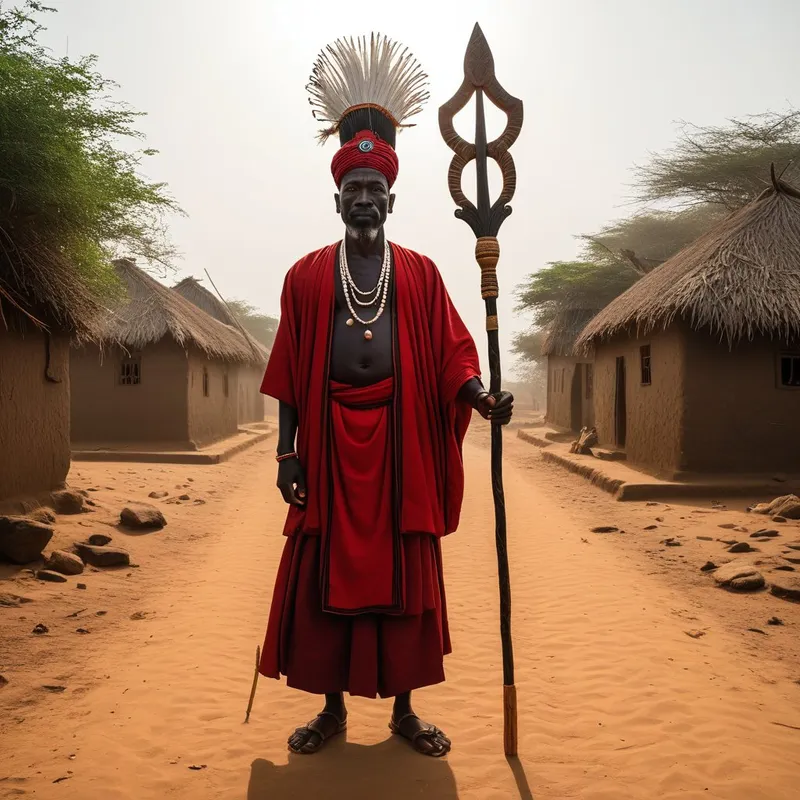
One day, as the heat made the air shimmer like a spirit, a figure appeared on the road. It was Eshu, the lord of the crossroads, the master of paths. On his head sat a hat, brilliant red on one side, deepest black on the other. In his hand, a staff carved with secrets. He walked with a dancer’s grace, a smile playing on his lips that held the promise of a storm.
He did not enter the village. Instead, he walked directly between the compounds of the two friends, right down the invisible line that divided their world. As he passed the first friend’s field, he turned his head so the man saw only the blazing red side of his hat. He tipped it, a flash of crimson against the blue sky. The farmer paused, hoe in hand, and thought, “What a respectful stranger, to greet me with such a vibrant color.”
Eshu continued his few steps and, without breaking stride, turned his head the other way. Now, the second friend, looking up from his own plot, saw only the profound black side of the hat. A tip, a shadow against the light. This farmer frowned, thinking, “What an ill-omened fellow, to show me the color of mourning as a greeting.”
The figure of Eshu vanished down the road, leaving only a faint trace of unsettled dust.
That evening, as was their custom, the friends met to share the day’s gourd of palm wine. The first man, still warmed by the memory of the red greeting, said, “Did you see that splendid stranger today? His red hat was like a flame of good fortune.”
The second man slammed his cup down. “Red? You are either a liar or a fool! The man’s hat was black as a moonless night. Are you mocking me?”
“Mocking? I speak truth! It was red!” “It was black!”
The warmth of years evaporated in an instant. Accusations, long-buried petty grievances, all rose like a swarm of stinging insects. The argument spilled from the compound into the village square, voices rising, families taking sides. The harmony was shattered, replaced by a bitter schism. The two friends, once a single unit, became the focal point of a village divided.
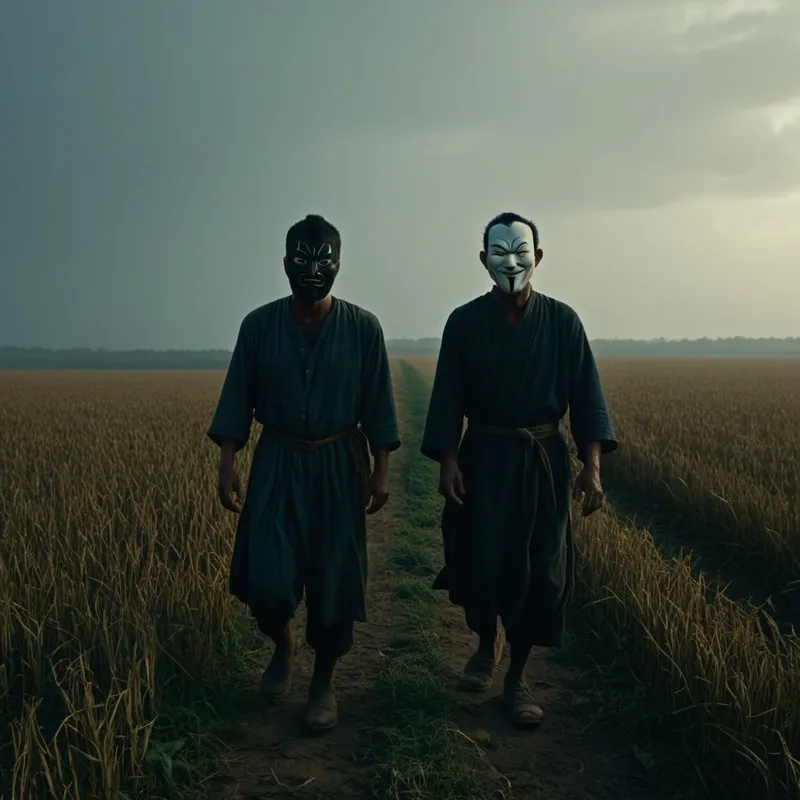
They decided to seek judgment from the wise Oduduwa in the great city of Ile-Ife. The entire journey was made in hostile silence. When they finally stood before the throne, they poured out their conflicting tales of the hat, each certain of his own perception, each convinced of the other’s bad faith.
Oduduwa listened, his ancient eyes seeing deeper than the quarrel. He sent swift messengers to find the traveler. They returned with Eshu, who stood before the assembly, his hat upon his head, his smile enigmatic.
“Show us,” commanded Oduduwa.
Eshu, without a word, slowly removed his hat. He turned it in his hands. The crowd gasped. One side was indeed a vibrant, undeniable red. The other was a deep, absolute black. He had shown each man only one truth, a partial truth, and from that fraction, a whole world of conflict had been born.
Eshu spoke, his voice like stones grinding in a riverbed. “I did not create the quarrel. I revealed it. Is it not my duty to test the foundations of friendship? To ensure that what is built is strong enough to withstand a shift in perspective?” He looked at the two friends, now humbled and ashamed. “You saw a hat. You did not see the man who wore it. You saw your side, and called it the whole world.”
The friends fell to their knees, not before the king, but before the understanding that had eluded them. The conflict had not been about a color. It had been about the inflexibility of their own sight. Eshu had not brought evil. He had brought the necessary, painful gift of awareness.
Cultural Origins & Context
The myth of Eshu originates from the Yoruba people of what is now southwestern Nigeria, Benin, and Togo. This is not a mere folktale but a sacred narrative (itan) central to the Ifa divination system. Eshu (also known as Elegba or Legba among the diaspora) is not a minor sprite but a primordial orisha, one of the first created by the supreme Olodumare.
These stories were not written but carried in the breath and memory of Babalawos and master storytellers (arokin). They were performed, chanted, and recalled during rituals, festivals, and judicial proceedings. The societal function was profound: Eshu’s myths served as a psychological and social regulatory mechanism. They explained the source of sudden misunderstandings and societal friction, providing a divine framework for conflict resolution. By attributing chaos to Eshu’s testing, the culture created a way to step back from blame and seek the larger perspective—the other side of the hat. He was the divine prosecutor, the enforcer of cosmic law, and the reminder that no human perspective is total.
Symbolic Architecture
Eshu is the embodied archetype of the crossroads. He is not chaos for its own sake, but the necessary agent of dynamism that prevents systems—whether psychic, relational, or social—from stagnating into dogma. His two-colored hat is the perfect symbol of relativistic truth and subjective perception.
The trickster does not lie; he reveals the lie of absolute perspective.
He represents the principle of necessary disruption. Without the friction he introduces, growth is impossible, weaknesses remain hidden, and agreements are untested. Psychologically, Eshu symbolizes the autonomous complex of the psyche that interrupts our conscious ego-narratives. He is the sudden, inconvenient thought, the burst of anger that reveals a buried resentment, the accident that forces a change of path. He is the messenger because he carries the news we did not wish to hear, the feedback from the unconscious or from the "other" that our ego-centric view has excluded.
His domain is the threshold, the marketplace, the door, the road—all places of exchange, transition, and potential. To encounter Eshu is to be forced to choose, to acknowledge multiplicity, and to accept that every path taken implies a path forsaken.

The Dreamer's Resonance
When the pattern of Eshu manifests in modern dreams, it rarely appears as a mythological figure. Instead, it surfaces as the experience of paradoxical conflict. One might dream of being late because of absurd, contradictory signs; of a trusted friend giving a devastating insult with a smile; of a door that is both entrance and exit simultaneously.
The somatic process is one of acute frustration and disorientation—a feeling of being "gaslit" by reality itself. Psychologically, this indicates a point of psychic gridlock. The dreamer’s conscious attitude has become rigid, perhaps clinging to a single "side of the hat"—a fixed self-image, a stubborn opinion, a relationship dynamic that feels secure but is based on unexamined assumptions. Eshu-dreams are the psyche’s immune response to this rigidity. The discomfort, the argument in the dream, is the psychic tension required to break the deadlock and make new consciousness possible. It is the feeling of the crossroads before the choice is made.

Alchemical Translation
The alchemical journey modeled by Eshu is the transmutation of certainty into wisdom. The prima materia is the naive, unified state—the friendship, the plan, the identity. Eshu, as the spiritus mercurius, the volatile trickster spirit of alchemy, introduces the nigredo: the blackening, the conflict, the confusion. This is not a mistake but the first, essential stage of the work.
The ego’s peace is often the soul’s stagnation. The crisis is the call to a higher synthesis.
The two friends, secure in their partial truths, represent a conscious attitude that has conflated its perspective with reality. The quarrel is the painful but necessary dissolution of that false unity. The journey to Oduduwa (symbolizing the transcendent function, the Self) is the movement toward a reconciling viewpoint. The final revelation—seeing the whole hat—is the albedo, the whitening, the dawn of understanding. The conflict is not erased but integrated. The individuals are not returned to their old, unconscious friendship but have the opportunity to forge a new, conscious bond, one that includes an awareness of their own capacity for error and the existence of other realities.
For the modern individual, the myth instructs us to welcome the "Eshu moments." When communication breaks down, when plans shatter, when we feel betrayed by circumstance, the question is not "Who is to blame?" but "What side of the hat am I seeing? What reality have I excluded?" The goal is not to avoid the crossroads, but to learn to stand consciously within them, to acknowledge the trickster within and without as the divine agent of our own becoming. In honoring Eshu, we honor the unpredictable, disruptive, and utterly essential force that compels us to grow beyond our own limited sight.
Associated Symbols
Explore related symbols from the CaleaDream lexicon: