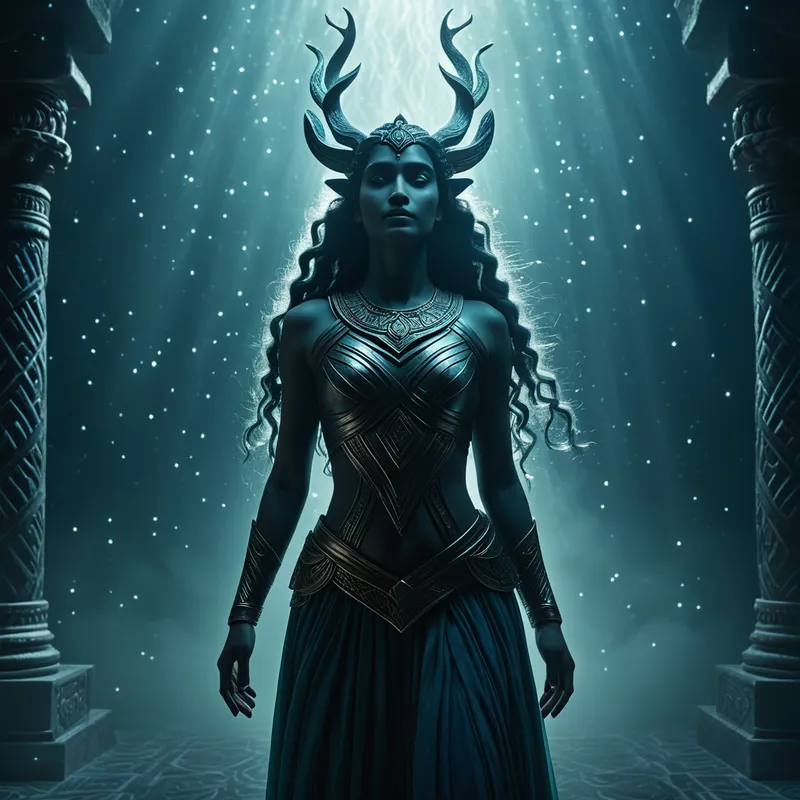
Esagila Temple of Marduk
The central temple of Babylon dedicated to Marduk, chief god of the Mesopotamian pantheon, representing divine authority and cosmic order.
The Tale of Esagila Temple of Marduk
In the beginning, before the first brick was laid, there was a word: Esagila. “The House Whose Top is Raised High.” It was not merely a name but a promise, a divine blueprint etched into the fabric of the cosmos by the will of Marduk. The tale of its raising is the tale of the world’s ordering.
After his titanic victory over the primordial sea-dragon Tiamat, Marduk, the champion of the younger gods, did not rest. Having cleaved chaos and fashioned the heavens and earth from her divided body, he turned his gaze to the very center of his new, ordered universe. He decreed that at the axis of the world, in the sacred city of Babylon, a dwelling must be built—a fixed point where divine authority would touch the earth, and earthly devotion could ascend to the divine. This was to be his seat, the throne of cosmic kingship.
The gods themselves, grateful for their deliverance from chaos, became its first laborers. For one year, they molded bricks from the very clay of the ordered earth. They laid the foundations not upon sand, but upon the firmament of the underworld, the Apsu, the sweet-water abyss that was the domain of the god Ea, Marduk’s wise father. Thus, the temple was rooted in the deep, ancestral wisdom of the waters, while its summit aspired to touch the stars. When the great structure was complete, a hush fell over heaven and earth. Marduk entered his house, and his presence filled it like a silent, potent storm. The statue of the god, crafted with terrifying care, was installed in the innermost sanctuary. Its eyes were opened in a elaborate ceremony, the pīt pî (“mouth-washing”), transforming inert matter into a vessel for the god’s very essence. From that moment, Esagila was not just a building; it was the beating Heart of creation, the nexus where the divine decree became manifest law, and the fate of the land was woven with the threads of ritual and offering.
Yet, the temple’s story is not one of static glory. It is a story of contestation and renewal, mirroring the eternal struggle between Order and Chaos. Kings who sought legitimacy would take the hand of the statue of Marduk in the Akitu festival, their power derivative, borrowed from the god. When empires fell—when the Elamites raided Babylon and carried off Marduk’s statue—the temple became a Wound in the world’s side, a symbol of a cosmos unmoored. Its subsequent restoration by a pious king was not mere reconstruction; it was a Rebirth, a re-enactment of the original victory over chaos, stitching the fabric of reality back together. Esagila stood, therefore, as both the prize and the proof of cosmic sovereignty, its fate inextricably linked to the rise and fall of civilizations, a Stone of Power tested by time.
Cultural Origins & Context
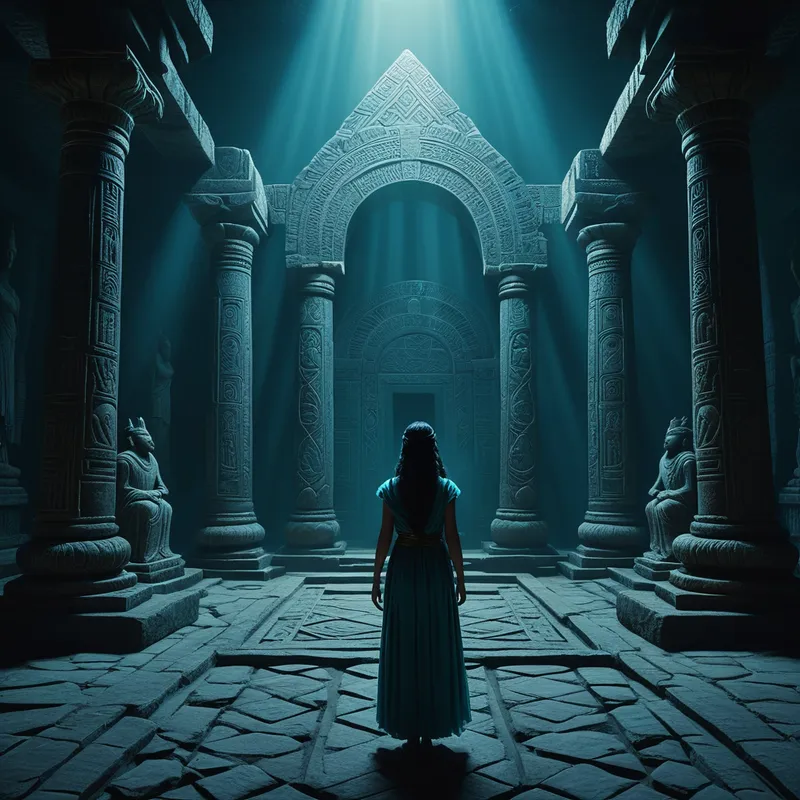
The Esagila was the theological and political engine of the Babylonian empire. Its origins are inseparable from the rise of Babylon itself from a modest city to the imperial capital under Hammurabi (c. 1792–1750 BCE) and, most significantly, under the Neo-Babylonian dynasty of Nebuchadnezzar II (c. 605–562 BCE). Its mythology, however, was projected back to the dawn of time through the Enuma Elish, the Babylonian creation epic. This text served as the temple’s divine charter, legitimizing Babylon as the “navel of the world” and Marduk’s temple as its axis.
Culturally, Esagila was the ultimate expression of the Mesopotamian worldview: a universe governed by divine will, where human society’s primary role was to serve the gods through elaborate ritual to maintain cosmic harmony. The temple complex was a city within a city, housing not only the sanctuary of Marduk but also chapels for his divine family—his consort Sarpanitu, his son Nabu—and vast administrative offices, storerooms, and workshops. It was the economic, theological, and intellectual center of the empire. The priesthood of Esagila were the keepers of celestial omens, medical lore, and literary tradition; they were the intermediaries who decoded the will of the gods, making the temple a living Bridge between the human and the divine. Its existence justified the king’s rule and the empire’s hegemony, framing Babylonian conquest and law as the earthly enforcement of Marduk’s cosmic Order.
Symbolic Architecture
The physical form of Esagila was a profound symbolic language. While its precise dimensions are lost, descriptions paint a picture of a structure designed to map the cosmos. It did not soar skyward like the adjacent Etemenanki ziggurat; instead, it sprawled horizontally, a vast, low complex representing the stable, founded earth. Its very layout was a microcosm.
The temple’s innermost sanctuary, the cella, was more than a room; it was the Cave of the god, the dark, womb-like center of the world where the divine presence was most concentrated and potent. Here, the statue of Marduk sat in perpetual, unseen majesty.
The processional way leading to its gates, used during the Akitu festival, was a ritualized Journey from the periphery of ordinary life to the numinous center. The temple’s foundations, said to be anchored in the Apsu, connected it to the primordial, subterranean waters—the source of all life and wisdom. Its gates were Thresholds of transformation, guarded by colossal bulls and dragons (mušḫuššu), hybrid creatures who were themselves symbols of Marduk’s conquered chaos. Every brick, every chamber, was a syllable in a continuous prayer for stability, a bulwark against the ever-lurking Chaos that the Babylonians knew could flood back in at any moment.
The Dreamer's Resonance
To encounter the Esagila in the inner landscape of the psyche is to confront the archetype of the inner Ruler in its most potent form. It represents the central organizing principle of the Self—the core authority that structures the chaos of instinct, emotion, and thought into a coherent, functioning identity. When this inner “temple” is strong and attended to (through ritual, discipline, or introspection), there is a sense of Order, purpose, and legitimacy. One feels centered, capable, and in right relation to one’s inner and outer worlds.
Conversely, when this psychic structure is damaged—through trauma, neglect, or the “sacking” of one’s values by life’s hardships—it manifests as a profound disorientation. The inner statue is toppled. This is the experience of a Wound at the core of one’s being, a loss of faith in one’s own authority, leading to Chaos, anxiety, and a fragmented sense of self. The dream of a ruined temple, a desecrated sanctuary, speaks directly to this condition. The restorative work, then, becomes a psychological Akitu festival: a humbling journey to reclaim the scattered parts of the self, to “take the hand” of one’s own inner authority again, and to laboriously rebuild the sacred center. It is the Hero’s task not of slaying dragons abroad, but of returning order to the kingdom within.

Alchemical Translation
The alchemical process mirrored in Esagila’s myth is the coagulatio—the fixing of the volatile into the solid, the spiritual into the material. Marduk’s victory represents the initial separatio (defeating and dividing chaotic Tiamat). The building of Esagila is the subsequent coagulatio: giving that victorious, ordering spirit a permanent, earthly home. The temple is the Philosopher’s Stone of civilization—the tangible, perfected product of a cosmic process.
In the alchemy of the soul, Esagila symbolizes the creation of a durable inner vessel, a temenos or sacred space, capable of containing and withstanding the fiery, transformative presence of the spirit. It is the establishment of a conscious, enduring structure (ethics, practice, discipline) to house the fleeting Vision of the divine.
The cyclical desecration and restoration of the temple reflects the alchemical axiom of solve et coagula (dissolve and coagulate). The self must sometimes be broken down (“dissolved”) by experience—its certainties looted, its idols carried off—so that a more authentic, resilient structure can be rebuilt (“coagulated”). Each restoration is not a return to the old, but a Rebirth at a higher level of integration, the gold refined again in the furnace of fate. The god’s statue is the lapis, the ultimate treasure, which must be continually rediscovered and reinstated at the center of one’s being.
Associated Symbols
Explore related symbols from the CaleaDream lexicon:
- Temple — The archetypal container for the sacred, representing a consecrated space where the divine and human realms meet and communicate.
- Heart — The vital center of a system, be it a body, a city, or the cosmos; the seat of essential life, authority, and emotional-spiritual core.
- Order — The principle of cosmic and social arrangement, structure, and harmony, established through divine will and maintained through ritual and law.
- Chaos — The primordial, undifferentiated state of potential and confusion that exists before and threatens to disrupt established order.
- Stone — A symbol of permanence, foundation, and enduring power; the immutable material upon which lasting structures and truths are built.
- Wound — A profound injury to the integrity of a system, creating a vulnerability that necessitates healing and often becomes a source of transformation.
- Rebirth — The process of renewal and regeneration following a period of destruction, dissolution, or symbolic death.
- Cave — A deep, interior, often dark space that represents the womb of the world, the subconscious, and the place of primordial encounter with the numinous.
- Journey — A purposeful movement from a known state to an unknown destination, often involving trials and transformation, to achieve a specific goal or revelation.
- Bridge — A structure that connects two separate realms, enabling passage and communication between differing states of being, such as the human and divine.
- Threshold — The liminal space at a boundary or doorway, representing the moment of transition, decision, and potential transformation from one state to another.
- Hero — The archetypal figure who undertakes a great journey or task to restore order, retrieve a lost treasure, or achieve a transformative goal for themselves or their community.