Eris' Apple of Discord Myth Meaning & Symbolism
The uninvited goddess Eris tosses a golden apple inscribed 'to the fairest,' igniting a divine rivalry that leads to the Trojan War and the unraveling of fate.
The Tale of Eris’ Apple of Discord
The halls of Olympus were drunk with light and laughter. The very air shimmered with nectar and the scent of ambrosia, for a great wedding was being held. Zeus himself had decreed a feast to celebrate the union of [the sea](/myths/the-sea “Myth from Greek culture.”/)-nymph [Thetis](/myths/thetis “Myth from Greek culture.”/) and the mortal hero Peleus. Every god and goddess of note was summoned, their radiant forms filling the palace with a splendor unseen on earth. All were invited… save one.
She who walks alone, she whose footsteps sow strife, was pointedly omitted from the gleaming guest list. Eris, the sister of Ares, whose joy was contention and whose realm was the frayed edges of order. To be forgotten was one [thing](/myths/thing “Myth from Norse culture.”/); to be deliberately excluded was a provocation she could not ignore. While the music swelled and toasts were made to eternal love, Eris stood beyond the golden threshold, a silent shadow in her cloak of simmering wrath.
A plan, cold and perfect, crystallized in her mind. She did not storm the gates. She did not scream her grievance. Instead, with the patience of a predator, she waited for the moment of greatest harmony. When the laughter was loudest, when the gods were sated and complacent in their divine camaraderie, she acted.
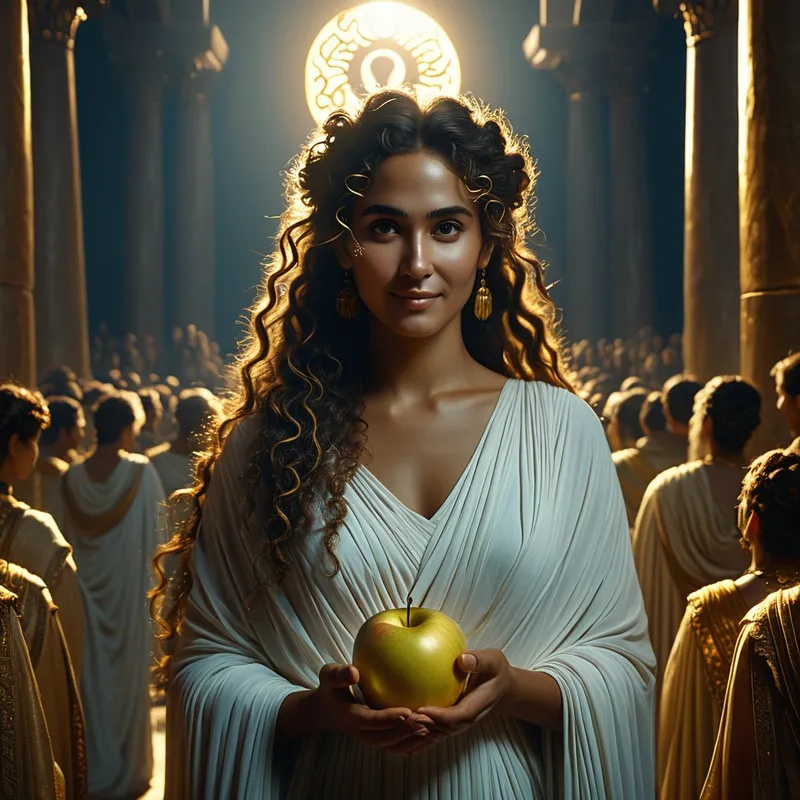
Into the very center of the celebration, where Hera, Athena, and Aphrodite sat together in regal splendor, Eris cast a single object. It was a fruit of purest gold, polished to a blinding sheen, more beautiful than any jewel in the hall. It rolled across the marble floor with a sound like a dropped coin, coming to rest at the feet of the three most powerful goddesses. All eyes fell upon it. Etched upon its skin, in fine, deliberate script, were three words: ΤΗΙ ΚΑΛΛΙΣΤΗΙ. “To the Fairest.”
The music died. The laughter choked in a hundred divine throats. A terrible, silent question hung in the perfumed air. The apple was a mirror, and in it, each goddess saw only herself. Hera, queen of Olympus, felt the weight of her sovereignty. Athena, grey-eyed and wise, knew the depth of her virtue and strategic mind. Aphrodite, born of sea-foam, felt the undeniable power of her own breathtaking form. The apple was a question that demanded an answer, and each believed the answer was her own name.
A petty argument began, a hissed debate over beauty and worth that quickly grew into a thunderous quarrel. The unity of the feast shattered like glass. No god dared judge between such powers. The tension became a living thing, coiling around the pillars of Olympus. Finally, in exasperation, Zeus declared the matter must be settled by a mortal—one untouched by divine bias, a shepherd prince named Paris, living in rustic innocence on the slopes of Mount Ida.
The three goddesses descended to the mortal plane, not as benevolent visitors, but as rival petitioners. They stood before the bewildered youth, and each offered a bribe for his vote. Hera promised imperial power over all Asia. Athena offered wisdom and invincible skill in war. Aphrodite, with a smile that could unravel fate itself, whispered of the most beautiful woman in [the world](/myths/the-world “Myth from Tarot culture.”/): Helen, wife of King Menelaus of Sparta.
Paris, young and ruled by desire, handed the apple to Aphrodite. With that simple gesture, he set in motion a chain of events no god could fully control. Helen was taken to Troy. A thousand ships were launched. For ten years, the plains below Troy ran red, heroes fell like wheat, and the great city burned to ash. All from a single, uninvited goddess and a golden apple tossed into the heart of perfection.

Cultural Origins & Context
This potent narrative comes to us primarily from the Cypria, a now-lost epic poem that was part of the larger Epic Cycle, which filled in the events leading up to [Homer](/myths/homer “Myth from Greek culture.”/)‘s Iliad. While Homer only alludes to [the judgment of Paris](/myths/the-judgment-of-paris “Myth from Global/Universal culture.”/), later writers like the tragedians and the mythographer Apollodorus fleshed out the tale. It was a foundational etiological myth, explaining the ultimate cause of [the Trojan War](/myths/the-trojan-war “Myth from Greek culture.”/)—not merely a human conflict, but one seeded in the unresolved tensions of the divine realm.
The story functioned as a profound cultural caution. For the Greeks, it illustrated the catastrophic consequences of hubris (excessive pride), embodied by the goddesses’ rivalry, and the dangerous, capricious nature of the gods, who used mortals as pawns in their disputes. It was a reminder that peace and order are fragile, and that chaos (Eris/Chaos) is never truly banished, only temporarily uninvited. The myth was told and retold not just as entertainment, but as a philosophical exploration of causality, the nature of beauty as a destructive force, and the inescapable intertwining of human choice and divine machination in the tapestry of fate.
Symbolic Architecture
The [Apple](/symbols/apple “Symbol: An apple symbolizes knowledge, temptation, and the duality of good and evil, often representing the pursuit of wisdom with potential consequences.”/) of Discord is not merely a [plot](/symbols/plot “Symbol: A plot symbolizes the unfolding of a story, representing personal narratives and life direction.”/) [device](/symbols/device “Symbol: A device in dreams often symbolizes the tools or mechanisms that we use to navigate our inner or outer worlds.”/); it is a perfect symbolic bomb. Eris herself represents the necessary, disruptive force that systems—whether divine, psychological, or social—attempt to exclude to maintain a superficial [harmony](/symbols/harmony “Symbol: A state of balance, agreement, and pleasing combination of elements, often associated with musical consonance and visual or social unity.”/). She is the return of the repressed, the [truth](/symbols/truth “Symbol: Truth represents authenticity, honesty, and the quest for knowledge beyond mere appearances.”/) that the party would rather not acknowledge.
The excluded element always returns, not as a beggar at the gate, but as an architect of reckoning.
The golden apple symbolizes the poisoned gift of comparison. Its [inscription](/symbols/inscription “Symbol: A permanent mark, carving, or writing on a surface, often carrying messages, records, or artistic expression meant to endure.”/), “To the Fairest,” is an [algorithm](/symbols/algorithm “Symbol: A step-by-step procedure for solving problems, representing logic, order, and deterministic processes in abstract thought.”/) for strife, reducing complex beings to a single, zero-sum metric. It represents any idealized standard—[beauty](/symbols/beauty “Symbol: This symbol embodies aesthetics, harmony, and the appreciation of life’s finer qualities.”/), success, worthiness—that, when internalized, forces a psychic civil war. The three goddesses embody archetypal values: Sovereignty (Hera), Wisdom and Competence (Athena), and Desire and [Connection](/symbols/connection “Symbol: Connection symbolizes relationships, communication, and bonds among individuals.”/) (Aphrodite). The myth suggests that when these core aspects of [the self](/myths/the-self “Myth from Jungian culture.”/) are forced into [competition](/symbols/competition “Symbol: Competition in dreams often symbolizes conflict, ambition, and the drive to succeed, reflecting personal goals and challenges.”/) for a singular prize, the integrity of the whole [psyche](/myths/psyche “Myth from Greek culture.”/) is shattered.
Paris’s judgment is the fateful [choice](/symbols/choice “Symbol: The concept of choice often embodies decision-making, freedom, and the multitude of paths available in life.”/) of the immature ego, seduced by immediate gratification (Aphrodite’s offer) over enduring power or wisdom. It symbolizes the [moment](/symbols/moment “Symbol: The symbol of a ‘moment’ embodies the significance of transient experiences that encapsulate emotional depth or pivotal transformations in life.”/) a latent conflict, once contained in the unconscious ([Olympus](/symbols/olympus “Symbol: In Greek mythology, Mount Olympus is the divine home of the gods, representing ultimate power, perfection, and spiritual transcendence.”/)), is projected into the outer world (Troy), necessitating a long, painful, and destructive process of [resolution](/symbols/resolution “Symbol: In arts and music, resolution refers to the movement from dissonance to consonance, creating a sense of completion, release, or finality in a composition.”/).

The Dreamer’s Resonance
When this myth pattern stirs in the modern dreamer, it often manifests as dreams of being at a party where one feels invisible or unwelcome, or of a serene situation suddenly disrupted by a strange, compelling object. To dream of a golden fruit, a disputed prize, or three powerful but arguing figures points to a psychological state of impending, necessary disruption.
Somatically, this may coincide with a feeling of tightness in the chest, a sense of restless irritation, or the somatic “knowing” that a fragile peace in one’s life is unsustainable. Psychologically, the dreamer is at a point where an excluded part of their nature—their own inner Eris, perhaps a talent, a grief, a rage, or a truth they have sidelined—is demanding recognition. The “apple” in the dream is the catalyst that makes an unspoken rivalry within the psyche (between, for example, the inner caregiver, the inner professional, and the inner lover) conscious and unavoidable. The dream is the psyche’s way of tossing that apple into the hall of the conscious mind, forcing a judgment that can no longer be deferred.

Alchemical Translation
The alchemical journey modeled here is the transmutation of naive unity (the false harmony of the wedding feast) into a more conscious, earned wholeness through the opus contra naturam—the work against nature, which here means against [the ego](/myths/the-ego “Myth from Jungian culture.”/)‘s desire for comfortable stasis. Eris is the essential [prima materia](/myths/prima-materia “Myth from Alchemical culture.”/), the base matter of chaos without which no transformation is possible. Her exclusion is [the ego](/myths/the-ego “Myth from Jungian culture.”/)‘s attempt to perform the alchemical work without getting its hands dirty, an impossibility.
The gold cannot be forged without the fire of discord.
The process begins with invitation. One must consciously invite the excluded Eris—[the shadow](/myths/the-shadow “Myth from Jungian culture.”/), the discordant emotion, the inconvenient truth—to the table. This is the opposite of the myth’s opening act. Then, one must hold the “apple,” the symbol of divisive comparison, and not immediately hand it to one competing aspect of the self. The alchemical task is to contain the tension of the opposites (Hera vs. Athena vs. Aphrodite) without enacting the judgment of Paris. This containment is the vas, the sealed vessel where the psychic conflict is allowed to heat and churn.
The goal is not to choose one goddess and start a Trojan War in one’s outer life, but to achieve a [coniunctio oppositorum](/myths/coniunctio-oppositorum “Myth from Alchemical culture.”/)—a union of opposites. This might mean developing a consciousness where sovereignty, wisdom, and love can coexist without one negating the others. The eventual “judgment” becomes an internal synthesis, not an external [projection](/myths/projection “Myth from Alchemical culture.”/). The long, destructive war (the neurosis, the life crisis) that follows Paris’s choice is the path of individuation gone awry, enacted externally. The alchemical translation offers the chance to fight that war symbolically, within [the vessel](/myths/the-vessel “Myth from Alchemical culture.”/) of the self, so that the city of the psyche is not destroyed, but rebuilt on more authentic, conscious ground. [The apple of discord](/myths/the-apple-of-discord “Myth from Greek culture.”/), thus integrated, loses its destructive power and becomes instead [the philosopher’s stone](/myths/the-philosophers-stone “Myth from Alchemical culture.”/) of self-knowledge—a golden awareness born from the acknowledgment of one’s own, necessary strife.
Associated Symbols
Explore related symbols from the CaleaDream lexicon: