Ereškigal Queen of the Underworld Myth Meaning & Symbolism
The myth of the goddess who rules the land of no return, her profound grief, and the fateful encounter that forces a reckoning with absolute power.
The Tale of Ereškigal Queen of the Underworld
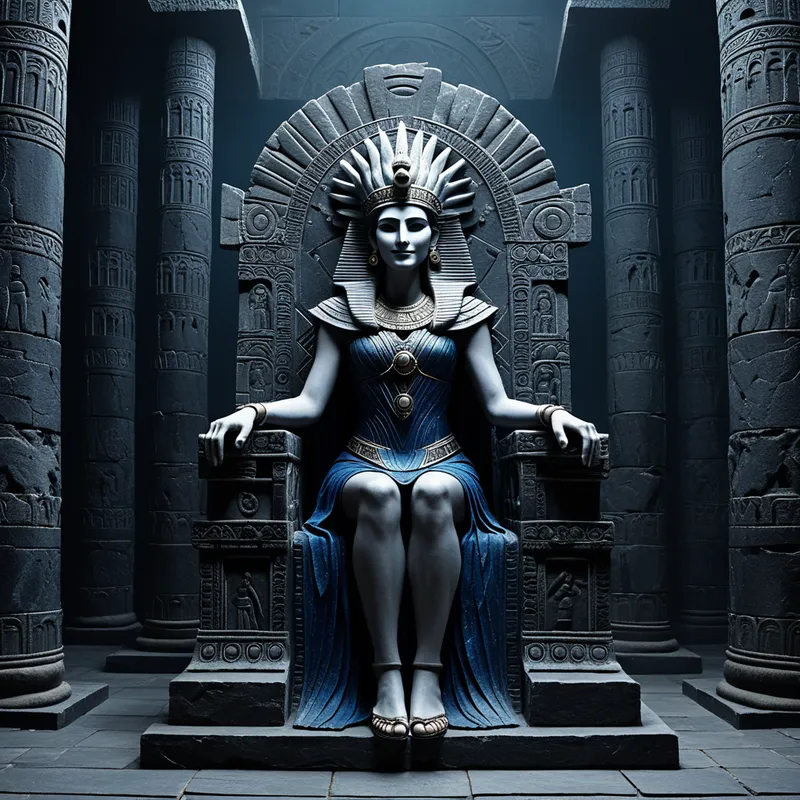
Listen, and hear the tale of the place from which no breath returns, the Kur, and of she who is its absolute sovereign. In the beginning, when the heavens were forged and the earth was measured, the great domains were divided. To the bright gods went the vault of An and the fertile plains. But to Ereškigal, the Great Lady of the Great Earth, fell the vast, silent land below. It was not a punishment, but a sovereignty. A realm of dust and shadows, where the dead, stripped of memory and light, drift as faint echoes. And there, in her palace of Ganzir, she ruled alone, a goddess complete in her terrible autonomy.
Her loneliness was a geography as vast as her kingdom. The laughter of the gods above was a distant, mocking wind. Until one day, a feast was prepared in the high heavens. A messenger was sent below to invite the Queen of the Underworld. But Ereškigal could not leave her throne, for the balance of all things would crumble. She instructed her minister, Namtar, to go in her stead. When Namtar arrived at the celestial feast, all the gods rose from their seats in respect—all but one. A fierce, young god of war and pestilence, Nergal, remained seated, scorning the servant of the dark queen.
This slight, carried back to Ganzir, ignited a cold fire in Ereškigal’s heart. She sent Namtar back to the heavens with a demand: send this disrespectful god to her, that he may be put to death. The council of gods, fearing her wrath, agreed. They instructed Nergal on the perilous journey, warning him to show no pity, to eat no food, to drink no water, and to resist the charms of the Queen herself.
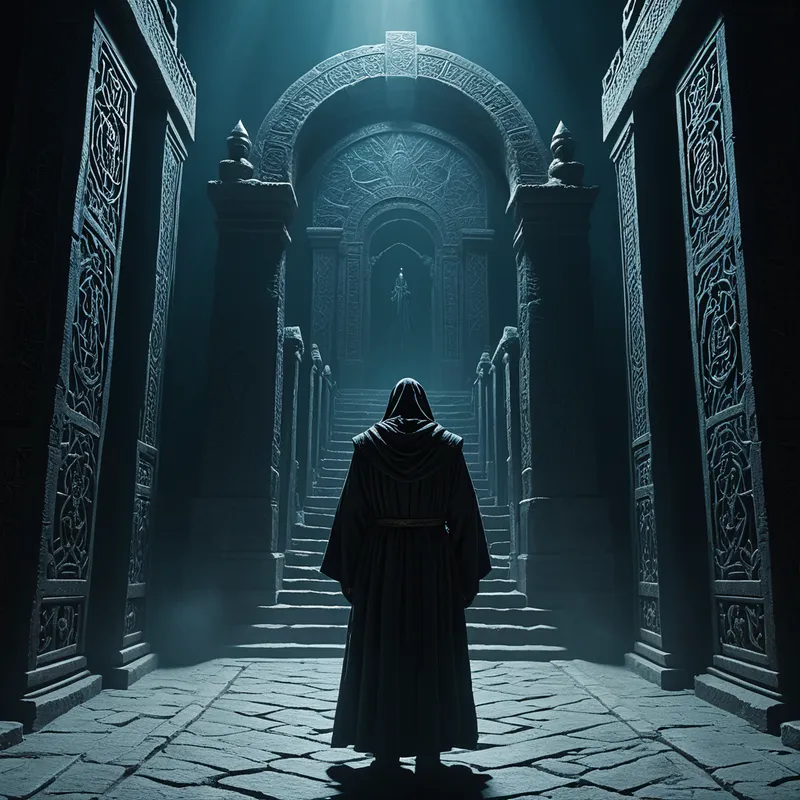
Nergal descended. He passed through the seven gates of the underworld, and at each, a piece of his worldly semblance was taken. His crown, his scepter, his robes—stripped away until he stood before the dark throne in his essential, formidable being. Ereškigal awaited him, rising from her throne to bathe. Here was the moment of fate. Instead of striking, Nergal seized her. He dragged her from her bath by her hair, and they fell to the floor of the throne room—not in combat, but in a fierce, consummating union that shook the foundations of both worlds.
For seven days, the cosmos held its breath. Then, Nergal, as if waking from a trance, fled back to the upper world. But the alchemy had occurred. In his absence, a new, raw agony pierced Ereškigal’s solitude. The grief of abandonment was sharper than any knife of stone. She writhed in pain, sending lamentations that echoed up to the very gates of heaven. “He has gone! The one who knew me has left me alone again!”
The gods, hearing this terrible sorrow, intervened once more. They commanded Nergal to return, this time forever, to take his place at her side. And so, the god of raging frontiers descended again, not as an executioner or a fugitive, but as a king. He pushed past Namtar, strode into her chamber, and took his seat upon the throne beside her. The Queen of the Great Below was alone no more. In the silent land, a balance of powers was wed.
Cultural Origins & Context
This myth, known primarily from the Akkadian-language Descent of Nergal to the Underworld but drawing on far older Sumerian cosmology, was not mere entertainment. It was a sacred narrative etched into clay in the scriptoria of temples in cities like Nippur or Babylon. It functioned as a theological cornerstone, explaining the necessary and terrifying balance between the generative, visible world and the destructive, invisible one. Ereškigal was not evil; she was a foundational principle. Her realm recycled the essence of life, and her moods—manifest as plague, famine, or stillbirth—were facts of existence to be acknowledged, not enemies to be slain.
The story was likely recited during rituals or periods of cosmological significance, serving as a reminder that even the gods are subject to the laws of polarity and consequence. It gave a face and a narrative to the profound human anxiety about death, loss, and the dark, sovereign parts of the self that society demands we disown. The scribes who copied it were not just clerks but custodians of a deep psychic truth, ensuring that the culture remembered its Queen Below.
Symbolic Architecture
At its core, this is a myth of the encounter with absolute, undiluted Sovereignty—the kind that exists beyond the reach of celestial laws and social pleasantries. Ereškigal represents the autonomous, unconscious psyche in its raw, unmediated state. She is the archetypal Shadow made ruler, the complex of grief, rage, and isolation that we exile to our personal underworld.
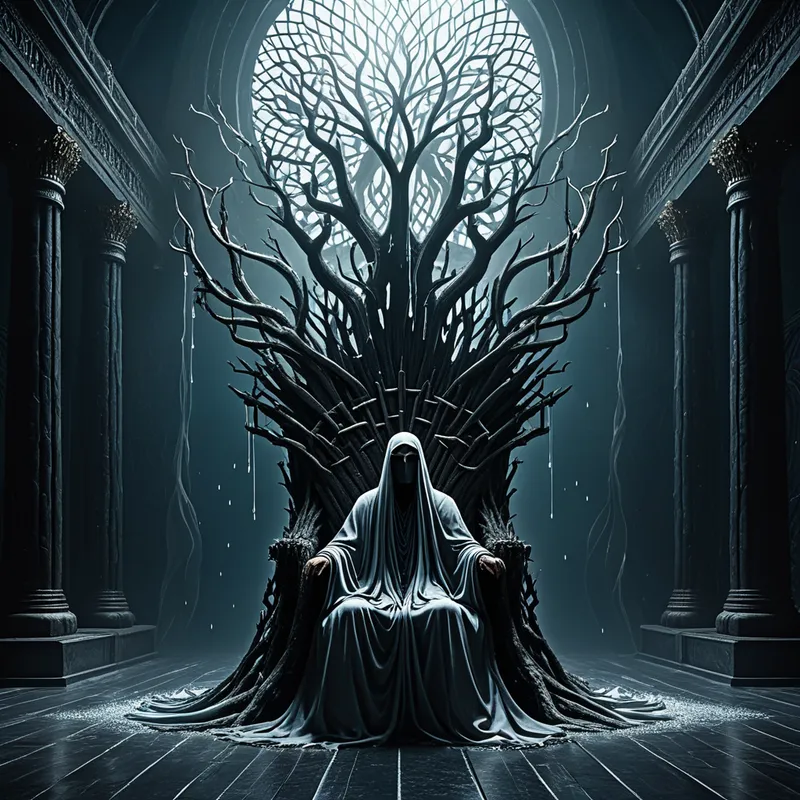
The throne of the underworld is not a seat of punishment, but the locus of a terrible and complete authority. To approach it is to be stripped of every borrowed identity.
Nergal’s journey is the ego’s forced descent. The stripping at the seven gates signifies the dissolution of persona—status, power, social self—required to meet this shadow-sovereign on her own terms. His initial refusal to bow to Namtar is the ego’s arrogance, its belief it is above the demands of the deep unconscious. The consequence is not destruction, but a summons to a transformative confrontation.
Their violent union is not romantic love, but a coniunctio oppositorum—the alchemical marriage of opposites. It is the moment the conscious mind (Nergal, god of focused, destructive force) truly engages with the autonomous unconscious (Ereškigal). The separation that follows is psychologically critical; it is the birth of conscious longing from the depths. Her lament is the shadow’s cry to be integrated, not just visited. The final, permanent return of Nergal symbolizes the establishment of a permanent inner council, where the fierce, directed power of consciousness rules with the deep, receptive authority of the unconscious.
The Dreamer's Resonance
When this myth stirs in the modern dreamer, it often announces a profound somatic and psychological process: the Descent. Dreams of being trapped in vast, empty palaces, of meeting a terrifying yet compelling queen or king in a basement or cave, or of a powerful, enigmatic figure demanding respect or payment—these are echoes of Ereškigal’s court.
The somatic experience is one of gravitational pull, heaviness, or chilling stillness. It is the body registering the psyche’s movement into its own foundational layers. The dreamer may be undergoing a period of depression, grief, or illness—not as pathology, but as an involuntary journey to the throne room. The psychological process is one of rending. The ego-structures that normally manage life are being stripped away (the seven gates) to expose a more authentic, often more vulnerable, core self. The dreamer is being prepared to meet a part of themselves that holds immense, often feared, power: a long-buried rage, a foundational sorrow, or a sense of sovereignty that feels too vast to claim.
Alchemical Translation
For the individual, the myth of Ereškigal and Nergal models the non-negotiable process of psychic transmutation known as individuation. It maps the journey from a state where our deep, instinctual nature (the Underworld Queen) is split off and ruling autonomously in darkness, to a state of integrated wholeness where consciousness sits in partnership with that depth.
The first alchemical stage is Calcinatio—the burning insult. Nergal’s slight is the spark. In life, this is the crisis, the failure, the humiliation, or the deep depression that forces a confrontation with what we have ignored. It is the summons.
The descent through the gates is Solutio and Separatio—dissolution and separation. We must let go of our attachments to who we think we are (our titles, our defenses, our stories) to become essential enough for the encounter.
The union in the throne room is the Coniunctio. It is not a gentle merging, but a fierce, often painful, engagement with our own rejected power and pain. It is acknowledging, “This too is me.”
Nergal’s flight is Coagulatio—the precipitation of a new substance. The experience is so powerful it cannot yet be held; it forms a new complex, a longing. Ereškigal’s lament is this new voice of the integrated complex crying out from the depths. It feels like unbearable grief, but it is actually the birth cry of a more complete self.
The final return is Mortificatio and Sublimatio—the death of the old, isolated rulership and the raising up of a new, dual monarchy. The conscious mind does not conquer the unconscious, nor does the unconscious overwhelm consciousness. They establish a joint rule. The individual learns to draw authority not from persona alone, but from a dialogue with the vast, ancient, and sometimes terrifying sovereignty within.
Associated Symbols
Explore related symbols from the CaleaDream lexicon:
- Queen — The archetype of absolute, autonomous authority residing within the psyche, ruling over the domain of instinct, memory, and the unvarnished self.
- Underworld — The psychic territory of the unconscious, where all that is forgotten, repressed, or deemed unacceptable resides and holds its own form of power.
- Door — The threshold between conscious awareness and the unconscious depths; each of the seven gates represents a layer of ego-identity that must be surrendered for passage.
- Throne — The fixed, central locus of inner authority and sovereignty, often encountered in dreams as the seat of a shadow aspect or the true self.
- Grief — The raw, transformative emotion that erupts when a deep, exiled part of the self is touched and then abandoned, acting as a potent catalyst for integration.
- Shadow — The totality of the unconscious psyche, personified by Ereškigal, containing both feared weaknesses and untapped reservoirs of power and authenticity.
- Ritual — The structured, necessary process of descent and engagement, as seen in Nergal's passage through the gates and the prescribed behaviors for the encounter.
- Crown — The symbol of legitimate rulership and identity; its removal at the gates signifies the stripping of persona, while its assumption by Nergal at the end marks shared sovereignty.
- Journey — The mandatory movement from the familiar heights of consciousness down into the unknown depths of the psyche, which is not a choice but a fateful summons.
- Sumerian Tablet — The medium of the myth itself, representing the enduring, encoded wisdom from ancient consciousness that maps eternal psychological processes.
- Death — Not merely an end, but the essential condition of Ereškigal's realm and a metaphor for the ego-death required for profound psychological transformation.
- Union — The fierce, non-negotiable conjoining of opposites (conscious/unconscious, active/receptive) that generates a new level of psychic wholeness and complexity.