Epona Myth Meaning & Symbolism
The myth of Epona, the divine mare, embodies sovereignty, the union of human and animal spirit, and the sacred journey of the soul across all realms.
The Tale of Epona
Listen. The wind does not just blow across the plains; it carries the memory of hooves. In the time before the written word, when the world was a tapestry of forest and fen, there lived a people whose lives were written in the rhythm of the herd. Their stories were not kept in scrolls, but in the trembling of the earth, in the snort of breath on a winter morning, in the trusting press of a warm flank against a shivering human form.
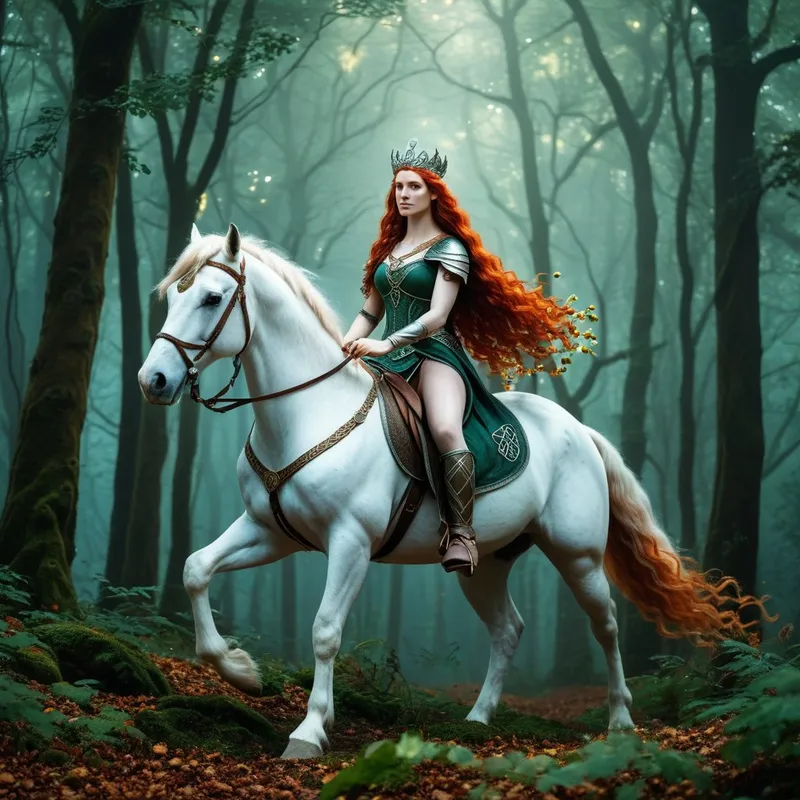
From this deep, wordless communion, she emerged. Not with a crash of thunder, but with the soft, sure step of a mare approaching her foal. She was Epona. Her hair was the colour of autumn bracken, her eyes held the deep patience of the earth. She was often seen astride a mare of impossible beauty—sometimes white as the first snow, sometimes dappled like sunlight through oak leaves. In her hands, she carried not weapons, but a cornucopia spilling with ripe grain and fruits, and sometimes, a key.
Her domain was the threshold. She stood where the stable met the wild, where the village path dissolved into the trackless wood, where the world of the living whispered to the realm of the ancestors. She was the guardian of every journey, whether a boy’s first ride on a pony, a warrior’s charge into battle, or the soul’s final passage into the misty otherworld. The people knew. To honour Epona was to ensure safe passage. They carved her image on stable walls, placed small stone horses in niches, and whispered prayers to her when the cavalry mounted, their fates tied to the strength and spirit of their steeds. She was the bond made divine, the silent pact between rider and ridden, the nurturing force that guided all creatures through the perils of transition.
Cultural Origins & Context
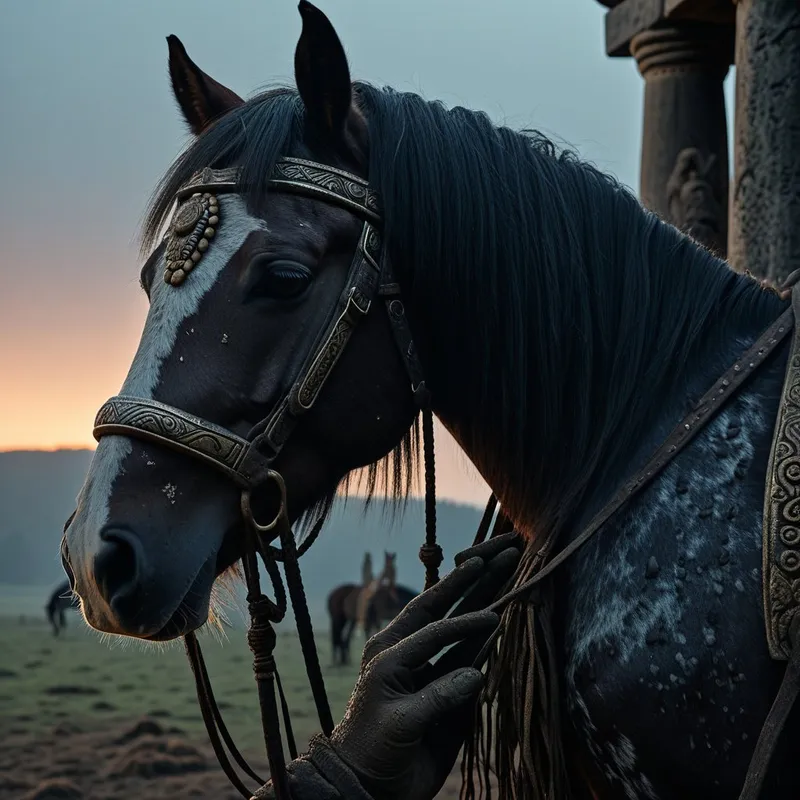
Epona is a singular figure in the Celtic world, a goddess whose worship was adopted and spread remarkably by the very people who conquered her devotees: the Romans. Unique among Celtic deities, she was venerated widely across the Roman Empire, particularly by the cavalry auxiliaries and horse-breeders. This tells us her roots were deep and her power undeniable. While no single, cohesive “myth” from an ancient Celtic source survives in a narrative form like those of Greece or Rome, her presence is etched in stone—literally.
Hundreds of inscriptions and stelae from Gaul, the Rhineland, and even Rome itself bear her name and image. She was a goddess of the people, of the everyday magic of survival and connection. Her worship was likely domestic and agrarian before it became military. In a culture where wealth was measured in cattle and horses, where sovereignty was literally embodied by a king’s unblemished white mare, Epona’s role was foundational. She presided over fertility, the health of flocks and herds, and the prosperity of the community. The transmission of her story was not the work of court bards alone, but of farmers, mothers, soldiers, and carvers, each adding to the living tapestry of her significance through ritual, offering, and the simple, profound act of caring for an animal upon whose back their world rested.
Symbolic Architecture
Epona’s symbolism is a triad of profound interconnectedness: the Horse, the Goddess, and the Key.
The Horse represents untamed life force, travel, and the physical vehicle of the self. It is our animal nature, our raw power and grace, our capacity for both labour and swift escape. The Goddess represents the nurturing, sovereign principle that does not break this spirit, but guides it, rides in harmony with it. She is the conscious ego in partnership with the powerful unconscious.
The true sovereign does not dominate the wild spirit, but forms a covenant with it, riding the chaos toward a purposeful horizon.
The Key is her most potent and mysterious attribute. It is the symbol of liminality. Epona holds the key to the stable door, to the gates of the otherworld, to the thresholds of birth and death. She unlocks the mysteries of passage—whether that passage is a physical journey, an emotional transition, or the ultimate psychic shift from one state of consciousness to another. Psychologically, she embodies the Self’s capacity to mediate between different realms of our being: the domestic and the wild, the civilized and the instinctual, life and the mystery that bookends it.
The Dreamer's Resonance
When Epona canters into the modern dreamscape, she announces a time of momentous passage and the need for a sacred partnership with one’s own power. To dream of a horse, particularly in a context of care, grooming, or anxious preparation for a journey, often signals that the dreamer is on the cusp of a significant life transition. The somatic feeling may be one of exhilaration mixed with dread—the thrill of the ride coupled with the fear of falling.
A dream of trying and failing to bridle a horse may point to a struggle to control overwhelming instincts or emotions. Conversely, a dream of riding in effortless unity with a horse suggests the dreamer is successfully integrating a powerful new energy or moving through a change with grace and agency. Epona’s specific presence—perhaps as a nurturing female figure associated with the animal—suggests this process is not one of conquest, but of forging an alliance. The psyche is working to harness its innate vitality (the horse) not through force, but through the respectful, guiding care of the conscious self (the goddess), preparing for a necessary journey across an inner landscape.
Alchemical Translation
The individuation process, the alchemy of becoming whole, is not a serene ascent. It is a series of perilous journeys between the known territories of the psyche. Epona is the archetypal guide for this work. Her myth models the alchemical stage of the Coniunctio, specifically between the human and the animal, the rational and the instinctual.
The modern seeker often attempts to transcend or sanitize their base nature—their passions, their bodily needs, their raw emotional power. Epona’s path is different. She teaches that wholeness is found not in rejection, but in sacred partnership. The “horse” of our instinctual life must be fed, groomed, respected, and ultimately, ridden with skill and mutual trust.
The goal is not to dismount from your animal nature, but to learn its gaits, to feel its strength as your own, and to let it carry you to places the walking self could never reach.
Her key is the tool of psychic transmutation. It unlocks the stable where we have kept our own power corralled and safe. It opens the gate to the shadowy forests of the unconscious, where necessary truths and wild creativity reside. It finally unlocks the door to the next stage of life, even the acceptance of mortality itself. To invoke Epona is to commit to the journey with all of oneself—the caring hand and the pounding hooves, the guiding mind and the untamed heart—moving together toward sovereignty over the entire terrain of the soul.
Associated Symbols
Explore related symbols from the CaleaDream lexicon: